Ask The Art Story AI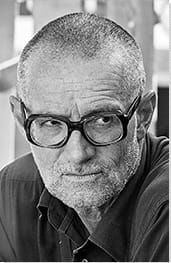

Summary of Thomas Hirschhorn
Hirschhorn reputation as one of the leading artists of his generation is built upon a series of overwhelming and chaotic gallery installations matched with a set (modest by comparison) of street sculptures. Made from everyday household materials, his "non-exclusive" art might be considered something of a paradox given that he turns to these throwaway items as a means of introducing his audience to the ideas of radical philosophers such as Arendt, Foucault, and Nietzsche. Although he regularly takes over gallery spaces around the world, his unwavering faith in the transformative and democratic power of art, has led Hirschhorn to place his many readymade "altars" and "monuments" on the streets and housing projects of working-class neighborhoods. Hirschhorn calls his art political, which for him, means work that invites his viewer to think consciously and more critically about the very things that effect their day-to-day lives.
Accomplishments
- Hirschorn uses mass produced materials - such as cardboard, plastic sheeting, packaging tape, aluminum foil, and press cuttings - to address ideas about art, consumer culture, and philosophy. For him, the use of everyday items dismantles time-honored divisions around art and class. Such items are, therefore, the ideal materials for conveying what Hirschorn has called a "democracy of thought".
- In his challenge to the principle that art is an act of aesthetic appreciation, Hirschhorn has produced a series of readymade urban street altars and monuments. Dedicated to the lives of great philosophers, including Spinoza, Bataille, Deleuze, and Gramsci, his ephemeral and perishable tributes are designed to live on, long after their physical demise, in the collective memory of those who have stood before them.
- Hirschorn has coined the moto "presence and production" to explain his working practice. This principle stipulates that in order to create its desired effects; viewers must experience the aura of his art (production) directly. In other words, Hirschorn believes that the power of his art is lost if viewed second hand through such means as photographic reproduction.
- Hirschorn's work, including one of his most famous pieces, World Airport (1999), is heavily associated with the concepts of chaos, and his firm belief that chaos is the haphazard energy that drives modern life. As he says: "I want to give form to chaos. Chaos means complexity, inclusion, incommensurability, clarity, precision, exaggeration. [...] Chaos is resistance, courage, and hope".
The Life of Thomas Hirschhorn
Curator Samuel Le Paire writes, "Once captivated by Hirschhorn's work, viewers are forced to consume and reflect on what they may have hitherto ignored in their daily lives. The disparity between the viewer and the bombardment of enlarged images reminds us how distant and removed we can feel before such images".
Important Art by Thomas Hirschhorn

Jemand kümmert sich um meine Arbeit (Someone is taking care of my work)
In this early, performative project, Hirschhorn placed several sculptural objects at the side of the road in Paris. He then documented through video and photography the reaction of city sanitation workers to the objects and to record how the objects would be treated in comparison to "actual" garbage. The project was soon thereafter replicated by the artist in Montreuil, a suburb to the east of Paris. Hirschhorn explains, "I said to myself 'if my works are like canvases by Picasso abandoned on the street, perhaps the guy isn't going to throw them away. He might say, that's beautiful, I'll take that home and I will hang it up, it's like a Picasso and it's valuable. He might say that - or not. And yet my objects didn't have any value. But what I had put on the street wasn't rubbish, it was works that I made at this moment. At that time my work had not any market value [...] I didn't want to put the person to the test. Instead, my idea was to hold an exhibition with active spectators [...] Even if everything ended up in the bin - it was the same as an exhibiting in a gallery or a museum to me".
Art historian and critic Benjamin Buchloh considers Someone is taking care of my work through the lens of a participatory or relational aesthetic. He sees the project as "reradicalizing the performative dimensions of post-Minimalism" (a reference to previous participatory performances, such as those by Vito Acconci and Dan Graham, that were carried out in gallery and museum spaces). Where Hirschhorn departed from such practices was in performative interventions in unexpected public locations. Buchloh called this "anticipating a rather different type of 'participation' [that] is bound to generate encounters that differ drastically from those permitted by traditionally protective frames and institutional spaces". In this way, Someone is taking care of my work anticipates the later relational artistic interventions of Olafur Eliasson's Green River Project (1998-2021) in which the Icelandic artist dumped green dye into rivers in major cities around the world without giving any previous notice to local residents who did not read his actions as "art".
Mixed media - Paris

Otto Freundlich Altar
Hirschhorn has created a number of "altars", including his first, Otto Freundlich Altar, dedicated to the German-Jewish artist (Freundlich) who was a pioneer of Minimalism before being murdered at the Majdanek concentration camp. Other altars by Hirschhorn include those dedicated to Dutch painter Piet Mondrian, Austrian poet and writer Ingeborg Bachmann, and American poet and writer, Raymond Carver. The artist explains "I want to fix my heroes [and] to give memory of someone who is dead and who was loved by somebody else. It is important to testify ones' love, ones' attachment". Comparisons could be made between Hirschhorn's monuments and the altar traditions of world cultures and religions, such as the ofrendas of the Mexican Day of the Dead, but the artist calls his altars "personal, artistic commitment[s]", or what art historian Harriet F. Senie calls, "¬expressions of love that reflect the importance of bearing witness".
Hirschhorn's altars are comprised of found objects including candles, stuffed animals, artificial flowers, written messages on scraps of paper, drawings, photographs (and more). Says the artist, "With this wild mixture of forms, the messages of love and attachment to the deceased person are expressed without any aesthetic concern; it is this personal commitment that interests me. It comes from the heart. It is pure energy. [...] The forms of these altars, that are profane and not religious, convey a visual form based on weakness. [...] The cruelty and the non-spectacular of these monuments makes them untouchable by people walking by, proprietors, street-cleaners, dog-walkers, policemen. Everyone could be concerned. Everyone is concerned". For Hirschhorn, moreover, his chosen locations are rather non-descript and positioned in "just any place". He reasons, "Most people don't die in the middle of a square or on a beautiful boulevard; their deaths rarely happen in a strategic location, even famous people don't die in the center. [...] The disappearance of the altar is as important as its presence. The memory of what is important doesn't need a monument".
Mixed media - Kaskadenkondensator Basel

Flugplatz Welt/World Airport
First presented by Hirschhorn in 1999 at the Venice Biennale, Flugplatz Welt/World Airport is one of his best known (and largest) works. As arts editor Mark Rappolt describes, "At its heart is a world map, redrawn as a rank of crudely made model aircraft, each branded with the colours of a different national airline. Around it all is a somewhat bewildering network of texts, images and handmade objects, incorporating representations of commercial brands that dominate the world economy - a giant Nike trainer and ranks of anonymous Ford motor cars - alongside tributes to socialist martyrs and campaigners for workers' rights - such as Rosa Luxemburg and Antonio Gramsci". Some of the objects are meant to invite tongue-in-cheek or ironic interpretations, such as "silver" spoons made of aluminum foil, (a reference to the well-known English phrase, "born with a silver spoon in one's mouth"). The display also includes books written by philosophers, and texts on Buddhism, Taoism, and Christianity, which are meant to encourage viewers to spend time contemplating different world views.
World Airport is constructed through Hirschhorn's trademark multi-media assemblage style, with his preference for found and/or everyday objects, bringing about a sense of haphazard chaos. He says of this approach, "I'm trying to connect things that I don't understand. I show it in my work in a stupid sort of way. I can work with material that has a meaning. As soon as you work with foil or cardboard, it doesn't stay clean; it's 'trash.' I want my work to be dense and full of energy. To arrive at that, you can't be overly preoccupied with questions of finish, form, exhibition, arrangement".
Rappolt concludes, "As a whole [World Airport] is overwhelming and rather difficult to take in, but perhaps that provides a more accurate snapshot of the world and its troubles than the more simplified daily image of cheap flights, instant global connectedness and a never-ending supply of factory-made consumer goods ever could. Somehow Hirschhorn's comic constructions have a habit of appearing more real than reality ever does. Perhaps indeed he is telling us that in the real world we tolerate too much. Irritatingly though, it only takes one more look at his crappy construction style to make you wonder if that might be interpreting too much".
Mixed media - Musée d'Art Moderne Grand-Duc Jean (MUDAM), Luxembourg

Hannah Arendt-Map
Hannah Arendt-Map was amongst the first of his 30-or-so (to date) "Maps" series. It was produced with his friend, the German philosopher Marcus Steinweg. Hirschhorn has referred to his Maps - collages comprised of press-cuttings and images, and hand-written statements and drawings - as "plans" and "commitments" to those who have helped shape his thinking, and to the idea of philosophy as a guide to life per-se. He said of his interest in Arendt: "The map shows the lines of force, the influences, and the dynamics of Hannah Arendt's philosophy. This map depicts the position of Hannah Arendt's philosophy within the galaxy of philosophy".
Arendt is widely regarded as one of the most influential political philosophers of her time, and is best known, perhaps, for her controversial concept of the "banality of evil". Writing on the trial of the SS Officer, Adolf Eichmann in Jerusalem in 1961 (in which he was sentenced to death for crimes against the Jewish people and crimes against humanity), she argued that evil was not only perpetrated by human monsters, but also by individuals (such as Eichmann) who were thoughtlessly ("banally") beholden to totalitarian bureaucratic systems and to career advancement. She argued that evil was only able to thrive if a country's citizens did not, or could not, think independently or critically of/about the State. It was Arendt's commitment to the principles of human freedom, and the faculties of critical thought and judgement, coupled with the importance he placed on philosophy to his own way of thinking, that appealed to Hirschhorn.
Hirschhorn said of the Arendt Map, "I want to show with my work, with my art, with each of my individual works and with each exhibition that I have a position and that I have a plan. [The] question is: Where do I stand? What is my position? What do I want?" [...] The 'Hanna Arendt Map' is a homage to friendship, to the friendship between art and philosophy. The friendship between art and philosophy is based on the assertion that philosophy is art. [...] The philosophy that interests me is pure philosophy, which acts and creates something new. I don't need philosophy for my art, I don't need philosophy as an artist, I need philosophy as a man, as a human being and I need philosophy to live".
Mixed media collage

Swiss Swiss Democracy
In late 2004 Hirschhorn presented a new exhibition, Swiss Swiss Democracy, at the Swiss Cultural Centre in Paris. As its title suggests, the exhibition (put together over three months with the help of eight assistants) was a critical examination of his country's famed democratic systems. Hirschhorn struck on the idea following Switzerland's 2003 general election when the controversial right-wing nationalist, and billionaire businessman, Christoph Blocher, won a seat in government. Such was Hirschhorn's dismay at Blocher's election victory (and his subsequent appointment as director of the Federal Department of Justice and Police) he refused to exhibit in his country of origin. However, the invitation from the Swiss Cultural Centre in Paris proved too much of an opportunity to turn down and he set about creating an installation that questioned the foundations of Swiss democracy. Hirschhorn stated, "I want to express my revolt not against democracy but against the usage that is made of it for personal interests" (a statement that rather undermines his insistence that his political art is impartial).
Hirschhorn, who collaborated with philosopher Marcus Steinweg, and Gwenaël Morin and his theatre company, transformed the building into pavilion constructed mainly from recycled cardboard held together by scotch tape. The building featured yellow, pink, and blue cardboard rooms, adorned with newspaper clippings and political slogans, and a library, bar, and TV lounge. The exhibition also housed a host of objects displayed in cabinets, Swiss maps, flags, and tourist ephemera, and a working model train set and Swiss mountainscapes constructed of papier-mâché. Hirschhorn also produced a daily zine/newsletter quoting the likes of Enlightenment philosopher Immanuel Kant, and a daily lecture series delivered by Steinweg. Morin's theater troupe, meanwhile, presented daily performances attacking Blocher and lampooning the myth of Switzerland's great folk hero, and symbol of national independence, William Tell.
Swiss Swiss Democracy was not well received by the mainstream Swiss press. As art critic Jeff Rian writes, "The tempest began with a review in the French-language Swiss tabloid Le Matin [...] vilifying the artist for this 'assault' on his native country and unleashing a torrent of negative press in Switzerland. But they were angriest about Hirschhorn's pillorying of the minister of justice and police [and] for using $200,000 in Swiss funds to mount an attack on his own country from France, where Hirschhorn lives. The Swiss parliament reacted by cutting more than a million dollars (about 3 percent) from the annual budget of Pro Helvetia, the government-funded foundation charged with promoting Swiss culture abroad, which finances the CCS [Swiss Capital of Culture in Bern]. The more radical legislators wanted to fire CCS director Michel Ritter, who had begun planning this exhibition two years ago".
Mixed media - Swiss Cultural Center, Paris

In-Between
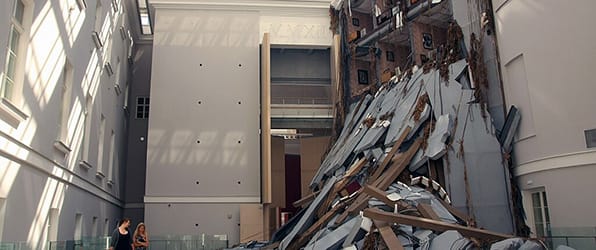
In more recent years, Hirschhorn has explored destruction as a form of creation with works such as, Concordia, Concordia (2012), Break-Through (2013), and Höhere Gewalt (2014). His 2015 work, In-Between, is described by art critic Francesca Gavin, as the artist's "version of a post-apocalyptic, post-capitalist world [represented through] the ruins of an office space - the ceiling falling through, exploded rooms, a chaos of cardboard, foil, Styrofoam, and glossy brown masking tape". Arts editor Harry Thorne adds that the work is "a dissection of 21st-century infrastructure. From wall to wall and floor to ceiling, ventilation pipes and bunches of red wire hang limp like bloodless veins; sinks and toilets sit forgotten in the corners of derelict rooms; and strips of parcel tape cluster and bunch, gradually losing the ability to stick". In-Between was inspired by a quote (posted on one of the walls) by Italian Marxist, Antonio Gramsci: "Destruction is difficult. It is as difficult as creation". For Hirschhorn, Gramsci's quote "is not about separating or opposing 'creation' and 'destruction', but about the difficulty of positioning oneself in the midst of the moving world".
Through works such as In-Between, Hirschhorn explores the aesthetics of destruction, drawing visual inspiration from images of sites and structures ruined by war, natural disasters, accidents, and other violent occurrences. Yet, at the same time, he challenges society's desensitization toward such imagery by transforming them into three-dimension environments in which the viewer becomes fully immersed and thereby eliciting a more visceral bodily response to the experience of being within such a ravaged scene. Hirschhorn stated that "A ruin stands for a structural, an economical, a cultural, a political or a human failure. [...] I can testify that to set-up a work in an exhibition space which gives form to destruction is indeed as difficult as anything else. With In-Between I want to create a new form, I want to propose an experience, an art-experience in the range of 'successes, failures and in-betweens'". While some, like Thorne, view In-Between as a frightening reminder of the "unseen fragility that pockmarks the beating heart of society", others, like Gavin, assert that "the space feels almost utopian: a beautifully staged ruin made from the rubble of a consumerist society".
Mixed media - South Gallery, London

Fake it, Fake it - till you Fake it
In this single-work, wall-to-wall, installation, Hirschhorn uses his favored materials including cardboard, scotch tape, printed images, polystyrene, and aluminium foil. Fake it amounts to a dissection of Silicon Valley. As viewers enter the gallery, they are confronted with a spraypainted wall that reads "Dear World, we are talking about 'Artificial Intelligence' - but why only 'Intelligence', why not 'Artificial Willpower?' 'Artificial Belief?' [...] 'BE AWARE OR BE NEXT!'". Once inside the gallery, viewers were confronted with scores of hanging, cutout emojis, and aisles of cardboard tables on which were stacked cracked computer monitors, with juxtaposed images taken from violent computer games and newspaper images of real, war-torn, urban locations. Next to these lay cellphones, credit cards, games controllers, and mugs and fast-food items fashioned from polystyrene. Hirschhorn also produced soda cans using tinfoil and affixed inkjet-printed Red Bull labels to them.
Unlike his earlier work (with the possible exception of Swiss Swiss Democracy (2004-05)), Fake it seems to make more of a "statement" on the "fake" items it is asking viewers to contemplate. Aa art critic Jenny Wu writes, "At first blush, the installation may seem juvenile in spirit, in terms of both the scene it depicts - a den of drugs and videogames - and the confidence with which it dispatches its abstract philosophical arguments. What might prove illuminating, once the viewer has read and turned over every possible meaning of the writing on the wall, would be to try hunting for the sources of the photographs reproduced among the cardboard effigies: a simple Google search yields dozens of comparable images of modern ruins captured in Ukraine and the Gaza Strip. In this sense, without spelling it out plainly, Fake it taps into the trepidation of today's netizens in the face of con-current global conflicts and surfaces the structural causes of our collective disquiet".
Mixed media - Gladstone Gallery, New York
Biography of Thomas Hirschhorn
Childhood
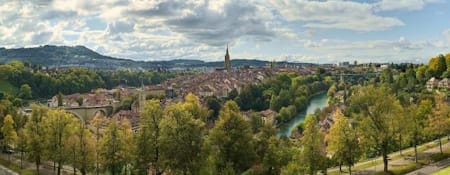
Thomas Hirschhorn has remained stubbornly disinclined to discuss his childhood or share details about his personal life. He has said: "There is nothing 'personal' to explain [...] I am not interested in 'the personal' or 'the social' as an artist. I am interested in life, in dream, in change, in action and in hope". And on the idea of being classed a "Swiss artist", he commented "I don't think that an artist coming from a specific country has more or less responsibility toward Art than another artist from elsewhere. I believe that toward Art, we all have the same responsibility: to do our work with love, with passion, with insistence".
Hirschhorn has, however, stated that he was an adopted child. He recalled, "I was very withdrawn [as a child]. I remember spending my afternoons lying on a sofa, listening to all sorts of radio programs. I really liked to draw and was quite good at it, but I grew up in a family that had no art in the house, and no interest in poetry, or philosophy. And it took me quite a long time to realise how I could apply my talent, what to do with it. No one in my [adopted] family encouraged me to do something in a creative field".
Education and Early Training
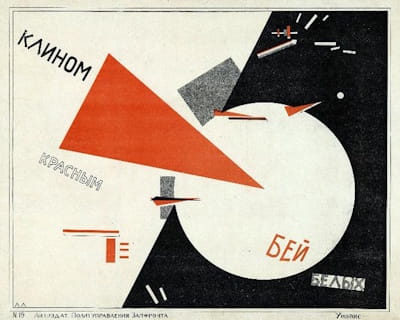
At the age of 19, Hirschhorn enrolled at the Kunstgewerbeschule (now the Schule für Gestaltung) in Zürich. He has spoken of his sense of pride when his drawings won praise from a competition jury: "For the first time I felt some reaction and response to what I enjoyed doing so much", he said. He thought that the school's academic programme was unusual inasmuch as it did not have a dedicated art department. He explains, "The educational philosophy at [Kunstgewerbeschule] was inspired by the principles of the Bauhaus, but in a degenerate and rather deviant version. Of course, it was neither the Bauhaus, nor the Ulm School [of design], yet it adopted the precepts of both. [The] teaching at the school was generalized: the vague and the 'unsaid' dominated the official discourse". Hirschhorn does, however, recall being fascinated by lectures on Russian revolutionary artists of the early twentieth century such as Kazimir Malevich, Alexander Rodchenko, Vladimir Tatlin, Gustav Klutsis, El Lissitzky, Lyubov Popova, and Varvara Stepanova.
The curriculum at Kunstgewerbeschule placed strong emphasis on the legacy of accomplished Swiss-German graphic designers, such as Joseph Müller-Brockmann, Armin Hoffman, Emil Ruder, Ernst Keller and Karl Gerstner, and the rise of the famous post-war International Style (or "Swiss Style" as it became known). Having graduated in 1983, Hirschhorn moved to Paris and began working as a graphic designer with the socially minded Grapus collective. However, Hirschhorn quickly became disillusioned with design work. He said "[I believed that graphic designers] could really influence the world, shape it by drawing posters, making booklets, creating flyers and stickers. I thought they had a direct connection with the audience. But I realized that the very essence of graphic design is always a response to someone's [commercial] demand".
Although he continued with his day job at Grapus, Hirschhorn gravitated more-and-more towards the world of fine art, following the work of Joseph Beuys, Andy Warhol, Piet Mondrian, Kurt Schwitters, and Otto Freundlich, the latter becoming a major influences on his own practice. Hirschhorn held his first solo exhibition, which comprised of small drawings and paintings with imagery derived from political propaganda, in 1986 at the Bar Floréal in Paris.
A major turning point in his career as a fine artist came at a 1990 Warhol exhibition at the Fondation Cartier at Jouy-en-Josas, in which Hirschhorn was able to view some of Warhol's early works as an illustrator (including drawings of butterflies and flowers). Hirschhorn explains, "This exhibition was truly important for me. I understood that he remained truthful to himself. He pursued what he loved, as in his early works, and took it on a new level". In 1991 Hirschhorn abandoned graphic design entirely, and devoted himself to collage and assemblage. He experimented with everyday mass-produced materials like cardboard, aluminum foil, scotch tape, magazines, plywood, and plastic wrap. For Hirschhorn cardboard was a key material because "it is cheap, everyone knows it, it does not have any privilege as a material. It's universal. [...] it's two-dimensional, but you can add the third dimension". Similarly, he was drawn to aluminum foil because, in his words, "it's cheap. It's a practical, everyday material, and it's destroyed as it's used. People use it for decoration, protection, even in medicine. It's also a material one uses as a child".
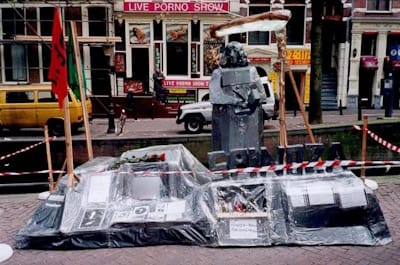
During the 1990s, Hirschhorn made four "Altars", each dedicated to an artist or writer who had inspired him: Piet Mondrian (1997), Otto Freundlich (1998), Ingeborg Bachmann (1998), and Raymond Carver (1998). Initially placed on ordinary city streets (in Geneva, Basel, Zürich, and Fribourg respectively) Hirschhorn labelled his Altars, "personal, artistic dedication[s]". Following on immediately from his Altars, Hirschhorn created the first of his series of "Monuments". These differed from the former inasmuch as they were produced on a bigger scale and were site-specific. As Hirschhorn said, "the monuments for these philosophers are conceived as community commitments in contrast to the altars which are personal commitments". The first was the Spinoza Monument, created in Amsterdam's red light district in 1999, and dedicated to seventeenth-century, Dutch-born, Portuguese-Jewish philosopher Baruch (de) Spinoza, whose controversial writings on religion, metaphysics, epistemology, politics, and science were banned in the Dutch Republic in 1677. Hirschhorn would go on to create the Deleuze Monument (Avignon, France, 2000), Bataille Monument (Kassel, Germany, 2002) (and later, the Gramsci Monument in New York in 2013).
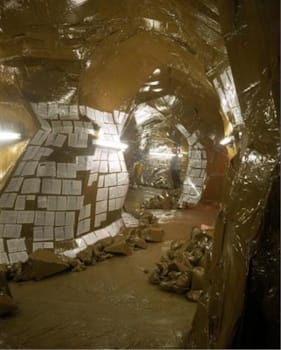
In 2002 Hirschhorn first presented Cavemanman at the Barbara Gladstone Gallery in New York. His "three-dimensional collage" (the artist's preferred term) covered a floorspace of approximately 3700 square feet, and comprised of a network of five caves, built primarily of cardboard, plywood, and packing tape with each cave interior lit by fluorescent tubes. Viewers were invited to walk through the caves where they would be presented with a variety of multimedia objects, sculptures, and texts. Curator Carly Whitefield describes, for instance, how "In one cave, walls are papered with photocopied 'world clocks' all set to the same time and day: 10:10 on Saturday the 22nd. In others, bookshelves with philosophy texts protrude from walls covered in pop culture posters, the tag '1Man=1Man' is spray-painted repeatedly, and video monitors 'taped' to the walls display footage of the Lascaux II cave at Montignac in southwestern France - a full-size reproduction of part of the original Paleolithic cave that is designed for visitor entry".
Between 2003 and 2004, Hirschhorn produced the first of his "Maps" series: Hannah Arendt-Map (with German philosopher Marcus Steinweg), Nietzsche-Map, and Foucault Map. Of this ongoing series, which now number around 30, Hirschhorn said, "I want my Maps to be statements and also commitments toward myself". Combining fragments of printed text, hand-written comments, and assorted press cuttings and images, the Maps amount to an archive of Hirschhorn's thought processes and the artist's tribute to the philosophers who have inspired him. He draws on the ideas of Nietzsche, for example, because he sees the German philosopher's view on life as a struggle to confront reality, and what he called the the "incommensurable nature" of modern living, as embodying the goals of his own practice. His interest in Foucault, meanwhile, relates to the Frenchman's writings on "power and knowledge", "the self", and "sexuality" and "transgression". Hirschhorn's overall goal with his Maps is to encourage his audience to navigate an embroidery of ideas as a way of gaining a deeper cerebral connection with their world.
Mature Period
In 2004 Hirschhorn unveiled his Swiss Swiss Democracy installation, a commentary on the mechanisms of the politics of his country of birth. Staged at the Swiss Cultural Centre in Paris, it was to prove his most controversial installation. Working with eight assistants, over a period of four months, Hirschhorn created a set of cardboard caverns, housing press articles and pictures, scripted slogans, philosophy books, videos, and found objects covered in scotch tape. Swiss Swiss Democracy also featured one-hour stage revue, by French theater director, Gwenaël Morin, and a daily lecture by Steinweg. As art critic Jeff Rian explains, "The tempest began with a review in the French-language Swiss tabloid Le Matin on December 5, vilifying the artist for this 'assault' on his native country and unleashing a torrent of negative press in Switzerland. But they were angriest about Hirschhorn's pillorying of the minister of justice and police, the conservative nationalist Christoph Blocher. [and] for using $200,000 in Swiss funds to mount an attack on his own country from France. [...] The Swiss parliament reacted by cutting more than a million dollars (about 3 percent) from the annual budget of Pro Helvetia, the government-funded foundation charged with promoting Swiss culture abroad".
![Thomas Hirschhorn, pictured in 2014. He says “living in Paris is beautiful. It makes sense for me as an artist and it's a challenge! [It is] a special, powerful, rich, and graceful city of creation”.](/images20/photo/photo_hirschhorn_thomas_5.jpg?1)
Also in 2004, Hirschhorn collaborated with the Les Laboratoires d'Aubervilliers art center, and local residents in Aubervilliers (a suburb of Paris), to open the Musée Précaire Albinet. It was a temporary, interactive, and participatory art museum that exhibited artworks borrowed from the Centre Pompidou by artists including Warhol, Duchamp, Malevich, Mondrian, Dalí, Beuys, Le Corbusier, and Léger. Says Hirschhorn, "In Aubervilliers, as in other Parisian suburbs, one can touch the truth and be in contact with it. It's in the suburbs that there is vitality, deception, depression, energy, utopia, autonomy, craziness, creativity, destruction, ideas, young people, hope, fights to be fought, audaciousness, disagreements, problems, and dreams. It's in the suburbs that today's big issues are written on the building facades. It's in the suburbs that today's reality can be grasped, and it's in the suburbs that the pulse of vitality hurts. It's in the suburbs that there is necessity and urgency. It's the suburbs that will save the city center from a most certain death!".
In 2019, Hirschhorn created Robert-Walser Sculpture for the 13th Swiss Sculpture Exhibition in Biel/ Bienne, Switzerland. The temporary sculpture (exhibited for three months) honored one of Switzerland's most prominent novelist (Walser). The sculpture brought art onto the streets of Biel (the city of Walser's birth) transforming them into a space for public reflection and interaction. The sculpture acted as a focal point for related events including readings, walking tours, lectures, and children's activities. Arts researcher Alice Smits wrote, "[the work] is not just a symbolic representation but a political gesture and action model for community building around public issues rather than according to lines of identity politics or placemaking. Introducing the work and ideas of 'difficult' intellectuals to the general urban residents shows a commendable belief in the democratic potential of art and philosophy and the conviction that this is a public good that concerns each and everyone and should not remain in intellectual academic circles".
In 2024 Hirschhorn presented a single-work exhibition, Fake It, Fake It - Till you Fake it, around the impact of digital technology on modern living, at New York's Gladstone Gallery. Hirschhorn wanted to confront the following questions with the project: "How to do art in times of war, destruction, violence, anger, hate, resentment? What kind of art should be done in moments of darkness and desperation? Can art be a tool for understanding history's changes? Can a work of art draw alternative forms of understanding the world? How to continue working - as an artist - and in doing so, avoid falling into the traps of facts, journalism, and comments?" Hirschhorn was under no illusions that he would find definitive answers these questions. Rather he wanted Fake it "to contribute to this problematic, as a form cutting a break-through in the analog into the digital".
The Legacy of Thomas Hirschhorn
Taking his lead from the performative practices of Fluxus, Happenings, and the Post-Minimalism movements, Hirschhorn ranks next to artists of the standing of Allan Kaprow, Robert Whitman, Claes Oldenburg, Joseph Beuys, Michael Asher, Dan Graham, Gordon Matta-Clark, and Robert Smithson. His preference for working with the "detritus" of everyday life represents the artist's drive to dismantle the aesthetic excellence and exclusivity fostered within the traditional art world. He is committed to "working politically", which is not to create political art per se, but rather to create works that stimulate his viewer and to make them willing to think more critically about the things that effect the realities of their daily lives. Arts writer Maria Bilke states, "while Hirschhorn engages with [...] political issues, his work is not didactic; he does not present a political message. Rather he tries to represent the complexities of social and political situations. In this way, he makes it harder to come to any simple understanding of the situation, suggesting that if the world is complex and conflicted, any easily reached position is simplistic and false".
Throughout his long career, Hirschhorn has been dedicated to the use of "universal, economic, inclusive" materials, and a preference for the physical locations where his works are erected and exhibited. And while he continues to show in prestigious galleries, museums, and "white cube" spaces, Hirschhorn often favors working-class neighborhoods and street locations where he finds what he has called a "non-exclusive audience". Indeed, curator Pablo Lafuente comments that "Hirschhorn's work often suffers from being shown in the wrong sort of setting" and that when exhibited in galleries and museums, his art can become "somehow sanitized by the surrounding white walls and the presence of gallery assistants". Many of Hirschhorn's projects are strategically situated in ordinary public spaces. Produced with the help of the local community, he has found a way to democratize hierarchies in art in the way it creates a tangible bond between art, artist, and community.
Influences and Connections

-
![Joseph Beuys]() Joseph Beuys
Joseph Beuys -
![Andy Warhol]() Andy Warhol
Andy Warhol -
![Piet Mondrian]() Piet Mondrian
Piet Mondrian ![Gordon Matta-Clark]() Gordon Matta-Clark
Gordon Matta-Clark![No image available]() Otto Freundlich
Otto Freundlich


![No image available]() Gwenaël Morin
Gwenaël Morin![No image available]() Marcus Steinweg
Marcus Steinweg


-
![Olafur Eliasson]() Olafur Eliasson
Olafur Eliasson ![No image available]() Sarah Sze
Sarah Sze![No image available]() Erwin Wurm
Erwin Wurm![No image available]() Katharina Grosse
Katharina Grosse

![No image available]() Gwenaël Morin
Gwenaël Morin![No image available]() Marcus Steinweg
Marcus Steinweg


Useful Resources on Thomas Hirschhorn
- Thomas Hirschhorn: Gramsci Monument
- Critical Laboratory: The Writings of Thomas HirschhornOur Pick
- Utopia, Utopia = One World, One War, One Army, One Dress
- Thomas Hirschhorn: V.C.R.T.
- Thomas Hirschhorn (Phaidon Contemporary Artist Series)Our PickBy Alison M Gingeras, Benjamin H D Buchloh, and Carlos Basualdo
- Thomas Hirschhorn: Deleuze MonumentBy Anna Dezeuze
- Thomas Hirschhorn: MapsBy Clément Dirié and Julie Julliard
- Thomas Hirschhorn: Establishing a Critical CorpusOur PickBy Thomas Bizzarri
- Thomas Hirschhorn: Robert Walser-SculptureBy Kathleen Bühler
- Thomas Hirschhorn: A New Political Understanding of Art?Our PickBy Christina Braun
- Thomas Hirschhorn: The Bijlmer Spinoza-Festival: The Ambassador's DiaryBy Vittoria Martini