Ask The Art Story AI


Summary of Ellsworth Kelly
Ellsworth Kelly has been a widely influential force in the post-war art world. He first rose to critical acclaim in the 1950s with his bright, multi-paneled and largely monochromatic canvases. Maintaining a persistent focus on the dynamic relationships between shape, form and color, Kelly was one of the first artists to create irregularly shaped canvases. His subsequent layered reliefs, flat sculptures, and line drawings further challenged viewers' conceptions of space. While not adhering to any one artistic movement, Kelly vitally influenced the development of Minimalism, Hard-edge painting, Color Field, and Pop art.
Accomplishments
- Kelly intends for viewers to experience his artwork with instinctive, physical responses to the work's structure, color, and surrounding space rather than with contextual or interpretive analysis. He encourages a kind of silent encounter, or bodily participation by the viewer with the artwork, chiefly by presenting bold and contrasting colors free of gestural brushstrokes or recognizable imagery, panels protruding gracefully from the wall, and irregular forms inhabiting space as confidently as the viewer before them.
- Real-life observations are the backbone of Kelly's abstraction works, which are replications of the shapes, shadows, and other visual sensations he experiences in the world around him. As did the early-20th-century Dadaists, Kelly delights in the spontaneous, the casual, and the ephemeral means of finding such readymade subjects.
- The subtle fluctuation between the meditative, decorative and industrial in much of Kelly's work can be traced in part to this design training in art school. In this sense, Kelly continues Henri Matisse's lyrical and decorative ideal of creating an art of visual serenity, even as the painted motif is now reduced to its simplest and sometimes most mysterious configuration. The special camouflage unit of which Kelly was a part during his service in World War II, and the principles of visual scrambling he undertook, has also contributed greatly to Kelly's intense visual motifs.
Important Art by Ellsworth Kelly
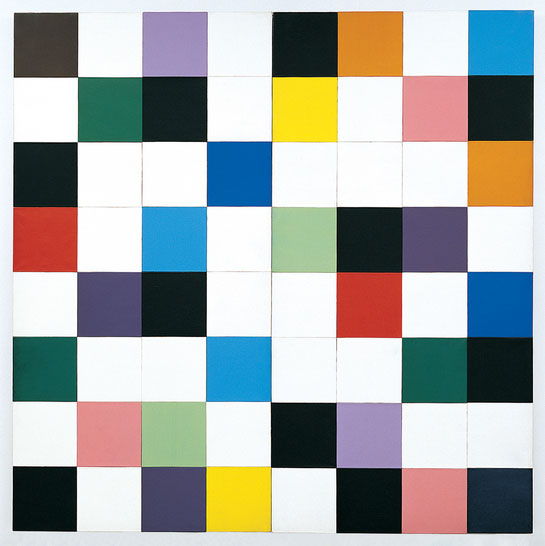
Colors for a Large Wall
The large-scale Colors for a Large Wall is one of Kelly's early forays into multi-panel paintings, a fundamental motif throughout his career. Colors for a Large Wall helped introduce his deeply held view of paintings as objects; not only was this painting an object in itself, but it was comprised of many smaller objects (panels) supposedly having come together in chance collision. In this work, Kelly covered each of the 64 square canvases in a single color and fused them together based on a collage study he had arbitrarily arranged. Much of Kelly's subsequent work stemmed from this painting, as he continued to juxtapose panels of differing sizes, shapes, colors and materials in innumerable variations.
Oil on canvas, mounted on 64 joined panels. Dimensions: 94 1/2 x 94 1/2 inches. Photo by courtesy of the artist. ©Estate of Ellsworth Kelly - The Museum of Modern Art, New York. Gift of the artist, 1969
Cite
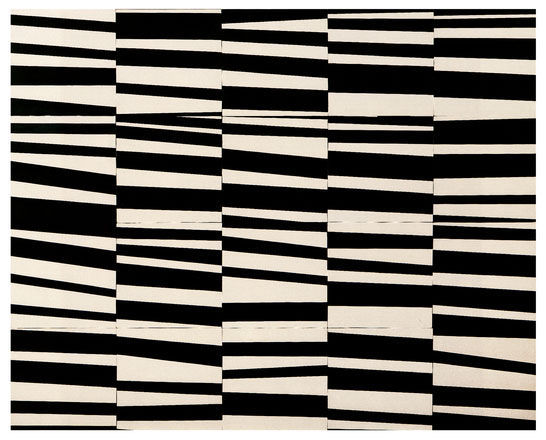
In Paris, artists such as John Cage and Hans Arp encouraged Kelly to experiment with the idea of chance in his artwork. For Cite, Kelly cut a black and white brushstroke drawing into twenty squares and randomly rearranged the pieces. He then turned this composition upside down and painted it onto twenty wood panels. After rearranging it once more, he connected the panels into the final painting. Although his artistic decisions ultimately dictate the final composition, Kelly's use of chance partially disconnects him from the resulting work. Such efforts to reduce the artist's emotions, influence, or individual marks have been important facets of Kelly's artwork, suggesting that all apparently "controlled" creativity is always partly a matter of an artist's making the most of chance collisions with unexpected and impersonal forces.
Oil on wood, twenty joined panels. Dimensions: 58 1/2 x 70 3/4 inches. Photo by Jerry L. Thompson, courtesy of the artist. ©Estate of Ellsworth Kelly - San Francisco Museum of Modern Art, The Doris and Donald Fisher Collection
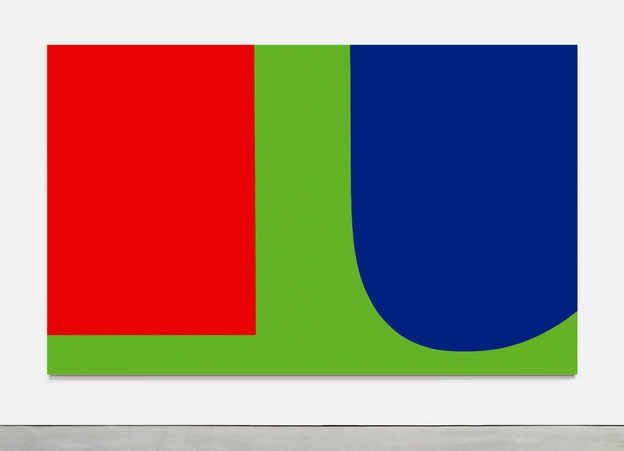
Red Blue Green
Kelly put great emphasis on the tensions between the 'figure' and the 'ground' in his paintings, aiming to establish dynamism within otherwise flat surfaces. In Red Blue Green, part of his crucial series exploring this motif, Kelly's sharply delineated, bold red and blue shapes both contrast and resonate with the solid green background, taking natural forms as inspiration. The relationship between the two balanced forms and the surrounding color anticipates the powerful depth that defined Kelly's later relief paintings. Therefore, these works serve an important bridge connecting his flat, multi-panel paintings to his sculptural, layered works.
Oil on canvas. Dimensions: 83 5/8 x 135 7/8 inches. Photo courtesy of the artist. ©Estate of Ellsworth Kelly - The Museum of Contemporary Art San Diego, gift of Dr. and Mrs. Jack M. Farris
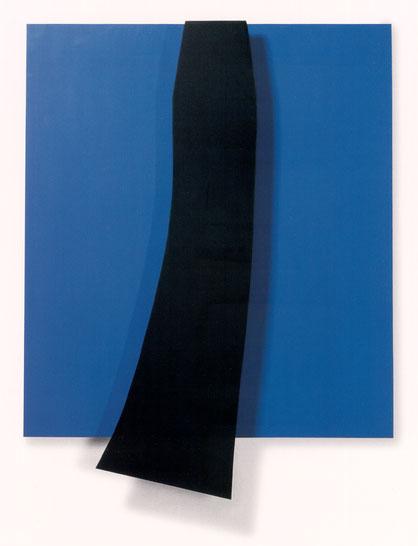
Black over Blue
Upon returning to New York after six influential years in Paris, Kelly progressed beyond his multiple-panel paintings to reliefs. Black over Blue, first exhibited in the Betty Parsons Gallery, reflects his recurring interest in both layered works and non-traditionally shaped canvases. His paintings are often hung away from the wall, giving them a three-dimensional, sculptural quality. In fact, the painting's interaction with the wall was a strong focus for Kelly. In Black over Blue, the curved, black panel extends beyond the confines of the rectangular blue canvas, making the surrounding wall an essential part of the composition. Wall, artwork, and space itself become nearly equally important aspects of the viewer's experience, finally leading to a heightened awareness of one's own body as a similar, energized "gesture" in the same architectural setting.
Painted aluminum. Dimensions: 81 3/4 x 64 x 7 inches. Photo by Jerry L. Thompson, courtesy of the artist. ©Estate of Ellsworth Kelly - San Francisco Museum of Modern Art, The Doris and Donald Fisher Collection
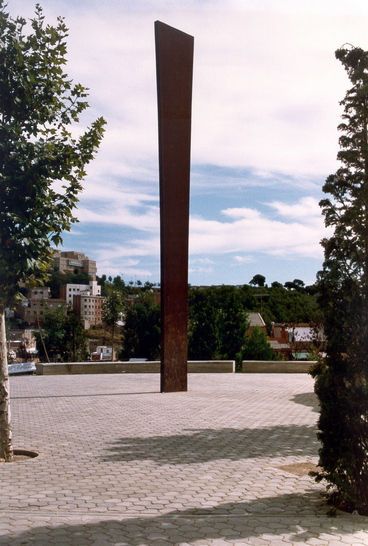
Creueta del Coll
During the 1970s and 1980s, inspired by his move to the pastoral upstate New York, Kelly began expanding his use of the curve and making large, totem-like sculptures - many designed to be displayed outdoors. The 12-foot tall, slightly curving Creueta del Coll reflects both of these important new directions in his work.Kelly created a highly abstracted version of a specific, recognizable form - in this case, an ancient Greek statuary form known as kouros, or male youth. Like many of Kelly's sculptures, this one and a half inch-thick piece painted matte-black is very flat and has a two-dimensional quality. He encouraged his viewers to question traditional perspectives by creating sculptural paintings that might sit on the floor and flat sculptures that lean against a wall.
Weathering steel. Dimensions: 390 x 330 x 5 1/4 inches. Photo courtesy of the artist. ©Estate of Ellsworth Kelly - City of Barcelona, Spain
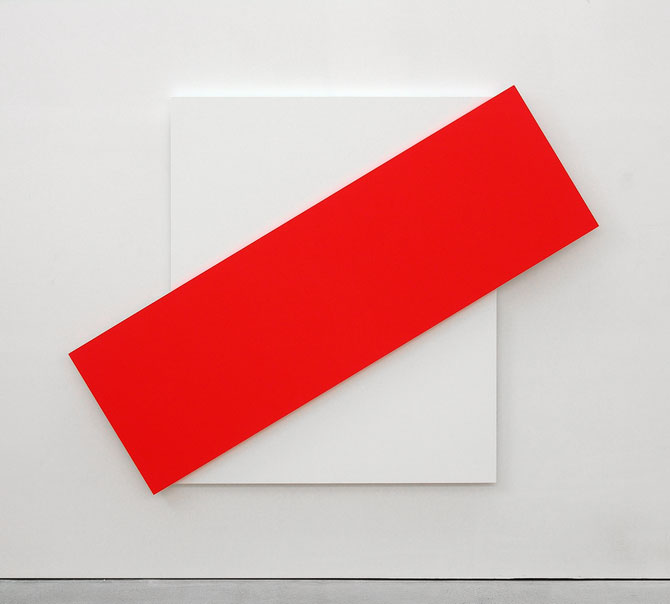
Red Diagonal
In the 1990s, Kelly further developed the possibilities of the relief and continues expanding on this motif today. Red Diagonal employs a striking, geometric construction that echoes the forms created by his earlier panels attached side-by-side. At the same time, these layered pieces extend away from the wall, cutting into the viewer's space. His careful placement of the overlapping canvases creates precise, yet varying shapes in both the positive and negative space.
Oil on canvas, two joined panels. Dimensions: 84 1/4 x 109 3/8 x 2 5/8 inches. Photo by Jerry L. Thompson, courtesy of the artist. ©Estate of Ellsworth Kelly - The Art Institute of Chicago, promised gift of Donna and Howard Stone Collection
Biography of Ellsworth Kelly
Childhood
Born in Newburgh, New York in 1923, Ellsworth Kelly was the second of three boys. He grew up in northern New Jersey, where he spent much of his time alone, often watching birds and insects. These observations of nature would later inform his unique way of creating and looking at art. After graduating from high school, he studied technical art and design at the Pratt Institute from 1941-1942. His parents, an insurance company executive and a teacher, were practical and supported his art career only if he pursued this technical training. In 1943, Kelly enlisted in the army and joined the camouflage unit called "the Ghost Army," which had among its members many artists and designers. The unit's task was to misdirect enemy soldiers with inflatable tanks. While in the army, Kelly served in France, England and Germany, including a brief stay in Paris. His visual experiences with camouflage and shadows, as well as his short time in Paris strongly impacted Kelly's aesthetic and future career path.
Early Training
After his army discharge in 1945, Kelly studied at the Boston Museum of the Fine Arts School for two years, where his work was largely figurative and classical. In 1948, with support from the G.I. Bill, he returned to Paris and began a six-year stay. Abstract Expressionism was taking shape in the U.S., but Kelly's physical distance allowed him to develop his style away from its dominating influence. He enrolled at the École des Beaux-Arts, saying at that point, "I wasn't interested in abstraction at all. I was interested in Picasso, in the Renaissance." Romanesque and Byzantine art appealed to him, as did the Surrealist method of automatic drawing and the concept of art dictated by chance.
While absorbing the work of these many movements and artists, Kelly has said, "I was deciding what I didn't want in a painting, and just kept throwing things out - like marks, lines and the painted edge." During a visit to the Musée d'Art Moderne in Paris, he paid more attention to the museum's windows than to the art on display. Directly inspired by this observation, he created his own version of these windows. After that point, he has said, "Painting as I had known it was finished for me. Everywhere I looked, everything I saw, became something to be made, and it had to be made exactly as it was, with nothing added." This view shaped what would become Kelly's overarching artistic perspective throughout his career, and his way of transforming what he saw in reality into the abstracted content, form, and colors of his art.
Mature Period
After being well received within the Paris art world, Kelly left for New York in 1954, at the height of Abstract Expressionism. While his work markedly differed from that of his New York colleagues, he said, "By the time I got to New York I felt like I was already through with gesture. I wanted something more subdued, less conscious.. I didn't want my personality in it. The space I was interested in was not the surface of the painting, but the space between you and the painting." Although his work was not a reaction to Abstract Expressionism, Kelly did find inspiration in the large scale of the Abstract Expressionist works and continued creating ever-larger paintings and sculptures.
In New York City, while creating canvases with precise blocks of solid color, he lived in a community with such artists as James Rosenquist, Jack Youngerman, and Agnes Martin. The Betty Parsons Gallery gave Kelly his first solo show in 1956. In 1959, he was part of the Museum of Modern Art's major Sixteen Americans exhibition, alongside Jasper Johns, Frank Stella and Robert Rauschenberg.
His rectangular panels gave way to unconventionally shaped canvases, painted in bold, monochromatic colors. At the same time, Kelly was making sculptures comprised of flat shapes and bright color. His sculptures were largely two-dimensional and shallow, more so than his paintings. Conversely, in the paintings he was experimenting with relief. During the 1960s, Kelly began printmaking as well. Throughout his career, frequent subjects for his lithographs and drawings have been simple, lined renditions of plants, leaves and flowers. In these works, as with his abstracted paintings, Kelly placed primary importance in form and shape.
Late Period
In 1970, Kelly moved to upstate New York. Over the next two decades, he made use of his bigger studio space by creating even larger multi-panel works and outdoor steel, aluminum and bronze sculptures. He also adopted more curved forms in both canvas shapes and areas of precisely painted color. In addition to creating totemic sculptures, Kelly began making publicly commissioned artwork, including a sculpture for the city of Barcelona in 1978 and an installation for the United States Holocaust Memorial Museum in Washington, D.C. in 1993. In 2013 President Barack Obama presented Kelly with the National Medal of Arts.
Towards the end of the artist’s life he was in ill health, hampered by an oxygen tank, the need for which he is quoted as saying was because of "the turpentine," which prevented him from working on his "big paintings." However, Kelly continued to paint and innovate until his death.
The Legacy of Ellsworth Kelly
When Kelly returned to the United States from Paris in 1954, he joined a new wave of American painters coming of age in the wake of Abstract Expressionism, many wishing to turn away from the New York School's preoccupation with inner, ego-based psychological expression toward a new mode of working with broad fields of color, the empirical observation of nature, and the referencing of everyday life. Kelly was increasingly influential during the early 1960s and 1970s among his own circle, including Robert Indiana, Agnes Martin, and James Rosenquist. He also provided an example of abstract, scaled-down visual reflection to evolving Minimalist sculptors such as Donald Judd, Carl Andre, and Richard Serra. More recently, Donald Sultan's schematic, abstract still lifes of fruit, flowers, and other everyday subjects clearly owe a debt to Kelly's example, as does the work of many graphic designers of the postwar period.
Influences and Connections


-
![Agnes Martin]() Agnes Martin
Agnes Martin -
![James Rosenquist]() James Rosenquist
James Rosenquist ![Jack Youngerman]() Jack Youngerman
Jack Youngerman



![Paul Klee: Affected Place [<i>Betroffener Ort</i>] (1922)](/images20/works/klee_paul_3.jpg)