Ask The Art Story AI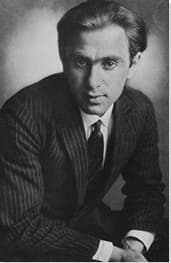

Summary of Issachar Ber Ryback
Issachar Ber Ryback was a leading light within the 20th century Jewish avant-garde. His output, which encompassed lithography, drawing, painting, sculpture, stage design, and theoretical writing, was linked by his drive to revitalize Eastern European Yiddish culture. He achieved this by creating a modern art based on Jewish folk traditions and the secular values of Haskalah (the so-called "Jewish Enlightenment"). As one of the founders of the Arts Section of the Jewish organization, Kultur-Lige (Culture League), Ryback co-authored (with Russian-American artist, set designer, and art critic Boris Aronson) the seminal theoretical essay, "The Voice of Jewish Painting" (1919). In it, Ryback advocated for a new Jewish art that incorporated Yiddish motifs reconfigured through modernist - in practice largely cubist and expressionistic, and to a lesser extent Futurist - techniques. Ryback in most celebrated for works depicting early 20th-century shtetl (village) life, and for creating the most salient visual record of Jewish communities living under the harrowing spectre of antisemitic pogroms.
Accomplishments
- Ryback devoted his whole artistic output to the portrayal of Jewish life and culture. Writing in 1922, he stated: "A Jewish artist who aspires to express this national material must therefore immerse himself in the cultural values of his people that have constituted themselves down the generations." His mission to blend ethnographical sources with avant-garde styles resulted in a body of work that places him in the pantheon of modern Jewish pioneers including El Lissitzky, Nathan Issajewitsch Altman, Boris Aronson, and Marc Chagall.
- Ryback sought to establish a Jewish cultural identity that would demand attention in a world where Eastern European Jewish cultural autonomy was being crushed in the Soviet Union by the Bolsheviks. Ryback formulated a semi-abstract style that emphasized stylized Yiddish iconography including Hebrew letters, Torah scrolls, and the contours of Eastern European synagogues.
- Considered by many to be his definitive work, Shtetl, My Destroyed Home, a Memorial (published in 1923), was a collection of lithographs depicting everyday Jewish life dating back to 1917. Featuring cubist and expressionistic treatments of Jewish rituals and ceremonies, the collection stands as a paean to the terrorized people of his hometown which was subsequently razed in an antisemitic pogrom.
- Although he is better known for his bleak shtetl works, in his last years Ryback's painting took on a more romantic and ethereal quality. His La Fiancée (1936), for example, carried something of the spirit of joy and optimism associated with Jewish spiritual life. It added a further dimension to an oeuvre that, on the occasion of his untimely death, saw critics compare him to his famous contemporary, Marc Chagall.
The Life of Issachar Ber Ryback
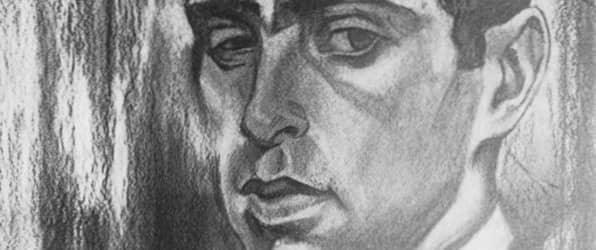
The art historian and critic Waldemar George said of Rymark: "By virtue of his magical colours, human waifs are changed into kings of legend, the desolated sites of Eastern Europe glow with intense brilliance, and his muddy farmyard evoke a rich tapestry, woven with silken threads."
Important Art by Issachar Ber Ryback
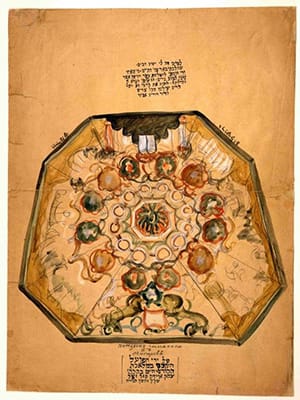
Ceiling of Mogilev Synagogue
This painting depicts the ceiling of the Mogilev Synagogue (ca. 1680) - better known as the Cold Synagogue (because of its lack of any heating) - in Mogilev, Belarus. Famous for its rich decoration, Rabbi Chaim Segal's murals adorned the ceiling and walls of the building's original wooden interior. El Lissitzky, who accompanied Ryback on his field trip to the synagogue, under the auspices of the S. An-sky Jewish Historical and Ethnographic Society, wrote, "the whole interior of the shul [a Yiddish term for synagogue] is so perfectly conceived by the painter with only a few uncomplicated colors that an entire grand world lives there and blooms and overflows this small space [this] is the fruit of a great culture."
Ryback's watercolor and ink copy (which some critics have suggested may have been a preliminary sketch for an unrealized oil painting) depicts a pair of lions at the bottom edge, and under which Segal has identified himself as "the artisan who is engaged in sacred craft." The seams between the triangular wooden sections on the octagonal cupola are clearly visible. On the upper edge, Ryback depicts the Tablets of the Law and the drapery surrounding the Holy Ark. Twelve seals around the center represent the signs of the Zodiac. Ryback's work captured for posterity some of the vitality and fluidity of the Segal's ceiling as figurative elements combine easily with the symbolic and calligraphic. Many modern Jewish artists, including Ryback, El Lissitzky, and Marc Chagall (who, given his birth name was Moishe Shagal, believed he was an ancestor of Segal's), placed the Rabbi in the very cradle of Jewish artistic tradition, and duly cited him as an important inspiration.
Watercolor and India ink - Israel Museum, Jerusalem
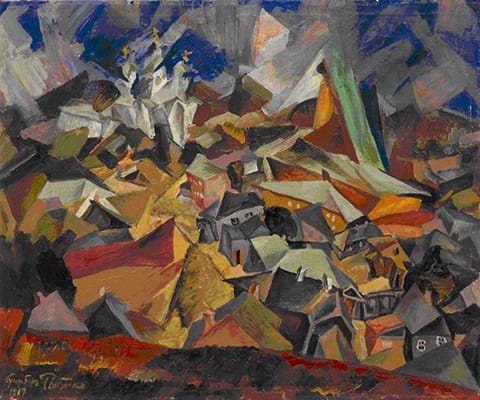
City-Shtetl
In this early work, painted the year after he finished his studies at art school, Ryback adopts an exuberant cubist approach. Infused with vivid color, the painting conveys the joys of shtetl life and its harmonious attunement to the natural landscape. Right of center, a large wooden synagogue rises above the rows of houses; its angular roof, painted in spring green, reaches energetically into the sky, broken into blue and white refractions and angles. On the upper left, a white church, its three spires mounted with golden crosses, looms above the horizon. This juxtaposition suggested Ryback's belief at the time that different religions (Judaism and Christianity) and faith communities could live in harmony. The painting's color palette and sense of energy also suggest the influence of Cubo-Futurism, and an accompanying belief in a progressive modernism.
This work was included in In the Eye of the Storm: Modernism in Ukraine, 1900 -1930s, a major UK exhibition at the Royal Academy in 2024. Art critic Susan Gray described the exhibition as "[telling] the story of a group of modernist artists who helped define Ukraine's cultural identity in their time." Co-curator, Katia Denysova added that the painting was the product of "an optimistic 'generative moment' when peaceful, creative coexistence between Ukraine's communities seemed possible." If that optimism seems to be reflected here in Ryback's light-infused depiction of the village life, it was to be give way to a series of much darker works that spoke of the rising fear of antisemitic persecution.
Oil on canvas - National Art Museum of Ukraine, Kyiv
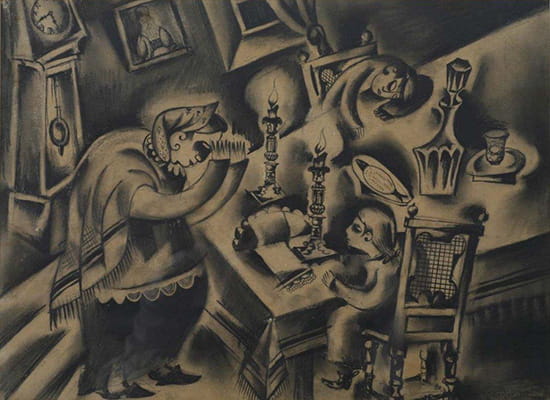
Blessing
This lithograph depicts a Jewish mother and her two children. The two candles and the sacred text laying on the table indicate that she is reciting the Sabbath Blessing. A child at the lower right perches on the edge of her seat as she listens attentively, while on the other side of the table a second child appears to have fallen asleep. Given that he would traditionally deliver the blessing, it is noticeable that the father is missing from the scene. The interior, aswirl with angular expressionistic shadows, brings a mood of deep foreboding, a feeling carried further in the darkly circled eyes of the woman and her children. Moreover, the table tilts at a precarious diagonal from lower left to upper right, as if the room were off-kilter and slipping into the darkness.
Blessing was part of Ryback's celebrated body of work Shtetl, mayn khoreve heym, a gedenkenish (Shtetl, My Destroyed Home, a Memorial), a series of 30 lithographs completed around 1917. (The lithographs were first published in Yiddish by a Berlin publisher in 1922, while Ryback was living in Germany.) Art historian Susan Baskin notes that Ryback's depictions "are not Chagall's light-infused shtetls of bold colors or lovers and fiddlers floating over rooftops [and that] an exhaustion seems to weigh down the shtetl's inhabitants." Scholar, Brendan McGeever, adds that, "Russian society in 1917 bore witness to a sharp increase in antisemitism [and that] newspaper reports [...] indicate that at least 235 attacks against Jews were carried out in 1917." However, the palpable sense of menace that haunts this and other images in the series also seems highly prescient given McGeever's observation that "the scale of anti-Jewish violence between February and October in 1917 in no way matched that of, say, the 1903-06 or 1918-22 pogrom waves [although other historians have stated that the pogroms ended in the Spring of 1921]."
Lithograph

Aleph-Beth
This collage, rendered in the manner of a Synthetic Cubist still life, celebrates the importance of the Hebrew language to everyday Jewish life. At the top center-right, a diagonal piece of brown paper is inscribed with the work's title, "Aleph-Beth," the first two letters of the Hebrew alphabet. In the lower left, two pieces of the same paper contain an image depicting a Jewish man reading a book, while above him is written in Hebrew "the righteous rabbi." In the center of the work are various objects associated with Jewish religious life, a matzah (the unleavened bread of Passover), a kiddush cup (used for blessings on religious holy days and on the Sabbath), and a candle. Ryback uses a variety of materials here, including tears of lace, newspaper pages, and small pieces of plaster, glued to the surface which is painted with an approach varying from impasto to glaze-like.
Scholar Vladyslava Moskalets wrote that "For Rybak, just like for El Lissitzky ... Hebrew letters were, on the one hand, in line with the visual tasks of abstract art, while on the other, served as an introduction to deeper motifs having to do with the Jewish tradition [and that] this work best reveals Rybak's approach to Jewish art." In the seminal essay, "Pathways of Jewish Painting. Reflections of an Artist" (1919), Ryback, with co-author Aronson, declared, "it is the Jewish artist, with his freshness and evident, passionate, naive gift of perception, who, by embodying his living, quivering pictorial sense by means of the national material, is destined to find the path of accomplishment of modern painting."
Collage - Ryback-Museum, Bat Yam, Israel

Pogrom in Kiev (the ship where Jews were slaughtered)
This emotive work depicts the fatal attack on the Tenishev, a steamship. It was boarded by pirates who murdered 73 Jewish passengers. In the left foreground, two skiffs full of pirates intercept the boat, as some of the men board the steamship. Visually it seems as if the vessel were cut in half, sinking into the brown and black waters where dead Jewish bodies float. Ryback uses scale unconventionally to emphasize certain figures and actions, and to heighten the emotional impact. The pirate who is stabbing a Jewish man on the deck looms much larger than other pirates, and his grim sense of purpose is etched across his face. Just behind him, a terrified child clings to his mother's skirt. While the woman overwhelms the scene, the fear and anguish of her twisted expression is palpable. Her hair falls at a sharp angle down her left shoulder, giving the impression that her arm and torso were severed. Her upraised arms are mirrored by the man standing behind the steering wheel, while at the upper left of the frame a pirate stabs a Jewish man who falls from the steamship.
This work was part of Ryback's Pogrom Series, comprising thirteen ink, pencil, and gouache works, most presented on cardboard. Ryback depicted the anguished agony, and also the shame, of the victims, through stylistic traits borrowed from Cubism, Expressionism, Primitivism, and Jewish folk art. In the words of Baskin, the Pogrom Series "represented a relentless narrative of the unbridled violence that was unleashed on the Jewish inhabitants of the shtetls [and showcased] a fateful timelessness to human barbarousness and Jewish suffering [...] where eruptions of murderous violence swept away Jewish hopes for the brotherhood of man." Pogrom in Kiev (the ship where Jews were slaughtered) seemed to foretell the 1921 Elisavetgrad pogrom in which Ryback's father lost his life.
Ink, pencil, and pigments on brown cardboard - Mishkan Museum of Art, Ein Harod, Israel
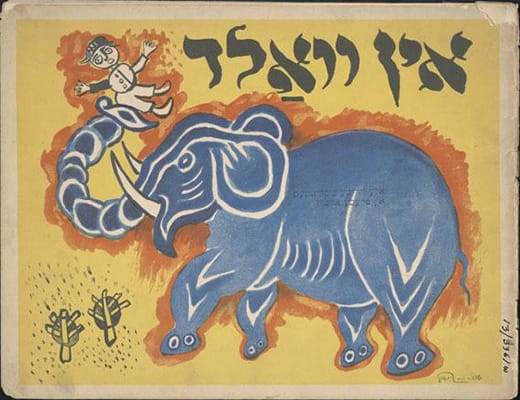
Title page of In Vald (In the Forest) by Leyb Kvitko
This illustration shows an elephant holding a boy aloft in his trunk. The boy holds out his arms, his eyes wide open in surprise (and, in all likelihood, fear). The white outline, creating triangular lines on the elephant's legs, the curves of its tusks, and the lines around its head and ears and leading up the animal's trunk, becomes a radial line of movement and visual energy. Yet with its soft blue color, and its small feet and ankles bearing two almost eye-like patterns, the animal seems nonthreatening.
"In Vald" ("In the Forest"), by the noted Yiddish poet, Leyb Kvitko, tells the story of Itsi, a young boy who dreamt of going to the forest where he encounters an array of animals including a lion, a wolf, a tiger, a kangaroo, and a monkey. Ryback depicted these animals in a uniform style. As art historian Seth L. Wolitz writes, "Influenced by Ivan Bilibin's Russian nationalist stylizations, [Ryback] set a group of Jewish motifs inside a Jugendstil arched frame - including goats, fences, carved wooden houses - with Hebrew letters in flat, schematic yet lively designs illustrating such works as Leyb Kvitko's poetry for children."
Like Ryback, Kvitko was born in a shtetl in Ukraine and attended a cheder, although he was orphaned at an early age. In 1917 Kvitko moved to Kyiv where he became part of the Kyiv Group that frequented the same cultural and artistic circles as Ryback. The two men's paths were to cross again when they both moved to Berlin in the early 1920s and then began collaborating on Kvitko's book. Ryback's illustrations would become another feature of his artistic portfolio. He illustrated other works, such as Ber Smolyar's, Kinder-velt (Children's World), in 1922. His illustrations for "In Vald" are still in print today in new translations of Kvitko's book, while some of his other drawings were published in Stories for Young Children by Miriam Margolin in 2004. A new edition of Kinder-velt (with Ryback's illustration) was reprinted in Russia in 2007.
Illustration - YIVO Institute for Jewish Research, New York, NY
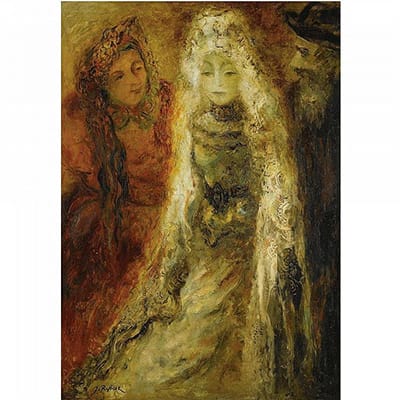
La Fiancée (The Bride)
Painted in the last year of Ryback's life, La Fiancée has a romantic and mysterious quality. The bride of the title is placed center frame while her parents stand on either side of her, looking with love and pride at their beautiful and radiant daughter. Her dress, long veil, and bejewelled headdress, create a presence that seems to materialize from the dark background. The bride shimmers almost like a phantom or spirit that Ryback has summoned from another time and place. Morasha, the Jewish history journal, states that La Fiancée "portrays the artist's love for the world he left behind, his childhood memories, the joy and optimism of the Jewish spiritual life he left in pursuit of his artistic dream, a world that was destroyed forever by pogroms. His romantic and nostalgic style is very clearly present in this work."
Baskin has noted too that, "Throughout his work, Ryback [has] confronted the darkness that permeates Jewish existence. But his creativity extended beyond that darkness." One might fit La Fiancée in this latter category, although the painting carries a hint of ambivalence with the bride's facial expression possibly connoting a sense of sadness (over one of joy). The French newspaper, Journal of debates, said of the work, it is precisely between the lightest fantasy and total romanticism that Ryback treads his path. In the restlessness of his people, in their melancholic mood, he superimposes a wealth of colors and themes, which is not without excess. The whole is totally harmonious with a dark, yet dramatic light." When summarizing his career, the prominent French/American poet and critic, Edouard Roditi, stated that "Ryback can be recognized as an artist whose genius can be compared only with that of Marc Chagall."
Oil on panel - Private collection
Biography of Issachar Ber Ryback
Childhood
Issachar Ber Ryback (also spelled as "Rybak") was born in 1897 in Yelisavetgrad (now Kropyvnytskyi, also known as Kirovograd), in the county of Elisavetgrad, in what was then the Russian Empire (now Central Ukraine). Descended from a distinguished Hassidic family that had emigrated from Lithuania, Issachar's father was a follower of Haskalah, a secular movement, known as the "Jewish Enlightenment," that advocated for a Jewish education that promoted science, reason, and rationalism. As a child Ryback seemed an unlikely candidate for artistic success. He was a sickly boy who suffered from tuberculosis. His verbal skills were also developmentally slow. It wasn't until he was ten years old that he was enrolled in a "cheder" (a Jewish faith school) which most boys entered at the age of five or six. Ryback attended religious classes and secretly joined evening art classes that were designed for local factory workers. When he subsequently enrolled in a vocational trade school, he took classes in scene painting and began working with a crew that decorated local churches and public buildings. Believing it was a fanciful and impractical career option, his father disapproved of his son's arts education. However, the money Ryback earned enabled him to become financially independent of his family and, aged just fifteen, Ryback left home for Kyiv where he enrolled at the Kyiv Art School.
Early Education
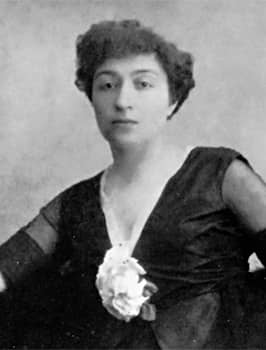
Opened in 1900, the Kyiv Art School was a vibrant and respected institution that attracted overseas students. Ryback studied with Ivan Seleznov, much admired for his genre paintings, and with Oleksander Murashko, a leading proponent of modernism and a key influence on Suprematist pioneer, Kazimir Malevich. Ryback's most important early influence, however, was Alexandra Ekster. A painter and stage designer, famous in Kyiv, Moscow, St. Petersburg, and Paris (where she had lived for long periods), her work was restless and experimental. In Paris she exhibited at the 1914 Salon des Indépendants next to Malevich, Sonia Delaunay, and Alexander Archipenko. By 1915 Ekster had aligned with Malevich and the Suprematist movement, while also taking inspiration from Ukrainian folk artists (with whom she sometimes exhibited).
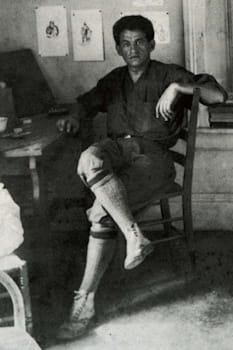
Ryback was a regular visitor to Ekster's studio which was a meeting place for Kyiv's artistic elite. Here he mingled with the likes of set designer Anatol Petrytsky; the poet Anna Akhmatova; and film director Les Kurbas. As the Merrill C. Berman Collection wrote "Ryback, together with his classmate Boris Aronson, was awakened to the vocabulary of modernism" in Ekster's studio. Indeed, Ryback and Aronson were introduced to Constructivist stage design by their host, whose work with Alexander Tairov's Chamber Theatre, had established her as a torchbearer in avant-grade stage design.
Early Work
Ryback, Aronson, and El Lissitzky formed a group, that, according to art historian Susan Baskin "[used] the language of modernism to express Jewish motifs and themes [with the goal of establishing] a Jewish national art that would synthesize the European avant-garde and the Jewish artistic folk traditions." Fiercely proud of his heritage, Ryback also joined the S. An-sky Jewish Historical and Ethnographic Society. In 1915, he exhibited at the Kiev Spring Exhibition for the first time.
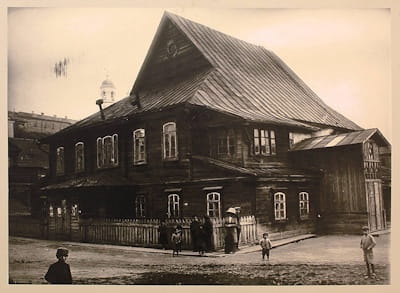
The Ethnographic society provided funds for Ryback and El Lissitzky to travel to Belarus and Lithuania where they researched and documented shtetls (villages), synagogues, and Yiddish folk art. Their trip, taken between 1915 and 1916, took in the so-called "Cold Synagogue" (named because it had no heating source) in Mogilev, a city in Belarus. The Cold Synagogue, a wooden structure dating from the late 17th or early 18th century, is distinguished by its basilica-like architecture and a series of spectacular polychrome murals by Rabbi Chaim Segal. Ryback produced detailed drawings and watercolor paintings of the murals and its vaulted structure which resembled a yarmulke (skullcap). Lissitzky provided additional sketches and detailed written accounts. Commenting on their trip, Baskin writes, "In the stylized images of tombstone engravings and decorative motifs of old synagogues, they discovered a traditional Jewish visual culture. But it was in the shtetls, under the constant threat of pogroms, that they saw the core of Jewish identity."
Mature Works
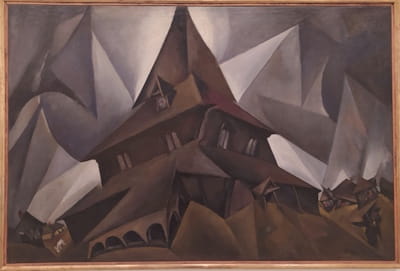
In 1917 Ryback participated in the Exhibition of Jewish Painters and Sculptors in Moscow. He was widely acclaimed by critics of the day as one of the most brilliant new artists of his time. In 1918, Ryback, Lissitzky, Mark Epstein, Iosif Chaikov, and others, co-founded the art division of the Kultur Lige (Cultural League) in Kyiv. Ryback became very active in the children's literature division, illustrating a number of books featuring fairy tales and Yiddish poetry collections.
In 1919, Ryback and Aronson published "Di vegn fun der yidisher maleray" ("Pathways of Jewish Art"). As the Jewish history journal, Morasha, describes, "The essay served as a manifesto of Jewish avant-garde art. The central theme was the difficulties faced in defining and establishing a 'Jewish national style.' According to the authors, Jewish art should represent a synthesis of the Jewish artistic tradition with the modernist movement. They believed it was necessary to establish a Jewish iconography based on Jewish folk art, mainly from the representation of Hebrew letters and the copying of Jewish folk artifacts. The stylizations used by Jewish artists, such as columns, deer, lions and candelabra, became the standard for modern Jewish art." During this period Ryback also created several stamps for Jewish book publishers as well-as sketches and scale models for stage productions by the Liga Cultural do Estúdio Teatral (a space dedicated to experimental and improvisational theater).
In 1919, Ryback moved to Moscow where he taught at the Free Art Studio. He also joined the Moscow State Jewish Theater where he worked on set designs. Ryback was also active in the Moscow Circle of Jewish Writers and Painters. In 1920 Ryback returned briefly to Kiev where he chaired the committee charged with organizing the first large group exhibition of Jewish artists. Shortly after he left for Lithuania where he stayed for six months.
In the spring of 1921, Ryback's father was murdered during the Elisavetgrad pogrom. As Morasha explains, "The anti-Semitic pogroms had begun in October 1917 and spread throughout Ukraine and other parts of the Soviet Union, and only ended in May 1921. During this period, 530 Jewish communities were attacked, and after 887 pogroms, more than 156 Jews were brutally murdered. Ryback's father's murder deeply disturbed him, and he created a series of works dedicated to the Jewish pogroms in Ukraine." After his father's death, Ryback left Russia and, for several months, while awaiting his entry visa to Berlin, resided in Kovno (today, Kaunas), Lithuania, where he illustrated Yiddish books on behalf the Lithuanian Culture League.
In October 1921 Ryback finally arrived in Berlin. He became a member of Novembergruppe (November Group), formed by German artists shortly after the First World War. Ryback participated in several important exhibitions with the group, and exhibited works at the Berlin Sezession, and the Juryfreie Kunstshau (an annual jury free show of avant-garde art). In 1922, Ryback, with other Jewish artists, Yankel Adler and Henryck Berlevi, travelled to Dusseldorf where they "participated in the preparation and conduct" of the congress of the Union of International Progressive Artists.
In 1923, the German-Jewish printing house, Shvelln, published Ryback's graphic album, Shtetl, My Destroyed Home, a Memorial, a collection of works dating from 1917. As Morasha explains "according to many critics [the album] is considered his most representative work. [...] The style of this work, which immortalized his hometown completely destroyed by pogroms, superimposes images of various moments of Jewish life in the synagogue, at school, at parties and in ceremonies and rituals, such as weddings and funerals. In the images it is possible to identify the residents' professions through the symbols introduced, such as shoemakers, knife sharpeners, butchers and the rabbi." Judaic studies scholar, Seth L. Wolitz, called the collection "Rybak's masterpiece" and admired it especially for the way he evoked "the shtetl in dark tones [by] fusing cubism and expressionism, asymmetrical design, exaggerated facial features, and interpenetrating planes."
The publication of Shtetl was quickly followed with a lithographic album, Jewish Types of Ukraine (1924) also based on Ryback's observations and recollections of his earlier tours of Ukrainian and Belarusian shtetls. In the Soviet Union, the persecution of Jews had continued, eventually leading to the closure of all institutions that supported Jewish culture. The Kultur Lige was taken over by the People's Commissariat of Education in 1924 and effectively disbanded. However, Ryback did return to Moscow one last time in 1925 when the Jewish Theatre invited him to work as a designer on a play by the noted Yiddish author I.L. Peretz. Soon after, he began a tour of Jewish cooperative farms in Ukraine and Crimea before settling (for the rest of his life) Paris in 1926.
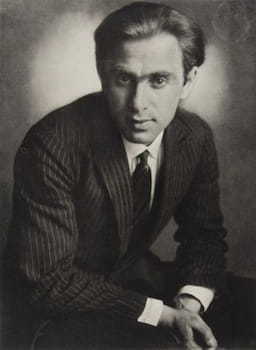
The French capital offered a welcoming environment for avant-garde artists (even though, in the aftermath of World War One, many had joined the Return to Order, a movement that looked to the timeless values of Classicism as a way of making sense of their broken world). In 1926, Ryback spent two months in Jewish villages in the Ukrainian province of Kherson, and in the Crimea. These agricultural settlements for Russian Jewish families in the newly established Soviet Union were set up through the creation of the American Jewish Joint Agricultural Corporation (JDC) in July 1924. An estimated 70,000 Jews were resettled in such communities where they worked the land and managed livestock in cooperatives. Having closely observed Jewish farmers working the land, Ryback produced On the Jewish Fields of Ukraine (1926). Commenting on the collection, the JDC writes, "Ryback sees a transformation of character and livelihood, which he depicts in a modern mindset. Cubist influences are at work with Ryback's fractured perspective. [...] Brushstrokes are converted into geometric patterns, executed in short, repetitive spurts on grass, hay, and pant legs. This fragmented environment aptly captures the new life of agricultural settlers embarking on untouched terrain."
Back in Paris Ryback held two solo exhibitions, at the Galerie aux Quatre Chemins, in 1928, and the Galerie L'Art Contemporain, in 1929. The exhibitions drew widespread acclaim leading to further exhibitions in the Netherlands (The Hague and Rotterdam) and Belgium (Brussels and Antwerp) in 1931 and 1932 respectively. 1932 also saw the release of his third album, a collection of his etchings, titled, Shadows of the Past.
Ryback continued to explore new artistic venues. In 1934 he created Hasidic Dance, Simchat Torah, and Folk Dance, as part of a series of terracotta statues for an International Dance exhibit. The works were subsequently reproduced by Sèvres Porcelain. Sadly, however, Ryback spent the last months of his short life in a Parisian hospital being treated for chronic illness. He helped organize a retrospective of his work from his sickbed, but three days after the retrospective opened in December 1935, Ryback (who had been too ill to attend) died of tuberculosis. He was just 38 years old.
The Legacy of Issachar Ber Ryback
By the time of his premature death, Ryback, had established a new standard in modern Jewish art. Indeed, Baskin notes that Ryback was being "compared to the already established Chagall, and viewed by many as the next, great Jewish artist." Sadly, his name fell into obscurity following his passing. It wasn't until the early 1960s that his work found a permanent home in Israel and began to receive a long overdue re-evaluation. Ryback House, part of The Museums of Bat Yam (MoBY) complex, led this rediscovery in his work. In the words of curator, Ruth-Gabriel, the museum allowed for a new appreciation and exploration of his art's "symbolic and cultural connection to the past and present of Jewish history" while providing visual evidence of "the search for modernist Jewish art in Russia during the revolution." As well as providing a permanent home for the artist's work, Ryback House functions as a thriving arts education center and live workshop designed predominantly for children, teenagers, and their schoolteachers.
Ryback's Pogrom Series, meanwhile, is housed at a second Israeli museum, the Mishkan Museum of Art, in Ein Harod. Baskin wrote, "Viewing the 'Pogrom Series' now is a chilling harbinger not only of the Nazi genocide, but of the Oct. 7 Hamas attacks, as well. Created before the widespread documentary testimony of photography or video postings, the paintings have a verisimilitude of their own. Stylized as the images are, there is an explicitness to the violence depicted that echoes specific atrocities of the Oct. 7 attacks and showcase a fateful timelessness to human barbarousness and Jewish suffering. In forcing us to look, to see, Ryback takes on a mantle of tragic honor."
Influences and Connections
![No image available]() Rabbi Chaim Segal
Rabbi Chaim Segal![No image available]() Alexandra Ekster
Alexandra Ekster![No image available]() Ivan Seleznov
Ivan Seleznov![No image available]() Oleksander Murashko
Oleksander Murashko

-
![El Lissitzky]() El Lissitzky
El Lissitzky ![No image available]() Boris Aronson
Boris Aronson![No image available]() Mark Epstein
Mark Epstein![No image available]() Iosif Chaikov
Iosif Chaikov![No image available]() Leyb Kvitko
Leyb Kvitko

-
![Cubism]() Cubism
Cubism -
![Expressionism]() Expressionism
Expressionism -
![Surrealism]() Surrealism
Surrealism ![Cubo-Futurism]() Cubo-Futurism
Cubo-Futurism![No image available]() Jewish Folk Art
Jewish Folk Art


![No image available]() Yankel Adler
Yankel Adler![No image available]() Henryck Berlevi
Henryck Berlevi
-
![El Lissitzky]() El Lissitzky
El Lissitzky ![No image available]() Boris Aronson
Boris Aronson![No image available]() Mark Epstein
Mark Epstein![No image available]() Iosif Chaikov
Iosif Chaikov![No image available]() Leyb Kvitko
Leyb Kvitko
![No image available]() Kyiv Kultur-Lige
Kyiv Kultur-Lige![No image available]() Novembergruppe
Novembergruppe