Ask The Art Story AI

Summary of Jean Fautrier
Jean Fautrier was a painter and sculptor best known today for his association with the Art Informel group, though(the artist himself refused to align himself with any named movement). His oeuvre evolved from figuration to abstraction, although Fautrier always claimed he never could completely abandon his faith in the former. What connects his figurative and semi-abstract/abstract pieces was Fautrier’s career-long mission to push the material limits – the “materiality” - of paint. Indeed, his Otages (Hostages) collection, the works for which he is still best known, gave rise to his “haute pâte” (“high paste“) technique which saw him apply thick impasto layers of paint, mixed with other materials, to create central picture planes that rose relief-like from the surface of his canvases. International recognition, which came late in Fautrier’s career (following his grand prize triumph at the 1960 Venice Biennale), coincided with the last “great hurrah” of European (and American) abstraction. Today he tends to be celebrated as a true “one-off” who stood at the intersection between the move from materiality and abstraction to figuration.
Accomplishments
- Fautrier’s fixation on the materiality of painting led critic and curator Michel Tapié, to coin the term “Art Informel”. While the artist himself objected to being classified in this way, critics positioned him as a pioneer of a loose group of postwar painters who, linked through their interest in material and process, were cast as the European counterpoint to the American Abstract Expressionists.
- Fautrier is associated chiefly with his so-called “haute pâte” (“high paste“) technique. He would glue pieces of thick paper onto a stretched canvas before then applying thick layers of paint with a palette knife or spatula. The first instances of this “sculpted painting” technique can be seen in his Otages paintings (1942-46) which were described by the author and art critic André Malraux as “lyrical improvisations of a slow ripening”.
- Fautrier’s early works reflected his deep admiration for the English artist J.M.W. Turner. His ominous impressionistic landscapes, such as The Glaciers (1926), captured (like Turner) something of the muscular power of the natural world. Fautrier’s aggressive use of thick impasto paint brought an added tactile quality to that sublime energy.
- Fautrier’s so-called “dark period” saw him create a series of still lifes, some of which, such as Les Peaux de Lapin (The Rabbit Skins) (1927), featured the remains of slaughtered animals. In these disquieting pieces the serene calm of the still life is unbalanced by the brutality with which the artist renders his subject matter.
The Life of Jean Fautrier
Art critic Siegfried Gohr wrote: “The Cubists had explored the objecthood of painting [through] a rejection of the notion of the canvas as a familiar, illusionistic window onto reality. Fautrier was traveling down the same path, but through the use of paint alone”.
Important Art by Jean Fautrier

Les glaciers (The glaciers)
In his early landscape series Fautrier painted a number of glaciers based upon his frequent travels to the French alps and Chamonix, a ski town known for its famous Mer de Glace (Sea of Ice). It is the longest glacier in France and was described by the eighteenth-century historian William Coxe as a “body of ice, broken into irregular ridges and deep chasms [that brought to mind] waves instantaneously frozen in the midst of a violent storm”. This painting depicts the glaciers of the title as shadowy rivers of ice. Seen from above, the tributaries combine to create a powerful flow through a valley. The glaciers emerge from darkness, while the earth itself seems to be in motion, churning and fluid, its materiality conveyed in the thick swirling impasto, brought to life with seams of white.
Darkly impressionistic, the painting carries a tangible emotional force and violent energy of the natural world with little sense of comfort or respite. The Glaciers bears tribute to J.M.W. Turner, whose paintings of the “sublime” force (to marvel at the breathtaking power of the natural world), were a strong influence on the Frenchman during his formative years in London. At the same time, the work debuts Fautrier’s use of thick impasto; the scored and turbulent surface almost dissolves the subject into an overwhelming sense of the paint’s materiality. The work is no longer so clearly a glacier but an aggressive stroke of the brush or the palette knife. The area became a place of temporary refuge for Fautrier in the 1930s when, unable to make a living as an artist in Paris, he relocated to the region where he worked as a ski instructor and jazz venue manager.
Oil on canvas - Menil Collection, Houston, Texas

Flowers of Disaster (Chrysanthemums) (c. 1927)
Darkness permeates Fautrier’s Flowers of Disaster. His chrysanthemums emerge from the shadows like the burning embers of a conflagration. Slightly off-center, a single flower flares like a solar explosion, its burst of yellow fringed with red petals of fire. The bouquet is subsumed by the darkness, its petals, stems, centers, momentarily illuminated. Art critic Donald Kuspit writes that “the deployment of black in Fautrier’s work is paradoxical: it is not only factored into form but is a formless substance, abstractly expressive as well as symbolically charged”.
The emotional impact of this still life is stressed through its being retitled Flowers of Disaster by Fautrier soon after it was first exhibited. Replacing the original, and more demure, Chrysanthemums, the later title evokes the themes of the Parisian poet Charles Baudelaire’s Flowers of Evil (1857), the famous collection that addressed the sense of alienation and inequity that was the byproduct of the relentless march of modernity. Indeed, Kuspit said of his still lifes, “when the artist returns to the things themselves [the flowers] he does so by way of a detour through Hades”. Others, such as historian Siegfried Gohr, focused their analysis on Fautrier’s command of color. He writes, “color has a powerful, elemental presence unconfined by line or convention. […] the painting’s subject lies like a jewel set in a frame”. Art critic Adam Gopnik referred to Chrysanthemums simply as “a firework display of autumnal colour”.
Oil on canvas - The Phillips Collection, Washington D.C.

Les Peaux de Lapin (The Rabbit Skins)
This haunting painting depicts a group of rabbit skins, peeled back to the hind paws, and hung in a darkened place. Black shadows create the specter of the absent body, with the animals’ fur suffused with a soft light and stained with a vivid red. The forms are both specific, identifiable as a species, and universal, symbolic of all slaughtered creatures, even, perhaps, human beings. Indeed, it is tempting to read the painting from Fautrier’s “dark period” as the artist’s attempts to come to terms with his traumatic experiences on the battle front during World War I. Gohr suggests, however, that with these pieces, “Fautrier was quite consciously experimenting with the question of what was, and what was not, acceptable subject matter in a picture of that time. [Fautrier’s] slaughtered animals do not read to us as expressionistic vehicles. Instead, they stand as simple, almost transparent gestures of paint. His carefully composed images always give a sense of deliberation, of care, of conscious control and restraint“.
Some critics (including Gohr) have picked up on the idea that Fautrier’s rabbits carried something of the spirit of the expressionist painter Chaïm Soutine. The Belarusian produced a series of carcass paintings (inspired by Rembrandt’s still life on the same subject matter) that are considered his most iconic works. Although they were not close friends, they were well acquainted, sharing the same dealer (Léopold Zborowski), and even exhibiting together in Paris in the early-mid 1920s. Art critic Donald Goddard writes “In the early paintings of the 1920s, images - flowers, nude figures, hanging carcasses, even landscapes - come out of a darkness or light or both that is indeterminate except for its existence as paint. […] Light does not shine upon The Hung Sheep, The Glaciers, The Rabbit Skins, or Chrysanthemums […] it is as much part of them as the darkness from which it emanates. [But whereas] Soutine's hanging carcasses smell of Europe's slaughterhouse, encapsulating life and death; Fautrier's stench is both specific and universal, however aesthetic its sources“.
Oil on canvas - Private Collection

Tête d’otage (Head of a Hostage)
In 1944 an SS regiment of the German army tortured and/or murdered - within earshot of Fautrier who was in hiding out in a nearby mental health facility – a total of 642 citizens in the rural village of Oradour-sur-Glane on suspicion of assisting the French Resistance. The horrors of this episode proved profoundly distressful for the artist who was himself a partisan of the Resistance. Fautrier responded by creating his Otages (Hostages) series (1943-5), a collection of sculptures and impasto paintings (including L'arbre vert (The Green Tree) (1942), which intermingles irregular curving brown lines that resemble stricken branches and a featureless human head) dedicated to the memory of those brave patriots massacred by the Gestapo.
Cast in lead, its surface scored and gouged, Head of a Hostage seems to take on the shape of an amorphous mass. On closer scrutiny, however, the viewer is unnerved by the sense of an exhumed body part. With a disturbing sense of recognition, the viewer begins to piece together the remnants of a human profile. As art historian Amy Dempsey writes, “The manipulation of the material of Head of a Hostage […] lends the appearance of mutilated flesh to the truncated form. Despite this apparent formlessness, a delicate profile is drawn out of the mass [...] In this way, Fautrier combined elements of figuration and abstraction, conveying both the individuality of the hostages and the amorphous quality of anonymous bodies found in mass graves”.
First exhibited as part of the Otages series at the Galerie René Drouin, Paris, in 1945, this sculpture was one of series of six casts (two in lead and four in bronze). Gopnik writes, “As works inspired by wartime acts of brutal terror, the 'Otages' are particularly unsettling now - all the more so by virtue of Fautrier's status as a purely aural witness”. In his exhibition essay, French writer André Malraux wrote that the Head sculptures were “the key” to the exhibition. “Rather than coming from Fautrier's paintings”, he argued, “these figures come from his sculpture […] which has found, through torture, what it had sought for a long time in vain: a means of incarnation”. Dempsey noted that Tête d’otage “was both the last in Jean Fautrier's Hostage series […] and the last sculpture that he made”.
Lead on Marble Base - Tate, London

Petite Construction
Petite Construction forms part of the artist’s bigger Constructions project. It embodies Fautrier’s signature “haute pâte” (“high paste”) painting technique. It is a small (“petite”) composition dominated by a thick lilac impasto rectangle protruding, relief-like, from a backdrop of a washed-out, thinly-applied, whitish-blue. Art historian Freddie Warshaw explains the Frenchman’s process thus: “Fautrier began by glueing several pieces of thick paper onto a stretched canvas support, upon which he would apply extremely thick, white paint with implements such as a palette knife or spatula in order to build up the centralised heap”. Warshaw adds that “research has found that this paint is made up of a very fine plaster” and that with “the thick paste still moist, [Fautrier] would then apply colour through a dusting of powder and crushed pastels and further through ‘gouache, ink, and also oil paint’”.
Coming towards the latter part of his career, Petite Construction helped bring the artist new international recognition. Indeed, in 1960, Fautrier was awarded the International Grand Prize, which he shared with the German artist Hans Hartung, at the thirtieth Venice Biennale. Fautrier showcased around 150 paintings and sketches, including Petite Construction, and pieces from his Otages series. However, news of Fautrier's win was somewhat overshadowed following his widely reported spat with the Abstract Expressionist Franz Kline. Time magazine reported that “walking up to U.S. Abstractionist Franz Kline (himself a $1,600 prizewinner), Fautrier reportedly told him that his work ‘stinks.’ Kline’s reply, so the story goes, was a realistic right to the jaw that dumped Fautrier on the seat of his pants”.
Mixed media

Grand Nu (Large Nude)
In its apparent lack of figuration, the image seems to belie its title (Grand Nu, or Large Nude) given that the human figure is not even a suggestion here. And yet a kind of aggressive sexuality seems to define the work. Thick black diagonal lines overlay a pink, almost flesh-colored, shape that blur in the center as if dissolving into the underlying form. Through the suggestion of an aggressive male-female encounter, the work might also evoke the encounter between form and line, and perhaps the artist’s desire for domination of the material world. As the Städel Museum wrote, “The title leaves no room for doubt: despite all the abstraction, Jean Fautrier is concerned solely with reality. Delicate colors meet intense, dark brushstrokes in a relief-like, brittle center [...] With its extreme materiality, the painting itself appears more as an object than as a picture”.
Coming on the back of his triumph at the Venice Biennale two years earlier, Grand Nu is indicative of the slow demise of American and European abstraction. Indeed, the thirty-first Biennale in 1962 signaled a return to figuration with the Gran Premio (Grand Prize) for sculpture going to the Swiss Alberto Giacometti, and the grand prize in painting awarded to French semi-abstract artist Alfred Manessier. The historian Curtis L. Carter says of this swing, “At this point [in 1962] new developments and a shift of emphasis of the Biennale moved beyond Abstract Expressionism, as well as Art Informel to consider the new developments including new figuration and Pop Art. In 1964 Robert Rauschenberg at the age of 39 was awarded the Grand Biennale Prize, finally validating new developments in American art and signalling that art had moved on”. But, as Gohr concludes, “if we are to look at the developments of the 20th century with accuracy and clarity, we find Jean Fautrier an isolated yet significant artist who, on the outskirts of every camp or school, demonstrated the possibilities of transporting the objective and object-filled world into the spirit and substance of paint”.
Oil and mixed media on paper on canvas - Städel Museum, Frankfurt
Biography of Jean Fautrier
Childhood and Early Education
Born in Paris in 1898, Jean Fautrier was raised by his maternal grandmother until her passing in 1908. Fautrier then moved to London to live with his mother (he was born out of wedlock, nothing is known of his father). He quickly developed an interest in art, and aged fourteen, enroled at the Academy of Arts where he received a classical training. Fautrier soon tired of the Academy’s conservative approach, however, and moved to the more progressive Slade School of Fine Art. Fautrier spent much of his free time visiting the Tate and the National Gallery where he fostered a great admiration for the paintings of J.M.W. Turner. Turner’s ability to capture the violent and capricious forces of the natural world influenced Fautrier’s early paintings. Even as his work shifted towards materiality and abstraction, he never lost sight of figuration. He wrote, “No art can trigger emotion if it is not somehow connected with reality. This reference, this fragment – however slight or intangible – is the key to understanding the entire work”.
Early Career
Following the outbreak of World War I, Fautrier returned home to serve in the French army. He was posted to the front line in 1917 and suffered from a gas attack. He was discharged from the army on grounds of his poor health and, after a short period of rehabilitation in Austria, returned to France where he took up several odd jobs. By 1921 he was settled in Paris where he quickly fell in with the city’s bohemian community. In 1922 Fautrier exhibited his work at the Salon d’Automne, and the following year, at Jeanne Castel’s Fabre Gallery. His first solo exhibition followed in 1924 at the Galerie Visconti. During this period, Fautrier was painting still lifes, portraits, and nudes: figurative works that were distinctive for their dark palette, black outlines, and shadowy backgrounds. Dubbed his “Black Period”, important works such as Portrait de jeune fille (Portrait of a young girl) (1922), and Tete d’homme barbu (Head of a Bearded Man) (1925), were centered on figurative forms.
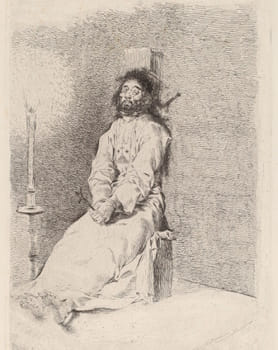
In 1928 Castel introduced Fautrier to the novelist and art critic André Malraux. He (with Castel) is often credited with advancing the career of an artist who was contemptuous of commerce. Curator and art historian Seigfried Gohr described Fautrier as “a difficult and diffident man [who] deliberately avoided outside influences, and consistently perceived the exhibition system and the social and political trappings of the art market as threats to his mission”. Nevertheless, Malraux championed his friend’s “thick powerful style” that was imbued with a “tragic resonance [and] intense colour [that was] violently spontaneous“. In 1930, Malraux suggested that Fautrier choose a literary work to illustrate, and after some discussion, the artist agreed to create lithographs for a new edition of Dante’s Inferno. Ultimately, however, the publisher dropped the project having deemed his shadowy semi-abstract illustrations too obstruse.
This was the period of the great global depression and its effects were strongly felt on the art markets. Fautrier (like many other artists) had difficulty exhibiting and selling his work. As a result, he abandoned art altogether and moved to Tignes, a French Alpine ski resort near the border with Italy, where he lived between 1934 and 1939. Here he worked as a ski instructor and manager of a small jazz venue, La Grande Ourse. In 1935 he met Yvonne Loyer. The couple were married in the same year.
Mature Work
The Fautriers left Tignes with the outbreak of World War II. Having passed through Provence and Bordeaux, they arrived in Paris in 1940 where they lodged initially with Castel and her husband. Fautrier took up painting again and began experimenting with different materials. He said, “I liked the idea of mixing things […] A formula had to be found to be able to work with everything”. Christie’s auction house described Fautrier’s work during this period as exhibiting a “radical experimentation [...] a new, semi-abstracted style, in which figures were reduced to a series of scoured, limbless shapes. Visceral and irrational, these disfigured forms seemed to embody the monstrosity of the times”. Fautrier became friends with a number of avant-garde writers, including Réne Char, Francis Ponge, Paul Eluard, and Jean Paulhan, providing illustrations for a number of their works. This literary group became influential supporters of his artworks. As art historian and curator Dieter Schwarz notes, Fautrier’s art was “so defended by writers” because it offered “a kind of visual rhetoric that corresponds to [the] rhetoric of speech”. Ponge, for instance, likening Fautrier’s art to fine wine, with a “brilliant discomfort and rage [soaked] in a smooth bouquet”.
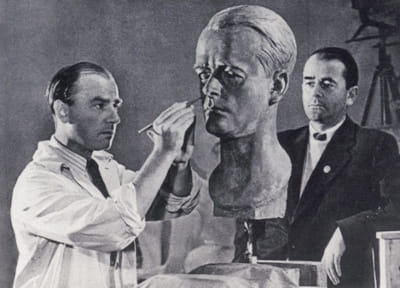
When, in 1940, the German army invaded France, Fautrier began meeting regularly with other artists and writers connected to the French Resistance. During the Nazi occupation, anyone suspected of being a member of the Resistance was arrested (usually with dire consequence). In January 1943 Fautrier (who had divorced his first wife Yvonne the previous year) was held by the Gestapo for four days. However, Paulhan contacted his friend, the German sculptor (and Nazi supporter) Arno Becker (who was a long established figure on the Paris art scene), to help facilitate Fautrier’s release. On his release, the Frenchman went into hiding at Dr. Henry Le Savoureuz’s psychiatric retreat located in a forest on the outskirts of Paris.
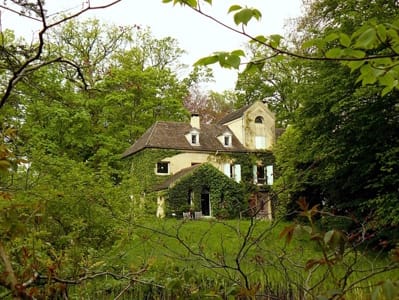
Dr. Savoureux and his wife had bought the Maison de Chateaubriand in 1914 and established a clinic on the estate. The chateau also hosted regular gatherings for well-known writers and artists, many of whom found a place of refuge on the estate. Fautrier worked in Velléda Tower, a solitary structure that he used as a studio, and from where he could hear the screams of citizens being tortured and/or executed by the Gestapo in the surrounding forest. Out of sense of helpless rage, he created his Otages, (Hostages) series (1943-5), a collection of sculptures, as well as sculpted paintings for which he developed a technique of applying plaster and pigment to paper. He said of this period in his life, “I felt alone to the point of longing for the atrocious and total annihilation of everything”. During this time Fautrier also provided illustrations for Éluard’s collection of poems, Dignes de Vivre (Worthy of Living). In 1944, Fautrier, by now in his mid-forties, and divorced from Loyer, met twenty-two year old artist Jeannine Aeply, with whom he set up home in the nearby Villa Barbier at Châtenay.
In 1945, Otages, peintures de Jean Fautrier, opened at the Galerie René Drouin in Paris. Malraux described the work as capturing the “hieroglyphics of pain”, while another critic, Pierre Restany commented that the exhibition represented “anger, fear, hatred, impotence, tenderness, and human solidarity”. Artists too were profoundly impacted by the works. Jean Dubuffet wrote that the “exhibition made an extremely strong impression on me” adding that art “had never before appeared so fully realized in its pure state [and] never before been so loaded with meaning”. Indeed, it was after attending this exhibition that critic Michel Tapié coined the phrase “Art Informel”. For him Fautrier’s work represented the birth of “another kind of art”; one not defined by style or technique but, rather, by “something much rarer [and] authentic“.
With Dubuffet, Antoni Tapiés, and Pierre Soulages, Art Informel became a movement that offered a European counterpoint to the supremacy of the American Abstract Expressionists. The American movement’s most important champion, Clement Greenberg, felt sufficiently challenged by the group that, in 1953, he offered the following missive: “For all the adventurousness of their images the latest generation in Paris still goes in for paint quality in the accepted sense. They ‘enrich‘ the surface with films of oil or varnish, or with buttery paint“. In any case, Fautrier resisted being defined by the movement while insisting that his work would forever be rooted in the figurative: “No art form can create emotion if it does not bear some trace of the real” , he said.
Late Period and Death
Although never married, Fautrier and Aeply had two children (Dominique in 1946, and Manuelle in 1947). The couple’s relationship was volatile. They managed to work well as a team, however, and in 1950 they developed a process that combined elements of print-making with gouache or pastels for reproducing existing artworks. Called the “Aeply process”, and “originaux multiples” (multiple originals), the pair helped introduce a new era of art reproduction. In 1950 Aeply Replicas opened in London, followed a few months later by an exhibition, Les débuts d’un art universel (The debut of a universal art), in Paris. Aeply’s reproductions of famous artworks by the likes of Pablo Picasso, Georges Braque, André Derain, and Maurice Valminck, met with public and commercial approval and helped her establish an independent career in publishing and gallery and museum curation. After viewing the 1950 Paris exhibit, Georges Braque commented “These pictures are more than mere reproductions; they are reconstitutions of the original”, while Malraux called them “the most successful reproductions in the world”.
Sadly, interest in Fautrier’s “originaux multiples”, wherein he reproduced his own works as limited editions, never took off. In 1956, his New York exhibition failed to sell a single work. Gopnik writes, “Part painting, part print, these hybrid works occupy an ambiguous position in his career, having caused his dealers no small aggravation even as they were criticized as a blatant commercial ploy”. As a result of this setback, Fautrier turned to two new series, Objets (1954)), depicting everyday items such as coffee mills, bottles, and cardboard boxes, and Nus (Nudes) (1956).
He also created the series Les partisans (The Partisans) (1956) in honor of the Hungarian independence movement which was crushed by the invading Soviet army. The series were first exhibited at the Musée d’Art Moderne de la Ville de Paris in 1957. The museum wrote, “Using a glue-based paint for blends of pigment with transparent and opaque inks, Fautrier composed intricate, luminous harmonies whose impastos and textures induced a certain anxiety”. However, the works generated a mixed response. Some observers dismissed Objets as “kitsch”, though influential critic André Berne-Jouffroy was more enthused: “Fautrier paints a box as if the concept of box did not yet exist [he] offers us objects in their nascent condition, offering them to us through something resembling painting but also reinvented, rediscovered”.
Fautrier’s previous work, his impasto technique, and his move toward abstraction and materiality, began to gain international recognition following exhibitions in Milan, Rome, London, Madrid, Tokyo, and New York. His success was confirmed when he was awarded the Grand International Prize in Painting at the 1960 Venice Biennial. Gopnik writes, “Grounded in an haute pâte technique of thickly worked plaster, sprinkled with pigment and centred on a canvas and paper support, Fautrier's concoctions were less than palatable to the Action painting-dominated art world of the day. Of course, it didn't help that, on receiving the grand prize at the 1960 Venice Biennale, Fautrier lashed out at Franz Kline and Americans in general”. (Kline responded by dismissing Fautrier as a “French Cook”). The Frenchman was the recipient of the Grand International Prize at the Tokyo Biennial in the following year with his paintings, as art historian Sarah Wilson noted, “having a great impact on the Gutai artists”.
Fautrier spent his final years in Châtenay-Malabry, with his female companion, Jacqueline Cousin, whom he met in 1962. The two planned their wedding for July 21, 1964, but that same day Fautrier passed away due to complications believed to have stemmed initially from the damage to his lungs sustained during World War I.
The Legacy of Jean Fautrier
Seigfried Gohr has pointed out that “The reservations about Fautrier’s art are deep rooted and complex, arising from qualities in both the work itself and its maker’s own character. In an era that valued in its artists the passionate flamboyance of a Picasso, or the luminous sensuality of a Matisse, or the demanding rigor of a Mondrian, Fautrier’s idiosyncrasies were far less alluring”. Indeed, after his death, critical and public interest in Fautrier’s work waned noticeably. Nearly two decades would pass before his art enjoyed a revival in critical and curatorial attention. During the early-to-mid 1980s his paintings featured in major exhibitions in Cologne, Amsterdam, Paris, and London, but even then, his achievements remained, in the words of, Gohr, “shadowed and in dispute”. His work was also overlooked in the United States where it wasn’t the subject of a major exhibition until 2002-03 (at Columbia University and the Fogg Art Museum at Harvard).
Today, however, Fautrier is treated with renewed deference. In 2023 Paul Nyzam argued that he was “one of the most important 20th-century European artists. As well as having a decisive influence on younger artists, he gave birth to an absolutely original and independent body of work”. Indeed, it is now almost taken as given that Fautrier’s work had influenced the likes of Gerhard Richter, George Baselitz, and Anselm Kiefer, all of whom, according to Christie’s auction house, “perceived in Fautrier’s ravaged layers, a way to address their country’s violent past”. Gohr concludes, “there was always a marked disjunction between Fautrier’s painting and prevailing artistic trends. And yet it is precisely the distance he kept from what was happening around him that provides the key to appreciating his contribution [to 20th century art]”.
Influences and Connections


-
![Paul Eluard]() Paul Eluard
Paul Eluard ![Francis Ponge]() Francis Ponge
Francis Ponge![Jean Paulhan]() Jean Paulhan
Jean Paulhan![No image available]() André Malraux
André Malraux![No image available]() Réne Char
Réne Char


-
![Impressionism]() Impressionism
Impressionism -
![Expressionism]() Expressionism
Expressionism ![No image available]() Abstraction
Abstraction


-
![Paul Eluard]() Paul Eluard
Paul Eluard ![Francis Ponge]() Francis Ponge
Francis Ponge![Jean Paulhan]() Jean Paulhan
Jean Paulhan![No image available]() André Malraux
André Malraux![No image available]() Réne Char
Réne Char