


 Ask The Art Story AI


Summary of Afrofuturism
Afrofuturism is a cultural, artistic, and intellectual framework that merges Black history and African diasporic identity with elements of science fiction, technology, spirituality, and cosmology to imagine speculative futures in which Black people are central agents rather than absent or marginalized figures. Emerging through music, literature, visual art, and critical theory from the mid-20th century onward, and rooted in African cosmologies and Pan-African thought, Afrofuturism challenges Eurocentric narratives of progress and modernity by positioning Black imagination as a site of innovation, resilience, and world-building. It is not simply a genre, but a mode of revisioning that asserts Black existence across space, time, and possibility.
Key Ideas & Accomplishments
- Afrofuturism fundamentally disrupts the modern art canon’s assumption that technological progress, futurity, and abstraction are Western inheritances. By embedding Black bodies, histories, and spiritual systems within visions of the future, Afrofuturism reframes Blackness as generative rather than reactive to modernity.
- Long before interdisciplinarity became institutionalized, Afrofuturist artists collapsed boundaries between music, performance, literature, visual art, philosophy, and science. This approach helped legitimize hybrid practices now central to contemporary art and curatorial discourse.
- Afrofuturism elevated speculation regarding utopias, alternate histories, and imagined futures as a rigorous method of cultural critique. Rather than escapism, speculative aesthetics became a means of addressing systemic violence, displacement, and historical erasure within both art and society.
- By inserting African diasporic symbols, mythologies, technologies, and bodies into genres long dominated by white experience, Afrofuturism transformed sci-fi and fantasy into inclusive, politically charged visual languages that now inform film, design, fashion, and digital culture.
- Afrofuturism has influenced how museums and cultural institutions approach history, moving away from static Eurocentrism and toward speculative, restorative, and future-oriented storytelling that acknowledges loss, resilience, and unrealized Black possibilities.
Artworks and Artists of Afrofuturism

Black Girl's Window
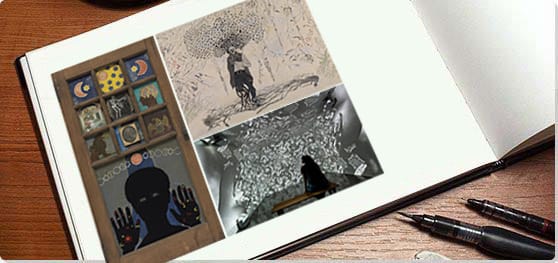
Towards the late 1960s, Betye Saar shifted her focus from painting to collage and assemblage. Black Girl’s Window is the first major work of art she created that is representative of her signature aesthetic style.
The frame and substrate on which Saar created her imagery is a salvaged window frame. The structure enabled Saar to divide her composition into multiple scenes or vignettes. The biggest subsection of the screen is where Saar painted a stylized portrait of a Black girl. The figure is presented almost entirely as a silhouette, except for her eyes. The girl is depicted as if she is pressing herself up against a window. The palms of her hands are decorated with constellations and other celestial objects. Above her head is an illustration of the moon’s phases, as well as an astrological symbol for Leo, which is Saar’s zodiac sign. In addition to more upbeat imagery, Saar juxtaposes symbols alluding to racism and white supremacy. A white paper skeleton looming above a Black plastic skeleton expresses systemic racial violence. Next to it, a diagram of a Black human head that reveals a map of the brain signifies racial propaganda in white society that has been employed to uphold white hegemonic structures. The brain map specifically references the racist and pseudo-scientific practice of phrenology, which falsely posited that white brains were superior to Black brains.
Mystical themes in Saar’s work reflect spiritual yearning and cultural advancements towards social liberation. Black spiritual traditions and totemic objects from across the African diaspora are reinterpreted to make profound statements of Black unity and in the spirit of Afrofuturism, imagine a better and more just world for Black people. Saar explains that “each item I collect I feel has a certain energy, from whatever it served as in its previous life.”
Saar acknowledges that Black Girl’s Window is inspired by her personal history and identity as a Black woman. The ongoing fight for civil rights and the Black power movement was also an impetus behind the making of the piece. She notes, “we’d had the Watts Riots and the Black revolution. Also, that was the year of my divorce. So, in addition to the occult subject matter there was political and also personal content.”
Wooden window frame with paint, cut-and- pasted printed and painted papers, daguerreotype, lenticular print, and plastic figurine - Museum of Modern Art, New York

There Are Black People in the Future
Wormsley’s There Are Black People in the Future is a billboard-sized, text-based work of art that is a literal affirmation of Afrofuturism. The first version of this public artwork was an installation of these poignant words on top of an existing billboard in the East Liberty section of Pittsburgh, Pennsylvania. When that artwork was displayed in 2017, the neighborhood was experiencing gentrification, which led to the displacement of its traditionally Black and immigrant working class community.
Wormsley’s artist’s statement declares: “There Are Black People in the Future is inspired by Afrofuturist artists and writers who highlight the need for Black people to claim their place. Through the inscription and utterance of the words, ‘There are Black People in the Future,’ the project addresses systemic oppression of black communities through space and time by reassuring the presence of Black bodies.”
Overall, the public art campaign reinforces the prowess of the African diaspora, and its perseverance over past and present struggles, while noting that any future problems will be overcome as well. It is also a rallying cry for Black individuals and communities to envision a future that suits their individual and collective needs. It offers a blank canvas for portraying Black identities and narratives throughout the culture at large. It eschews the mainstream narratives that science fiction and fantasy are strictly Eurocentric and white genres. Reverend Heather Janules notes that, “There Are Black People in The Future is an affirmation among science-fiction nerds who are also Black, in response to the mysterious absence of African American characters in sci-fi films. If you think about it, the failure of vision on the part of media producers is strange.”
Billboards for There Are Black People in the Future have been erected in Detroit, Charlotte, New York City, Kansas City, and Houston, as well as internationally in London, Accra, and Qatar.
Public artwork displayed on various billboards throughout U.S. cities.

The Seated I
The Seated I by Kenyan-American artist Wangechi Mutu, is one of a group of four sculptures of hers that were commissioned by the Metropolitan Museum of Art in New York. The four works are collectively titled The New Ones, will free Us. The sculpture was initially installed outside of the museum along its historic facade, marking the first time that a contemporary work of art adorned the outside of the museum.
The sculpture depicts a seated humanoid-woman. She is wearing a long and flowing coiled garment that combines the delicacy of a dress with the sturdy protection of armor. Her face is stylized resemblant to features of the Maasai people’s expressive wooden masks. A polished disk decorates the mouth, which serves as a beacon that reflects natural light, as well as a mirror image of the viewer. Mutu took inspiration from both past and present cultural motifs among Indigenous African women to create a hybrid, futuristic vision of the African diaspora.
The Metropolitan Museum of Art’s description of the sculpture acknowledges its Afrofuturistic concept, stating “The Seated I represents the ‘new ones’ who bring word of new ideas and new perspectives, encouraging viewers to look forward to a better, more just future.”
Bronze - Metropolitan Museum of Art, New York

Bird in Hand
A human-like figure is the central subject of Ellen Gallagher’s Bird in Hand. Dressed like a pirate or sea captain, the figure stands within an imaginary landscape, which appears to be underwater. The figure’s face resembles an African tribal mask and there is a large plumage of swirling hair extending upwards to the edge of the canvas. His left arm is placed over his heart, holding a parrot. In place of his right leg is a wooden peg entangled in coral, seaweed, and other underwater matter.
Bird in Hand is a science fictional representation of the transatlantic slave trade, which involved the forced transportation of enslaved African people to the Americas. The title refers to the idiom “a bird in the hand is worth two in the bush.” Gallagher describes the bird as having “just been caught, its expression felt in the plasticine eye closed in that way birds do when you hold them a bit too tightly.” This is a metaphor for the experience that Black Africans endured during their passage from freedom into slavery.
Regarding her intricate composition, Gallagher states, “I think of this painting as an origin myth of sorts, with a kind of evil doctor, perhaps related to Doctor Moreau or Frankenstein, at its center.” The main character, referred to as ‘pegleg,’ is commonly placed within several of the artist’s compositions. This figure indicates a sense of travel and worldliness, as well as a persistence to survive in spite of all the ongoing turmoil around him. In this particular composition, the placement of ‘pegleg’ under the sea, might allude to the myth of “Black Atlantis,” an underwater nation that is inhabited by hybrid species descended from enslaved Africans who drowned during the journey across the middle passage.
Oil paint, ink, paper, polymer, salt and gold leaf on canvas - The Tate, London

Soul Culture
Using projection mapping, Jamaican-American artist Renee Cox turned the walls and ceiling of Pittsburgh-based Mattress Factory’s gallery into an animated shrine with fantastical renderings of Black bodies in motion.
Cox alters individual human forms derived from black-and-white photographs into hybrid sculptural beings that resemble fantastical creatures or deities. The use of digital manipulation to choreograph the bodies into fractal-like patterns also creates a kaleidoscopic effect, which envelopes the entire space and creates a meditative experience. The allusion to geometric shapes, repetitive patterns, and the reflectivity of the kaleidoscope are indicative of peace, reflection, and joy.
Soul Culture fits within the Afrofuturist genre due to its imagined explorations and depictions of Black bodies through an intersectional lens. Through combining anatomical features of diverse bodies into fractal forms that resemble sacred geometry, Cox celebrates the beauty, mystique, and plurality of Blackness.
Video projection - Mattress Factory Art Museum, Pittsburgh, Pennsylvania

Untitled (Warrior) from the Celestial Bodies series
Celestial Bodies is a series of large mixed media works by Los Angeles based artist Carla Jay Harris. Harris combines numerous cultural symbols and motifs to create her own fantastical narratives that embrace Afrofuturism.
Ancient Greek mythology and folklore is one of the main cultural references that Harris reimagines and interprets. In Harris’ visual folklore, Black bodies are inserted into the canon, diverting the historical whitewashing of mythology. Throughout the body of work, Harris addresses themes of power, beauty, ingenuity, and an overall more inclusive representation of the future.
Harris describes her process and vision as an amalgamation of personal experiences and an interest in the supernatural and metaphysical world: “Conceptually, I start each project with an aspect of my own personal experience that I want to explore; then, evolve the work into a lasting statement on human nature. I describe the end-style of my work as narrative with a hint of fantasy…The mixture of archival, documented, and imagined imagery allows me to transgress unwritten social laws and encourage viewers to look differently and imaginatively at their own existence.”
Mixed media

Miyale Ya Blue
Miyale Ya Blue, is a retrofitted transistor radio that merges the past and present. Kabiru’s series of artfully repurposed transistor radios speak to memory, nostalgia, and cultural heritage. They are futuristic in their design and their conceptual reinterpretation. Kabiru notes that the transistor radio was an important familial object, recalling gathering together with the family and listening to the news on his grandmother’s wireless radio.
The word Miyale means “rays” in Swahili. The entire title Miyale Ya Blue translates to “Rays of Blue.” This is formally indicative in Kabiru’s design, which colorfully references the stylized form of a shining sun. The sun’s rays are formed by nine repurposed radio antennas. Art critic Salamishah Tillet notes that it alludes to “the intergalactic while also curved in the shape of a crown.”
In addition to personal significance, Kabiru’s radios are endowed with a metaphorical spiritual energy. These spiritual powers suggest a metaphysical and cognitive communication with our ancestors across space and time. Through a futuristic lens, Miyale Ya Blue reinvents the time-honored traditions of honoring one's ancestors through ritual and cultural expressions.
Steel and found objects - Metropolitan Museum of Art, New York
Beginnings of Afrofuturism
Astral Jazz
Afrofuturism is largely known to have proliferated through the work of Black science fiction writers, but its roots can also be traced to astral jazz. John Coltrane’s incorporation of Black spiritual music and themes within his 1965 landmark album, A Love Supreme is considered to be the impetus behind this genre of music. The album features Coltrane on saxophone along with pianist McCoy Tyner, bassist Jimmy Garrison, and drummer Elvin Jones. The tonal phrasing on the album has been described by critics and jazz scholars as a spiritual map representing the African diaspora. Music essayist Robert Christgau noted that A Love Supreme is "meditative rather than freewheeling, with each member of his classic quartet instructed to embark on his own harmonically mapped excursion and the title set to a chanted four-note melody you could hum in your sleep….But how much you value it, I expect, depends on how much faith you place in your own spirituality."
In A Love Supreme, Coltrane transformed the structure of African American prayer and traditional hymns into an improvised expression of spiritual recitation. In what he dubbed as “musical narration,” Coltrane sounds out the words from a poem he wrote called "Psalm" using his saxophone. The actual words of the poem are published in the album’s liner notes.
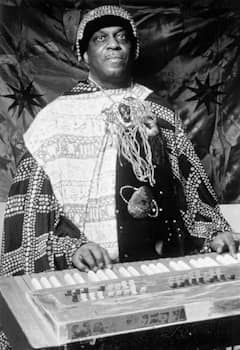
A Love Supreme was inspiration for avant-garde musicians like Sun Ra and Pharoah Sanders to musically connect ancient African traditions and contemporary themes. A major theme concerning astral jazz musicians is “cosmicology” and its notable origins in ancient Africa. “Cosmicology" isn't a standard scientific term but broadly refers to the study of the universe (Cosmology) or, more commonly, a modern blend of spiritual, astrological, and psychological practices that connect personal journeys to cosmic patterns. These historic roots were juxtaposed with the contemporary “Space Age” and interplanetary exploration. In addition to the music, album covers were unique for their aesthetics, often depicting Egyptian symbols and iconography against a cosmic background. Astral jazz musicians immersed themselves with sounds, instruments, and music theory from diverse genres of music. The common denominator among their influences was the intersection of spirituality and culture from the African diaspora with mystical, mythological, and scientific themes and narratives.
Sun Ra was especially indicative as a harbinger of Afrofuturism. He created a persona for both himself and his music that merged science fiction with culture and mythology from the African diaspora. He was a unique bandleader, known for orchestrating elaborate stage performances and attire. His costumes combined ancient Egyptian-style clothing with contemporary Space Age features. This merging of the past and present signified the long-standing contributions of Black individuals and civilizations on our collective history.
A vision that Ra had during the mid-late 1930s impacted his visionary futuristic aesthetic and ideology throughout his life and career. During a moment of deep spiritual meditation, Ra reflected on a vision and a metaphysical “trip to Saturn” that informed his shift to Afrofuturism and astral jazz: “My whole body changed into something else. I could see through myself. And I went up... I wasn't in human form... I landed on a planet that I identified as Saturn... they teleported me and I was down on [a] stage with them. They wanted to talk with me. They had one little antenna on each ear. A little antenna over each eye. They talked to me. They told me to stop [attending college] because there was going to be great trouble in schools... the world was going into complete chaos... I would speak [through music], and the world would listen. That's what they told me.”
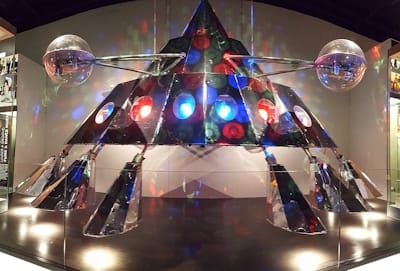
Another exemplary Afrofuturist musician is George Clinton, who has served as the bandleader of funk groups Parliament and Funkadelic, and the Parliament-Funkadelic Collective (a combination of both bands) since the late 1960s. Clinton and his collaborators developed an experimental type of funk music that references the aesthetic of science fiction, cosmology, and psychedelia. In 1975, Clinton and Parliament-Funkadelic released the album Mothership Connection, a concept album based on human exploration of outer space. The album embraced Afrofuturism by imagining a futuristic fleet of Black cosmonauts, spreading funk throughout the universe. Clinton reflects that: "we had put black people in situations nobody ever thought they would be in, like the White House. I figured another place you wouldn't think black people would be was in outer space. I was a big fan of Star Trek, so we did a thing with a pimp sitting in a spaceship shaped like a Cadillac, and we did all these James Brown-type grooves, but with street talk and ghetto slang." During live performances, a giant spaceship (the mothership) would land on the stage.
Black Panther

The July 1966 issue of Fantastic Four #52 by Stan Lee and Jack Kirby introduced one of Marvel Comics’ most popular protagonists named T'Challa who is most commonly known as Black Panther. Although Lee and Kirby were white-Jewish writers, their depiction of T’Challa and the Black Panther narrative was indicative of Afrofuturist ideologies, most notably the envisioning of futuristic narratives involving Black utopianism. The character’s prowess and assertive identity eschewed the racist stereotypes often used to depict Black figures in animation and comics. Black Panther was a timely work of art and literature with socially conscious undertones in support of the Black Power movement and fight for civil rights.
T’Challa was a king and his role included protecting the fictional African country of Wakanda. Like many other superheroes of his era, he was endowed with unique powers. Ancient Wakandan rituals and cultural experiences helped him to develop superhuman strength, intelligence, and agility. T’Challa combined his spiritual beliefs and African heritage with contemporary disciplines such as applied science. The Wakandan nation’s strong economy and advanced technological and scientific prowess aided T’Challa’s efforts as a leader and protector.
T’Challa was the first mainstream Black superhero, predating other major Marvel superheroes from the African diaspora such as The Falcon (1969), Luke Cage (1972), Blade (1973), and Storm (1975).
South African journalist Lynsey Chutel notes how important the character of Black Panther was to United States culture at the time he debuted. She writes, “a highly powerful and extremely intelligent black character from Africa and fighting in the United States was groundbreaking for its time, not only politically but artistically. From their inception, cartoon images, and later comic culture, echoed the beliefs of the society that drew and read them. In the early twentieth century, racism was not only policy, it was also pop culture.”
Black to the Future
Mark Dery’s 1993 essay, “Black to the Future,” was the first instance of Afrofuturism being contextualized. The essay is a critical analysis of Black science fiction, with Dery breaking down the common elements within the genre. He dubbed these facets “Afrofuturism.”
Other notable critics of Afrofuturism include Alondra Nelson, Greg Tate, Tricia Rose, and Kodwo Eshun. Eshun gives an account of the term Afrofuturism in his 1998 book, More Brilliant than the Sun: Adventures in Sonic Fiction:
“Afrofuturism comes from Mark Dery's '93 book [Flame Wars], but the trajectory starts with Mark Sinker. In 1992, Sinker starts writing on Black Science Fiction; that's because he's just been to the States and Greg Tate's been writing a lot about the interface between science fiction and Black Music. Tate wrote this review called "Yo Hermeneutics" which was a review of David Toop's Rap Attack plus a Houston Baker book, and it was one of the first pieces to lay out this science fiction of black technological music right there. And so anyway Mark went over, spoke to Greg, came back, started writing on Black Science Fiction. He wrote a big piece in The Wire, a really early piece on Black Science Fiction in which he posed this question, "What does it mean to be human?" In other words, Mark made the correlation between Blade Runner and slavery, between the idea of alien abduction and the real events of slavery.”
Tate was a polymath. Among other creative and critical pursuits, he was a futurist, musician, poet, and a scholar of the Black Arts Movement. His writing focuses on American music and culture from the Black diaspora. He is renowned for his unique and scholarly takes on Hip Hop, which helped the genre become more critically acclaimed. Tate has spoken extensively on the genre of Afrofuturism and the integration of science fiction within Black music and art. He stated that Afrofuturism connects “the dots of people, across literature, film, music, politics and historical events in the black community.”
Alondra Nelson’s critical writing about the confluence of Black identity and technology is also important to address the concept of “digital divide” and its impact on race and ethnicity. In 1998, while a graduate student at New York University, Nelson created an online forum for advancing the discourse around Black science fiction and other related genres, as well as technological advancements among the African diaspora.
Visual Artists and Afrofuturism
Like their musical and literary counterparts, Black visual artists working within Afrofuturism merge disciplines such as science, philosophy, and religion in a manner that envisages a Black future arising from Afro-diasporic experiences. Key examples of visual art reflecting the Afrofuturist theme are album covers for spiritual and astral jazz albums, like Miles Davis’ Agharta album released in 1975. The artwork by Japanese artist Tadanori Yokoo symbolically visualizes an advanced civilization. There are representations of Afrofuturism, Eastern subterranean realm myths (an underground world beneath the Earth), and ufology.
In 1972, musician Herbie Hancock collaborated with visual artist Robert Springett. The album covers that Springett designed reflected Hancock’s shift toward Afrofuturist music and Pan-African ideologies. For the cover of Crossings (1972), a group of robed elders are gathered on the shore of an unknown landscape. In the middle ground, two men are pulling a boat onto the beach. Hancock explains the imagery, “there are Africans that are pulling a boat up on a beach-that kind of primitive element, although the music itself is very modern and avant-garde. There’s a rawness, too, that is kind of a tie-in with the primitive and the kind of exploratory nature of stepping into areas of the unknown. The [cover and music] relate to each other in that sense.”
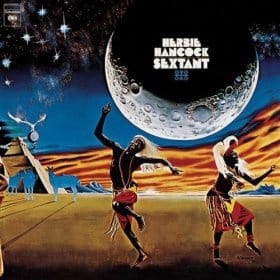
Springett’s art on Hancock’s 1972 album, Sextant (named after a tool used for navigation), is an even more elaborate example of the Afrofuturist aesthetic. The cover depicts an elaborate imagining of a multicultural world. There are aspects of the African diaspora, which is evident in the foreground and middle ground of the landscape. Most notably, two Black dancers dressed in colorful clothing are performing a tribal dance. There are blue animals behind them who resemble zebras or Namib Desert horses (feral horses of the African plains). These distinctly African features are accompanied by other cultural representations including a Ziggurat-like pyramid. There is also an Eastern theme, which is referenced via a bust of the Buddha. The most accentuated element of Springett’s cover art is the celestial forms looming over the entire landscape. Stars in constellations glisten above on the top right-hand side, while a crescent moon comprises nearly half of the picture plane. Music critic Tony Scherman wrote in Rolling Stone magazine that via the album, “Hancock went even further into outer space [...] much of Sextant, with its twittering, burbling effects, amounts to a primitive version of Nineties ambient music."
One contemporary artwork exemplary of Afrofuturism’s fusion of Black identity and cosmological concepts is Betye Saar’s Black Girl’s Window, an assemblage from 1969. The artwork is replete with celestial symbols and signs, as well as both personal and collective references to Black cultural experiences. Other contemporary artists whose work can be considered Afrofuturism are Eugene Ankomah, Renee Cox, Ellen Gallagher, Angelbert Metoyer, Wangechi Mutu, and Rashaad Newsome.

An example of art curation encompassing Afrofuturism is Before Yesterday We Could Fly, a period room installation at the Metropolitan Museum of Art in New York, that imagines the life of a resident from New York historical Seneca Village, a nineteenth century Black settlement in modern-day Central Park. Seneca Village was a flourishing neighborhood that provided sanctuary and prosperity to New York city’s Black population. By the mid-1850s, the neighborhood had around fifty homes, three churches, a school, and several gardens, as well as cemeteries. It was notable as a community where Black residents could own property, run their own businesses, and provide a variety of services that led to their overall prosperity.
Before Yesterday We Could Fly eschews the Eurocentric nature of traditional period rooms. Unlike conventional period rooms, which contain nearly accurate and precise renderings of the past, Before Yesterday We Could Fly takes a conceptual approach. The installation provides a glimpse of what life would be like for the Black community during the time they lived in Seneca Village and imagines what the community would be like today as well as into the future, had it not been destroyed.
The past, present, and future are represented by an amalgamation of objects from the museum’s collection of African art from the seventeenth century to present day, as well as via three commissioned works by Njideka Akunyili Crosby, Fabiola Jean-Louis, and Jenn Nkiru. Praising the exhibition’s content and context, African American Studies scholar Salamishah Tillet wrote that it “underscores the toll of the city's loss, and the consequences of denying Black people the ability to pass on their wealth across generations." She adds that the recontextualization of the period room from a whitewashed historical trope to an alternative narrative considers, "how the racial contradictions of New York City's history and the utopian aspirations of Seneca Village continue to shape our country today."
Concepts and Styles
Pan-Africanism
Afrofuturism’s exploration of Black identity relates to the sociocultural theory of Pan-Africanism, a concept of Black Nationalism that calls for social and cultural unity among all Black members of the worldwide African diaspora. Through literature, music, and visual art, Afrofuturism envisions the Black transcendence from trials and tribulations such as slavery and white supremacy.
The Afrofuturist genre provides ample examples of potential Black utopias that represent collective expressions of Black strength, culture, and ingenuity. In light of past and present struggles, it presents an uplifting and unifying message and means for Black people to see themselves in the future. Artist and author D. Denenge Duyst-Akpem explains, “we need to represent Blackness and Black people within every realm. We need to be able to see that that imagination is key, and representation has to do with allowing ourselves to be able to let our imaginations take flight.”
Examples of this concept within visual artworks include Alisha Wormsley’s There Are Black People in the Future, which are billboard sized, text-based, public art campaigns expressing the pride, strength, and resilience of the African diaspora; and Wangechi Mutu’s sculptural forms, which are futuristic and imaginative renditions of art and cultural objects made by Indigenous peoples of Africa.
Black Science Fiction
Historically, the science fiction genre has been overwhelmingly marginalizing to Black culture. Afrofuturism seeks to correct the historical omission of Black identities and narratives within the science fictional canon. Using tropes and imagery that are generally indicative of science fiction, Afrofuturism transforms the canon of sci-fi into conceptualized visions and messages which prompt viewers to consider what Black futures might look like.
In Mark Dery’s essay “Black to the Future,” he notes that many of the real-world concerns that African Americans have faced and continue to face are among the most common tropes in the science fiction genre. These recurring concepts include the “strangers in a strange land” theme, which has often been portrayed as humans being transplanted among alien races and strange unfamiliar territory (i.e. in Star Trek, Lost in Space, and Raised by Wolves). In Black history, the concept of “strangers in a strange land” has been actualized through slavery, forced migration, and displacement due to gentrification or other socioeconomic conditions. In the forward to the book Octavia's Brood, editors adrienne maree brown and Walidah Imarisha write: “For those of us from communities with historic, collective trauma, we must understand that each of us is already science-fiction walking around on two legs. …We think of our ancestors in chains, dreaming of a day when their children’s children’s children would be free. They had no reason to believe this was likely. But together they dreamed of freedom. And they brought us into being.”
Examples of Black science fiction include the creation of fictional utopias, such as Black Panther’s Wakanda, where people of the African diaspora are all welcome and live in peace and prosperity, as well as author Octavia Butler’s Earthseed communities in her Parable series. These environments seek to repair more than 500 years of displacement due to colonialism, slavery, Apartheid, and segregation.
African Cosmologies and Religions
From prehistory through the present-day, cosmology has played an important role in the daily lives and spiritual beliefs of African nations. Philosopher Barry Hallen writes that “Africa's indigenous religions and cosmologies are neither dying, nor are they operating as anachronisms. They have proved themselves capable of adapting to changing circumstances over which they may have little or no control.”
The African continent is expansive with more than 3,000 tribes and 2,000 languages and dialects. Each of the distinct African ethnic groups have a complex and fluctuating system of myths, rituals, and religion that explore both natural and metaphysical phenomena.
Afrofuturism explores elements of the diverse African belief systems in order to present a futuristic vision of Black intersectional identity. In works within the genre, spirituality is often a conduit to advance notions of Black liberation and unity.
These concepts are exemplified in visual artworks by contemporary artists like Betye Saar and Cyrus Kabiru. Saar’s work in sculpture and assemblage combines political, social, and cultural facets to present the plurality of the Black experience and the African diaspora. In her mixed-media sculpture titled The Trickster (1994), Saar creates a symbolic representation of Eshu, a deity of the Yoruba people from West Africa (parts of Nigeria, Benin, and Togo). Eshu is a mischievous figure who also functions as a protector. Saar’s rendition of Eshu is presented as a largely abstract totem created out of the form of an antique heater, which she adorned with a necklace of bells, chains, and vintage keys.
Cyrus Kabiru’s sculptural artworks combine traditional forms with technology to envision a futuristic evolution of African diasporic art and culture. His art is often constructed to function as masks or eyewear that embody futuristic garments of the African diaspora. The titles generally reference his own Kenyan heritage, as well as places he has traveled.
Earthseed Community
Octavia E. Butler’s science fiction novels Parable of the Sower and Parable of the Talents introduced the concept of Earthseed, which is a fictional religion based on the idea that “God is change.” In the books, the main protagonist named Lauren Oya Olamina is a resident of a company town, which was created in response to the economic and political dissolution of the United States. After a series of social and environmental disruptions, the entire country was relegated to live within a series of city states. These localities often fight over the use of land and the few remaining natural resources.
Lauren is an empath, which means that she feels physical pain whenever her community experiences traumatic events. She was raised in a religious household but finds that the old religion is not providing her and the community with a sense of hope or a mechanism for coping with their current situation. In order to survive and transcend the current reality, she develops a spiritual belief system that enables humans to dictate social and cultural change by shaping God’s malleability. Believers in the religion are prompted to shape God through conscious efforts that enact transformative change in their own lives and the lives of their fellow citizens. The ultimate goal among the Earthseed followers is to “take root among the stars.” In other words, to inhabit other planets.
Although it is fictional, the Earthseed concept has inspired actual spiritual movements such as the Terasem Movement, which attempts to “shape God” through technological development, thereby bridging together science and religion.
Traditional religion and various forms of spiritual practice are also common themes among Afrofuturist works of art. This is notable in the aforementioned astral jazz compositions by John Coltrane and Sun Ra, as well as the visual art compositions of Betye Saar. Other visual artists such as Ellen Gallagher and Carla Jay Harris reinterpret traditional mythology from global civilizations including Ancient Greece, in order to create new myths and narratives reflective of Black identity and multiculturalism.
Later Developments - After Afrofuturism
In 2018, the narrative of Black Panther was released by Marvel Studios as a major motion picture film. Its box office success and critical acclaim brought Afrofuturism further into mainstream culture. Lauded for its screenplay, acting, and special effects, Black Panther became the first superhero film to receive a Best Picture nomination during the 91st Academy Awards. The film addresses the main tenets of Afrofuturism including the integration of Pan-Africanism, advancements in technology, science, and wellness. United representations of cultural identity throughout the African diaspora include Ruth E. Carter’s costume design, which incorporates elements of Maasai, Himba, Dogon, Basotho, Tuareg, Turkana, Xhosa, Zulu, Suri and Dinka people. The film also addresses the ongoing issue of museums acquiring and owning African artifacts with dubious provenances.
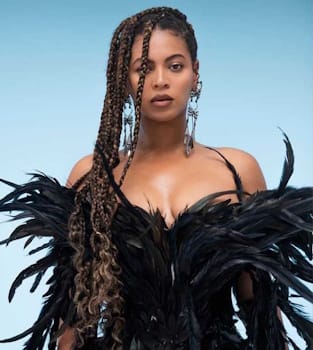
Beyoncé's Black Is King is another multimedia narrative that explores Black unity and power through an Afrofuturist perspective. Released in 2020 as both a conceptual album and a feature length film, Black Is King is the singer/songwriter’s tribute to past and present Blackness. The film is also a conceptual interpretation on the story of The Lion King. Through audio-visual vignettes, Black Is King highlights spiritual, mythological, and intellectual insights attributed to the African continent and its people throughout ancient, modern, and contemporary history. The film’s aesthetics and performative rituals such as song and dance incorporate elements from indigenous tribes such as the Maasai, from East Africa.
A large part of the film’s prowess comes from its subversion of power dynamics. Writer Natty Bakhita Kasambala notes: “From the country house to the renaissance supper table or the synchronized swimming sequences, it’s clear that Black Is King sought to fill historically White Spaces with an unfiltered, unapologetic Blackness. Not because ‘rich’ Black people are so unheard of or to yearn for respectability and upward social mobility within the current structures – African American debutantes, for example, have been happening for decades – but I think the statement is made more to disrupt. To depict the full breadth of possibilities for Black people not just in America but across the entire diaspora, to offset the often-complex relationship between Africa and its descendants across the globe.”
Due in part to the contributions of Black artists in the entertainment field, Afrofuturism has also impacted education. Some STEAM learning (a transdisciplinary confluence of Science, Technology, Engineering, Art, and Math) curricula, such as Pittsburgh-based learning center Assemble’s K-12 programming, have incorporated themes from Afrofuturism in order to include contributions to each of these fields from the African diaspora. Assemble’s educators are teaching artists who teach students about STEAM-related innovations by individuals and groups within the African diaspora. The program embraces the framework of Afrofuturism by looking back at the history of Black innovation in art, technology, and applied science, and prompting the students to imagine a future that incorporates and expands upon these innovations in order to envision an ideal future for themselves and their peers.
Useful Resources on Afrofuturism
- More Brilliant than the Sun: Adventures in Sonic FictionBy Kodwo Eshun
- Afrofuturism: The World of Black Sci-Fi and Fantasy CultureBy Ytasha Womack
- Blackspace: On the Poetics of an AfrofutureBy Anaïs Duplan


