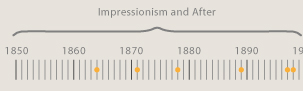
ACADEMY REALISM AESTHETIC MOVEMENT IMPRESSIONISM MODERN SCULPTURE SYMBOLISM POST-IMPRESSIONISM NEO-IMPRESSIONISM ART NOUVEAU   Founding of Hague School of
painting; in existence until 1890 A group of fourteen students leave
the Imperial Academy of Arts, Russia,
forming independent artistic society
known as the “Peredvizhniki” Establishment of Moscow School
of Painting, Sculpture and
Architecture, one of largest
educational institutions in Russia Leo Tolstoy’s War
and Peace published Peredvizhniki form the
Association of Traveling
Exhibitions, in existence
until 1923 First Impressionist
exhibition, Paris Eighth and last
Impressionist
exhibition, Paris Berlin Secession founded as
alternative to conservative,
state-run Association of Berlin Artists   Jews granted civil
rights in every
part of Germany,
except Bavaria Jews emancipated
in England Jews given equal rights in
Russian-controlled Congress Poland Ku Klux Klan organized to
maintain "white supremacy" Jews emancipated in Germany The First Aliyah, first major
wave of Jewish immigrants to
build a homeland in Palestine;
lasts until 1903 Educational Alliance
founded on New
York’s Lower East
Side to assist
Eastern European
immigrants French artillery officer Alfred Dreyfus
tried and convicted of treason based
on fabricated evidence—an event
later known as the Dreyfus Affair First Zionist Congress held in Basel, Switzerland   Emancipation of
Russian serfs January Uprising: Polish-Lithuanan
Commonwealth’s revolt against
the Russian Empire Austro-Prussian War, which results in
dissolution of German Confederation and
creation of North German Confederation
and Austro-Hungarian Dual Monarchy Franco-Prussian War;
lasts until 1871 Russo-Turkish War;
ends in 1878 Tsar Alexander II
assassinated France and the Russian
Empire sign military alliance   Russian critic Vladimir Stasov
and artist Mark Antokolsky begin
exploring concept of developing
a handicraft-inspired Jewish art Beginning of strict quotas on Jews
in Russian educational institutions;
culminates in establishment of
formal quota system in 1887 Sholem Aleichem begins writing first
episode of life of Tevye the Dairyman First Jewish museum
opens in Vienna Yehuda Pen founds first Jewish art
school in Russian Empire, School
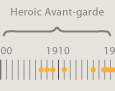
of Drawing and Painting, in Vitebsk | MODERN PHOTOGRAPHY CUBISM FUTURISM COLLAGE READYMADE SUPREMATISM DADA DE STIJL The Russo-Japanese War—“the
first great war of the twentieth
century”—begins; ends in 1905 Russian Revolution of 1905 Peak year for European immigration
to the United States, with roughly
1,285,000 individuals entering the country Archduke Franz Ferdinand
assassinated, leading to
start of World War I World War I
ends Amedeo Modigliani arrives in Paris, among
the many foreign artists to resettle in
this city in the early decades of the
twentieth century and form what comes to
be known as the “École de Paris” El Lissitzky creates his first
Proun, an acronym for “Project
for the Affirmation of the New.” Blood libel case Beilis
Affair begins in Russia;
lasts until 1913 American Jewish Relief Committee established
to distribute funds to needy Jews; later
combined with other Jewish relief organizations
to become Joint Distribution Committee Start of third major wave
of pogroms; lasts until 1920 Magazine Ost und West, which
regularly features articles
on East and West European Jewish
artists, founded in Berlin Bezalel School, which lends
name to first Israeli art
movement, founded in Jerusalem Jewish Historical and Ethnographic
Society founded in St. Petersburg Jewish Society for the
Encouragement of the
Arts formed in Petrograd Hebrew theater Habimah
founded in Moscow Yiddish cultural organization
Kultur Lige established in Kiev State Jewish Chamber
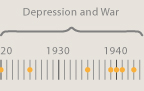
Theater founded in Moscow | CONSTRUCTIVISM SURREALISM BAUHAUS ART DECO NEUE SACHLICHKEIT/ NEW OBJECTIVITY TOTALITARIAN ART SOCIAL REALISM WELDED METAL SCULPTURE Soviet Union
officially
established Passage of Immigration Act in
U.S., aimed, like the Emergency
Quota Art of 1921, at restricting
the flow of Southern and Eastern
Europeans into the country Adolf Hitler
publishes Mein Kampf Stock Market crash,
signaling the start
of the Great Depression Franklin D. Roosevelt
elected U.S. President Comintern announces policy
of Popular Front in response
to rising threat of fascism Spanish Civil War starts Anschluss: Nazi Germany
annexes Austria Germany invades
Poland, starting
World War II Start of German occupation
of Paris; collaborationist
Vichy regime established Japanese forces bomb
Pearl Harbor; U.S.
enters World War II World War II
ends Term “École de Paris” coined
to describe group of foreign
painters that resettled in the
city in the years preceding and
immediately following World War I Museum of Modern Art
opens in New York Nazis close
down the Bauhaus Socialist Realism
proclaimed as only
permissible style
of Soviet art Roosevelt administration
creates Works Progress
Administration and Farm
Security Administration Walter Benjamin writes “The
Work of Art in the Age of
Mechanical Reproduction” Paris Exposition Internationale
des Arts et Techniques dans la
Vie Moderne (“Paris World’s Fair) Works Progress
Administration closes Farm Security
Administration closes Adolf Hitler comes to power
in Germany, leading to a mass
exodus of Jews, mostly to neighboring
countries, particularly France Soviet government establishes
Jewish Autonomous Oblast
in Birobidzhan to give Jews
their own “unity of territory” Kristallnacht: Jews
attacked throughout Nazi
Germany and parts of
Austria, November 9–10 Jewish refugees on SS.
St. Louis denied American
sanctuary by the U.S.
government, forcing the
ship’s return to Europe News of systematic
extermination of
Jews in Nazi death
camps reaches
throughout the world Degenerate Art Exhibition Marc Chagall and Jacques Lipchitz
flee Nazi-controlled France for
the U.S., among the many European
artists and intellectuals so
helped by Varian Fry and
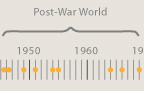
Emergency Relief Committee | ART INFORMEL ABSTRACT EXPRESSIONISM KINETIC ART OP ART ASSEMBLAGE POP ART FLUXUS ARTE POVERA MINIMALISM POST-MINIMALISM CONCEPTUAL ART Joseph Stalin dies Treaty of Rome signed,
leading to formation of
European Economic
Community
the following year Nikita Khrushchev
appointed Soviet Premier Fidel Castro becomes
Prime Minister of Cuba John F. Kennedy elected U.S. President Cuban Missile Crisis JFK assassinated; Lyndon
B. Johnson succeeds
to U.S. presidency Leonid Brezhnev takes over
as leader of Soviet Union Women’s Strike for Equality
held throughout U.S. House Un-American Activities Committee holds
nine days of hearings into alleged Communist
influence in the Hollywood motion-picture industry Barnett Newman paints Onement I Jackson Pollock creates
some of his most
famous drip paintings Harold
Rosenberg’s
essay “American
Action Painters”
appears in
ARTnews Vladimir Nabokov’s Lolita published
in Paris; appears in New York in 1958 Jackson Pollock dies in car crash Boris Pasternak’s novel Doctor
Zhivago first published;
Pasternak awarded Nobel Prize
for it the following year Joseph Kosuth creates
One and Three Chairs Survey of Minimalism,
Primary Structures,
at the Jewish Museum,
New York Joseph Kosuth’s
essay "Art After
Philosophy" published Hermann Goring commits suicide
two hours before scheduled
execution of first major group
of Nazi war criminals at Nuremburg General Assembly of the United Nations adopts
partition plan for Palestine, calling for
division into Jewish and Arab states, with
Jerusalem-Bethlehem to be administered by the UN Following its nationalization of Suez Canal,
Egypt blockades the Gulf of Aqaba, closing the
Suez Canal to Israeli shipping. Israel, England,
and France go to war and force Egypt to end
blockade and open the canal to all nations Adolf Eichmann
captured in
Argentina by Israeli
Secret Service Eichmann tried in Jerusalem
for crimes against the
Jewish people, crimes
against humanity, and war
crimes; hanged In Ramla,
the following year Vatican II revolutionizes
Christian-Jewish relations Six-Day War between Israel
and neighboring states of
Egypt, Jordan, and Syria Primo Levi publishes If This Is a Man,
account of his year as a prisoner at Auschwitz Yad Vashem, Israel’ official
memorial to the Jewish victims
of the Holocaust, established
through Yad Vashem Law passed
by the Knesset Alain Resnais directs French
documentary short film Night and Fog,
featuring abandoned grounds of Auschwitz
and Majdanek and describing
lives of prisoners in the camps Elie Wiesel’s account of his and
his father’s experiences as
prisoners at Auschwitz and Buchenwald,
appears in France as La Nuit;
published in U.S. as Night in 1960 Hannah Arendt, a Jew who
fled Germany during Adolf
Hitler's rise to power and
reported on the Eichmann
trial for The New Yorker,
publishes Eichmann
in Jerusalem Harold Rosenberg, major art critic
associated with Abstract Expressionism,
delivers talk “Is There a Jewish Art?”
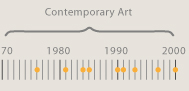
at New York’s Jewish Museum | PERFORMANCE ART LAND ART GRAFFITI ART NEO-EXPRESSIONISM Vietnam War ends SALT II Treaty signed by Jimmy
Carter and Leonid Brezhnev Ronald Reagan elected U.S. President Leonid Brezhnev dies Mikhail Gorbachev
becomes head of
Soviet Union Fall of Berlin Wall Bill Clinton elected
U.S. President Bill Clinton reelected
U.S. President Linda Nochlin publishes
groundbreaking essay “Why
Have There Been No Great
Women Artists?” in ArtNews Joseph Beuys stages
groundbreaking performance
I Like America and America
Likes Me at Rene Block
Gallery, New York First issue of the
feminist art magazine
Heresies published Pablo Picasso's
Guernica(1937)
sent to Madrid,
after being on
extended loan at
New York's MoMA
since 1939 Christo and Jeanne-Claude complete one
of their major projects, Surrounded
Islands, in which they surround
islands in Miami’s Biscayne Bay
with pink polypropylene fabric Following eight-year-long
controversy surrounding
Richard Serra’s Tilted Arc
(1981), the sculpture is
dismantled and then consigned
to a New York warehouse Vincent Van Gogh’s Portrait
of Dr. Gachet (1890) sells
at Christie’s auction
for $82.5 million The exhibition Sensation: Young
British Artists from the Charles
Saatchi Collection provokes
major scandal in New York, after
previous scandal in London Start of large-scale emigration
of Jews from Soviet Union, when
about 13,000 Soviet Jews and
their relatives leave the country Munich Massacre: members of Israeli
Olympic team taken hostage and
then killed at Munich Olympics by members
of Palestinian group Black September Yom Kippur War Comprehensive peace treaty Camp
David Accords signed by Israeli
Prime Minister Menachem Begin and
Egyptian President Anwar Sadat Start of First Intifada,
Palestinian uprising
against Israeli occupation
of Palestinian Territories Madrid Conference, early
international attempt to
launch Middle East
peace process Oslo Accords, an outgrowth of Madrid
Conference, seeking to resolve
Palestinian-Israeli conflict; signed
in presence of PLO chairman
Yasser Arafat, Israeli
Prime Minister Yitzhak Rabin,
and U.S. President Bill Clinton Yitzhak Rabin assassinated Jewish artists’ group Aleph
formed in Leningrad to
exhibit “a group of works
linked to the spirit and life
of the Jewish people and its
national and cultural traditions Isaac Bashevis Singer awarded
Nobel Prize in Literature French filmmaker Claude Lanzmann
completes Shoah, nine-hour thirty-six
minute documentary film about the Holocaust Elie Wiesel wins
Nobel Peace Prize Steven Spielberg directs Schindler's
List, about the German businessman
who saved the lives of more than a
thousand mostly Polish-Jewish
refugees during the Holocaust United States Holocaust Memorial
Museum, official U.S. memorial to
the Holocaust, opens in Washington,
D.C., adjacent to the National Mall |


 Ask The Art Story AI