A tendency among mainly New York painters after World War II, all of whom were committed to an expressive art of profound emotion and universal themes, Abstract Expressionism embraces the spacial breakthroughs of Jackson Pollock, color field painting of Mark Rothko, as well as the gestural abstraction of Willem de Kooning. Most were inspired by Surrealism and abstract art to create a new style fitted to the post-war mood of anxiety and trauma. Their success set the stage for America's post-war dominance of the international art world.
Art Nouveau was a movement that swept through the decorative arts and architecture in the late 19th and early 20th centuries. Artists drew inspiration from both organic and geometric forms, evolving elegant designs that united flowing, natural forms with more angular contours.
Arte Povera is a style of modern art. The term was introduced in Italy during a period of upheaval at the end of the 1960s. The term centered on a group of Italian artists who attacked established institutions with art made from unconventional materials. They often used found objects in their works.
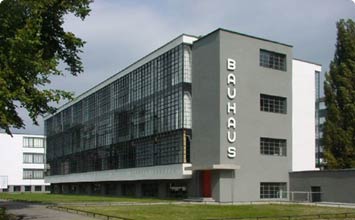
Bauhaus is a style and movement associated with the Bauhaus school, an extremely influential art and design school in Weimar Germany that emphasized the functionality and efficiency of design alongside its material properties. Prominent teachers include Josef Albers, Walter Gropius, Wassily Kandinsky, Ludwig Mies van der Rohe, and Paul Klee.
A tendency within Abstract Expressionism, distinct from gestural abstraction, color field painting was developed by Barnett Newman, Mark Rothko, and Clyfford Still in the late 1940s, and developed further by Helen Frankenthaler and others. It is characterized by large fields of color and an absence of any figurative motifs, and often expresses a yearning for transcendence and the infinite.
The practice of Conceptual art became popular after the 1960s and presented people with an idea about art, which was more significant than the completion of a tangible and traditional work of 'art'. The aim was to create a concept that obliged people to consider the nature of art itself, and decide for themselves whether what was present was a work of art.
Contructivism was a movement that emerged in Revolutionary Russia among such artists as Vladimir Tatlin, Aleksander Rodchenko, Antoine Pevsner, and Naum Gabo. Celebrating 'art as machine,' it emphasized space, construction, and industrial materials.
Cubism was first developed by Pablo Picasso and Georges Braque between 1907-1911. Its classic phase has two stages: 'Analytic', in which forms seem to be 'analyzed' and fragmented; and 'Synthetic', in which foreign materials such as newspaper and wood veneer are collaged to the surface of the canvas. The style attracted many adherents, both in Paris and abroad, and it would later influence the Abstract Expressionists, particularly Willem de Kooning.
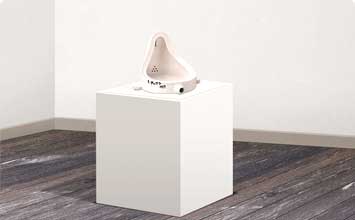
Dada emerged in the early twentieth century as a literary and artistic movement that celebrated random chance, readymade artworks, and outragous performances. Its practitioners, including Hugo Ball, Tristan Tzara, and Marcel Duchamp, scorned bourgeois conventions of high culture, especially the appreciation for artistic intention and skill.
Founded in the Netherlands in 1917, De Stijl was an avant-garde dedicated to isolating a single visual style that would be appropriate to all aspects of modern life, from art to design to architecture. Taking its name from a periodical, its most famous practitioners were Theo van Doesburg and Piet Mondrian, whose mature art employed geometric blocks of primary colors and vertical and horizontal lines.
Expressionism is a broad term for a host of movements in early twentieth-century Germany, from Die Brücke (1905) and Der Blaue Reiter (1911) to the early Neue Sachlichkeit painters in the 20s and 30s. Many German Expressionists used vivid colors and abstracted forms to create spiritually or psychologically intense works, while others focused on depictions of war, alienation, and the modern city.
Fauvism was an early twentieth-century art movement founded by Henri Matisse and André Derain. Labeled "les fauves" or "wild beasts" by critic Louis Vauxcelles, the artists favored vibrant colors and winding gestural strokes across the canvas.
Feminist art emerged in the 1960s and '70s to explore questions of sex, power, the body, and the ways in which gender categories structure how we see and understand the world. Developing at the same time as many new media strategies, feminist art frequently involves text, installation, and performance elements.
Fluxus was an international network of "intermedia" artists of the 1960s who worked in fields ranging from music to performance to the visual arts. Taking their name from the Latin "to flow," Fluxus artists adopted an often anarchic and satirical approach to conventional forms of art, and their ideas paved the way for Conceptual art.
Futurism developed in interwar Italy as an ideology that celebrated the speed, movement, machinery, and violence of modern times. Blending realism with collage and Cubist abstraction, its visual components include lines of force and dynamism to indicate objects moving through space.
The term "happening" was coined by artist Allan Kaprow in 1957 to decribe a series of multi-media artworks on display in a single locale. In general, a happening is an art event, often staged or pre-scripted, that requires active participation from an audience to come to full fruition. This relatively new form of artistic media could be called participatory.
Hard-edge painting, emerging in the 1950s and 60s, departs from the gesture and scrawl of Abstract Expressionism to favor blocks of color with well-defined edges.
Impressionism emerged in the mid-nineteent century in opposition to the finished style of academic painting. It often depicted scenes of daily life, and used painterly strokes and shifting color areas to capture the effects of light and atmosphere.
Kinetic art is usually a sculptural construction comprised of moving components, powered by wind, a motor or the viewers themselves. Its kinesis is what gives the artwork its overall effect, hence the name. The first artwork generally credited as Kinetic Art was Marcel Duchamp's Bicycle Wheel (1913). Some of the medium's most famous practitioners include Alexander Calder, Naum Gabo and Jean Tingeuly.
Minimalism emerged in the 1960s in response to the gestural and autographic excesses of Abstract Expressionism. Its early practitioners constructed huge geometric objects, serial structures, and simplified gridded planes.
Neo-Dada refers to works of art from the 1950s that employ popular imagery and modern materials, often resulting in a subtle commentary on the contemporary world. Neo-Dada is both a continuation of the earlier Dada movement and an important precursor to Pop art. Some important Neo-Dada artists include Robert Rauschenberg, Jasper Johns, Robert Morris and Allan Kaprow.
Neo-Expressionism began as a movement in German art in the early 1960s with the emergence of Georg Baselitz. It gained momentum in the 1970s, with the addition of painters such as Anselm Kiefer, Markus L??tz and Eugen Sch??eck. Drawing inspiration from German Expressionism, many of its practitioners focussed on the country's troubled modern history. In the 1980s, it inspired many successful painters across the world, including Julian Schnabel.
Op art, short for Optical art, is a style of abstraction that relies on geometric shapes, lines, and color juxtapositions to create optical illusions for the viewer. Gaining popularity in the 1960s, such art often features patterns, grids, and effects like curving or diminishing objects.
Performance art is a modern form of art that emphasizes the experiential and the relationship between performer and audience. It developed in the 1960s with such artists as Yves Klein, Joseph Beuys, Marina Abramovic and Allan Kaprow. Not to be confused with the performing arts (dance, theater and music), Performance art is closely related to Conceptual art, in which any inherent meaning is in the eye of the beholder.
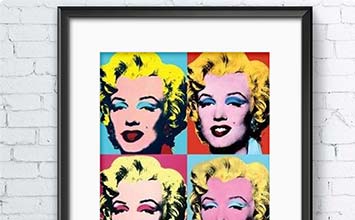
Pop art was a movement that developed in 1950s America in response to Abstract Expressionism's emphasis on formal qualities and inner expression. Artists like Jasper Johns, Robert Rauschenberg, Andy Warhol, and Roy Lichtenstein tried to subvert the artist's hand through techniques like serial printing, everyday materials, and pop culture imagery.
Post-Impressioism refers to a host of artists and styles that emerged after Impressionism in the late nineteenth century. Although diverse in style, they tend to share an emphasis on intense, sometimes arbitrary, colors, expressive forms, and painterly brushstrokes.
Post-minimalism in the visual arts refers to works created in the late-20th century that share the formalist or "pure" qualities of older Minimalist works. Unlike Minimalism, Post-minimalism does not always rely on formalist or linear aesthetics, and is often placed in public settings. Some of the movement's artists include Anish Kapoor, Damien Hirst and Eva Hesse.
Post-Painterly Abstraction was a term developed by critic Clement Greenberg in 1964 to describe a diverse range of abstract painters who rejected the gestural styles of the Abstract Expressionists and favored instead what he called "openness or clarity." Painters as different as Ellsworth Kelly and Helen Frankenthaler were described by the term. Some employed geometric form, others veils of stained color.
Suprematism was founded by Russian artist Kazimir Malevich in 1915. Using geometric shapes--as simple as a black square on a white ground or as complex as myriad bars, trapezoids, and circles arranged in space--Suprematism sought to convey the fundamental and transcendent properties of art.
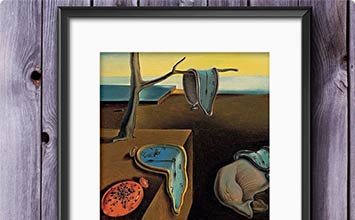
Perhaps the most influential avant-garde movement of the century, Surrealism was founded in Paris in 1924 by a small group of writers and artists who sought to channel the unconscious as a means to unlock the power of the imagination. Much influenced by Freud, they believed that the conscious mind repressed the power of the imagination. Influenced also by Marx, they hoped that the psyche had the power to reveal the contradictions in the everyday world and spur on revolution.