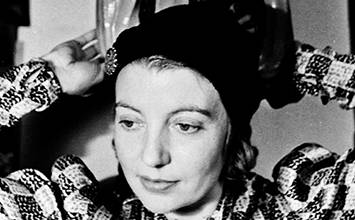
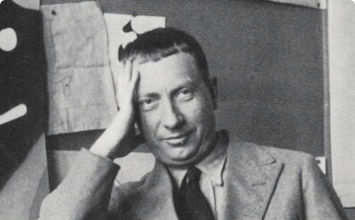
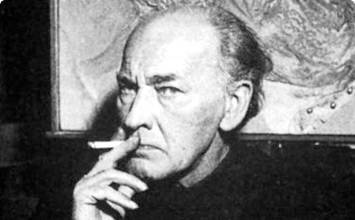
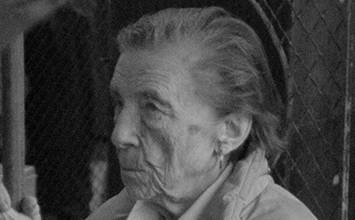
Below are biographies and analysis of the work of the artists who were central to Surrealism. If a major artist is missing from the list, The Art Story has not had a chance yet to research their life and art.
Louise Bourgeois is a French contemporary artist whose work adds a feminist perspective to Surrealism's themes of sex, childhood, and the uncanny. She is best known for her installation 'Cells' and her large-scale spider sculptures.
André Breton, author of the 1924 Surrealist Manifesto, was an influential theorizer of both Dada and Surrealism. Born in France, he emigrated to New York during World War II, where he greatly influenced the Abstract Expressionists.
Alexander Calder was an American artist who made important contributions to abstract sculpture, hanging mobiles, and kinetic art. His work reflects both modern and Surrealist influences.
Joseph Cornell was an American artist, best known for his collage work and "shadow boxes," which were highly complex diorama-like constructions. Cornell incorporated found objects, old photos, newspaper clippings and other objects into these boxes, resulting in uniquely surreal, three-dimensional worlds. Cornell was one of the few American artists associated with Surrealism.
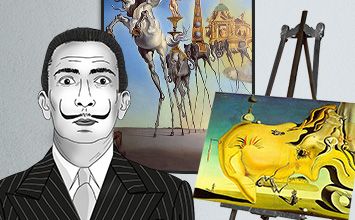
Salvador Dalí was a Spanish Surrealist painter who combined a hyperrealist style with dream-like, sexualized subject matter. His collaborations with Hollywood and commercial ventures, alongside his notoriously dramatic personality, earned him scorn from some Surrealist colleagues.
Giorgio de Chirico was a Greek-Italian painter and sculptor commonly associated with Surrealism. Initially discovered by Picasso and Apollinaire in France, de Chirico's best-known Surrealist paintings incorporated metaphysical subject matter and sculptural still-life. Instead of land- or cityscapes, de Chirico's art is more emblematic of a dreamscape.
The French artist Marcel Duchamp was an instrumental figure in the avant-garde art worlds of Paris and New York. Moving through Dada, Surrealism, readymades, sculpture, and installation, his work involves conceptual play and an implicit attack on bourgeois art sensibilities.
Arshile Gorky was an Armenian-born American painter and was a major influence on the development of Abstract Expressionism. In his own art he fused elements of Cubism, Surrealism and Expressionism, and was close with key figures central to New York's burgeoning abstrct art scene, such as John Graham, Stuart Davis and Willem de Kooning.
The Swiss artist Alberto Giacometti created semi-abstract sculptures that took up themes of violence, sex, and Surrealism. His famous later work is characterized by towering, elongated figures in bronze.
John Graham was a Russian-born American painter and a key figure in the development of Abstract Expressionism. Never adopting a singular style in his own art, Graham tutored many young abstract artists on the tenets of Cubism and Surrealism, of which he was an expert. Willem de Kooning credited Graham as the person who discovered Jackson Pollock.
A member of the German Expressionist group Der Blaue Reiter, and later a teacher at the Bauhaus, Kandinsky is best known for his pioneering breakthrough into expressive abstraction in 1913. His work prefigures that of the American Abstract Expressionists.
Rene Magritte has achieved great popular acclaim for his idiosyncratic approach to Surrealism. His beautiful and troubling images of bowler-hatted men and nature scenes are popular in art and general circles.
Roberto Matta was a Chilean-born artist who lived and worked in New York in the 1940s. His interest in automatism and painterly effects helped forge a crucial link between Surrealism and Abstract Expressionism.
Active in Paris from the 1920s onward, and influenced by Surrealism, Miró developed a style of biomorphic abstraction which blended abstract figurative motifs, large fields of color, and primitivist symbols. This style would be an important inspiration for many Abstract Expressionists.
Isamu Noguchi was a Japanese-American modern artist. Best known for his organic, biomorphic sculpture works, Noguchi was also a furniture designer and landscape artist.
Francis Picabia was a French artist who worked in Dada, Surrealist, and abstract modes, often employing language and mechanical imagery. He published the Dada journal 391 in Barcelona and America.
Picasso dominated European painting in the first half of the last century, and remains perhaps the century's most important, prolifically inventive and versatile artist. Alongside Georges Braque he pioneered Cubism. He also made significant contributions to Surrealist painting, and media such as collage, welded sculpture, and ceramics.
Jackson Pollock was the most well-known Abstract Expressionist and the key example of Action Painting. His work ranges from Jungian scenes of primitive rites to the purely abstract "drip paintings" of his later career.
Man Ray was an American artist in Paris whose photograms, objects, drawings, and other works played an important role in Dada, Surrealism, modern photography, and avant-garde art at large.