Below are biographies and analysis of the work of the artists who were central to Jewish Art. If a major artist is missing from the list, The Art Story has not had a chance yet to research their life and art.
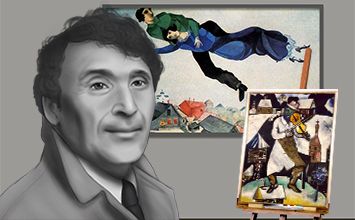
Marc Chagall was a Russian-born, Jewish-French artist that reached great popularity during the 20th century. Although his art is associated with several movements, Chagall is commonly grouped in with the German Expressionists. Much of his early work was credited with synthesizing visual elements of Cubism, Symbolism and Fauvism.
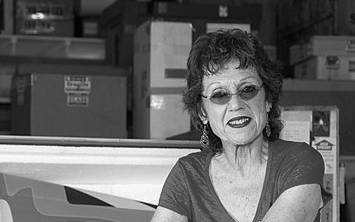
Judy Chicago is an American feminist artist and author. Originally associated with the Minimalist movement of the 1960s, Chicago soon abandoned this in favor of creating content-based art. Her most famous work to date is the installation piece The Dinner Party (1974-79), an homage to women's history.
Philip Guston was a Canadian painter during the 20th century. Initially associated with the New York School of abstract art, Guston famously abandoned pure abstraction in the 1950s and turned to figurative art and quasi-abstract cartoon imagery. His later work, for which he is best known, was a major influence on the development of Neo-Expressionism in the U.S.
Grace Hartigan was an American painter and an important figure among the second generation of Abstract Expressionists. Her paintings are characterized by their rich color and bold mixture of abstract and figurative styles.
Eva Hesse was a major New York artist whose sculpture, assemblage, and installation brought issues of feminism and the body into Minimalism's formal vocabulary. She is heralded as one of the quintessential Post-Minimalist artists.
Allan Kaprow was an American painter, collagist, assemblagist and performance artist. Kaprow was best known for trailblazing the artistic concept "happenings," which were experiential artistic events rather than single works of art.
Lee Krasner was an American abstract painter and a prominent first-generation Abstract Expressionist. A student of Hans Hofmann's, and a pioneer in the all-over technique of painting that later influenced color-field artists such as Frankenthaler, Louis, and her husband Jackson Pollock.
Barbara Kruger is an American conceptual artist. Much of Kruger's work merges found photographs taken from existing sources with pithy and aggressive text. Her captions engage the viewer in the work's greater struggle for power and control.
Ibram Lassaw was an American abstract sculptor, associated with multiple movements such as Cubism, Surrealism and Constructivism. Lassaw's sculpture famously incorporated mixed metals, intricately woven to create what many perceived as abstract paintings in three dimensions.
Sol LeWitt was an American artist commonly associated with the Minimalist and Conceptual movements. He rose to prominence in the 1960s with the likes of Rauschenberg, Johns and Stella, and his work was included in the famous 1966 exhibit Primary Structures at the Jewish Museum. LeWitt's art often employed simple geometric forms and archetypal symbols, and he worked in a variety of media but was most interested in the idea behind the artwork.
Roy Lichtenstein was an American painter and a pioneer of the Pop art movement. His signature reproductions of comic book imagery eventually redefined how the art world viewed high vs. lowbrow art. Lichtenstein employed a unique form of painting called the Benday dot technique, in which small, closely-knit dots of paint were applied to form a much larger image.
El Lissitzky was a Russian avant-garde painter, photographer, architect and designer. Along with his mentor Kazimir Malevich, Lissitzky helped found Suprematism. His art often employed the use of clean lines and simple geometric forms, and expressed a fascination with Jewish culture. Lissitzky was also a major influence on the Bauhaus school of artists and the Constructivist movement.
Morris Louis was an American painter and an original member of the so-called Washington Color School. Along with Noland, Frankenthaler and others, Louis pioneered the color-field school of painting, using a technique of soaking heavy oil paints into unprimed canvases. Louis's paintings in part inspired his friend Clement Greenberg to dub the second-generation AbEx artists Post-painterly Abstraction.
Amedeo Modigliani was a Jewish-Itailan painter working in Paris from 1906 onwards. His unique style was influenced by Post-Impressionism, Brancusi and Cézanne, and featured ovaloid faces, elongated forms, and the use of brushy, modulated color fields.
Louise Nevelson was a Russian-born American artist who worked in the WPA and was a member of the Abstract Expressionist scene. She is best known for her black-painted constructions of assembled crates, boxes, headboards, and other wooden materials.
Barnett Newman was an Abstract Expressonist painter in New York who painted large-scale fields of solid color, interrupted by vertical lines or "zips." His sometimes narrow or boxy canvases, part painting and part sculpture, were influential for Minimalism.
Jules Olitski was a Russian-born American painter and key figure in the mid-century movements of color-field painting and Post-painterly Abstraction. Olitski is most famous for his innovation of painting using multiple spray guns, applied to unprimed and unstrethed canvases.
Man Ray was an American artist in Paris whose photograms, objects, drawings, and other works played an important role in Dada, Surrealism, modern photography, and avant-garde art at large.
Mark Rothko was an Abstract Expressionist painter whose early interest in mythic landscapes gave way to mature works featuring large, hovering blocks of color on colored grounds.
Julian Schnabel is an American painter, interior decorator and filmmaker. In addition to being a major figure in the Neo-Expressionist movement, he is most well known as the director of such films as Basquiat and The Diving Bell and the Butterfly.
Carolee Schneemann is an American visual artist, known for her discourses on the body, sexuality and gender. Her work is primarily characterized by research into visual traditions, taboos, and the body of the individual in relationship to social bodies. Schneemann's works have been associated with a variety of art classifications including Fluxus, Neo-Dada, the Beat Generation, and happenings.
Richard Serra is an American Process and Minimalist artist. His sculptures have ranged from hurled drips of molten lead to gigantic steel pieces installed in public places.
Aaron Siskind was a 20th-century American photographer whose catalog of work bears the mark of Abstract Expressionism. Siskind's photographs of found objects were often closely focused on simple shapes in the object, reflecting the artist's preoccupation with basic form, line and texture. Siskind was a significant pioneer is turning photography into an abstract medium.
Cindy Sherman is an American photographer and film director, best known for her conceptual portraits. Sherman has raised challenging and important questions about the role and representation of women in society, the media and the nature of the creation of art.
Chaim Soutine was a Jewish Expressionist painter whose textured, impasto style was influential for later gestural painters. He is especially known for his portraits, landscapes, and studies of flayed meat.
Alfred Stieglitz was an American photographer who published the pioneering journal Camera Work. His gallery 291 was a locus for modern artists in America.