Below are biographies and analysis of the work of all the artists who were central to modern art. If a major artist is missing from the list, The Art Story has not had a chance yet to research their life and art.
Marina Abramovic's is one of the key artist in the performance art movement. Her work often involves putting herself in grave danger and performing lengthy, harmful routines that result in her being cut or burnt, or enduring some privation.
Josef Albers was a German-born American painter and teacher. Celebrated as a geometric abstractionist and influential instructor at Black Mountain College, Albers directly influenced such artists as Rauschenberg, Twombly and Ray Johnson.
Carl Andre is an American Minimalist whose prominence rose in the late 1960s with a series of large public artworks and sculpture. His linear sculpture was included in the famed 1966 Primary Structures group exhibition at the Jewish Museum.
Born Armand Pierre Fernandez, Arman is a French painter who moved from using the objects as paintbrushes, to using them as the painting itself. He is best known for his "accumulations" and destruction/recomposition of objects.
Francis Bacon was an Irish-born, English painter and one of the 20th century's most celebrated and controversial existentialist artists. Bacon favored dark subject matter, often painting slightly abstracted, biomorphic figures, with bodies contorted or in the throes of madness. Painterly themes of Bacon's include the crucifixion, isolation and the mind's fragility. Bacon was also one of the few English artists of any prominence in modern and contemporary circles during the better part of the 20th century.
John Baldessari, born in 1931, is an American conceptual artist. He often combines image and languages in his art. His early works were canvas paintings that were empty except for painted statements derived from contemporary art theory. His juxtaposition of image and text is reminiscent of Rene Magritte's surrealist paintings.
Georg Baselitz is a 20th-century German painter and sculptor, and was an originator of the Neo-Expressionist group "Neue Wilden," which focused on subject-based painting and the importance of color. Much of Baselitz's work is noted for its provocative subject matter, often sexual or overtly dark in nature.
Jean-Michel Basquiat was an American painter who rose to fame in the 1980s, and was the first African-American artist to gain international acclaim. His emotionally-charged paintings gave rise to graffiti art and the Neo-Expressionist movement, and are still considered among the most avant-garde artworks of the late-20th century.
Max Beckmann was a German artist, writer, and philosopher commonly associated with the Expressionist movement of the early twentieth century. He abhorred the label 'Expressionism', but juxtaposed scenes from reality by layering figures, colors, and shadows.
Leland Bell was an American painter and founding teacher of the New York Studio School. A contemporary of the Abstract Expressionists, his work nonetheless maintained aquasi-figurative, quasi-abstract style.
Thomas Hart Benton was an American painter whose rural and industrial subjects, grand-scale murals, and figurative style were hallmarks of American Regionalism.
Joseph Beuys was a German multi- and mixed-media artist best known for incorporating ideas of humanism, social philosophy and politics into his art. Beuys practiced everything from installation and performance art to traditional painting and "social sculpture." He was continually motivated by the belief of universal human creativity.
Umberto Boccioni was an Italian painter and sculptor. Like the other Futurists, his work centered on the portrayal of movement (dynamism), speed, and technology. After moving to Milan in 1907, he became acquainted with the Futurists, including the famous poet Filippo Tommaso Marinetti, and became one of the movement's main theorists.
Louise Bourgeois is a French contemporary artist whose work adds a feminist perspective to Surrealism's themes of sex, childhood, and the uncanny. She is best known for her installation 'Cells' and her large-scale spider sculptures.
Constantin Brancusi, a Romanian artist working in Paris, was one of the founders of modern sculpture. His abstracted animals, portrait busts, and totem-like figures revolutionized the traditional relationship between the sculpture and its base.
André Breton, author of the 1924 Surrealist Manifesto, was an influential theorizer of both Dada and Surrealism. Born in France, he emigrated to New York during World War II, where he greatly influenced the Abstract Expressionists.
John Cage was an American composer and conceptual artist who incorporated chance, silence, and environmental effects into his performances. An important art theorist, he influenced choreographers, musicians, and the Fluxus artists of the 1970s.
Alexander Calder was an American artist who made important contributions to abstract sculpture, hanging mobiles, and kinetic art. His work reflects both modern and Surrealist influences.
Paul Cézanne was an influential French Post-Impressionist painter whose depictions of the natural world, based on internal geometric planes, paved the way for Cubism and later modern art movements.
Marc Chagall was a Russian-born, Jewish-French artist that reached great popularity during the 20th century. Although his art is associated with several movements, Chagall is commonly grouped in with the German Expressionists. Much of his early work was credited with synthesizing visual elements of Cubism, Symbolism and Fauvism.
John Chamberlain is best known for his sculptures made of crushed and twisted automobile parts, works that bring the formal qualities of Abstract Expressionist painting into three dimensions.
Judy Chicago is an American feminist artist and author. Originally associated with the Minimalist movement of the 1960s, Chicago soon abandoned this in favor of creating content-based art. Her most famous work to date is the installation piece The Dinner Party (1974-79), an homage to women's history.
Chuck Close is an American painter and photographer who achieved fame as a photorealist through his large-scale portraits. Though a catastrophic spinal artery collapse in 1988 left him severely paralyzed, he has continued to paint and produce work that remains sought after by museums and collectors.
Joseph Cornell was an American artist, best known for his collage work and "shadow boxes," which were highly complex diorama-like constructions. Cornell incorporated found objects, old photos, newspaper clippings and other objects into these boxes, resulting in uniquely surreal, three-dimensional worlds. Cornell was one of the few American artists associated with Surrealism.
Gustave Courbet was a French painter and chief figure in the Realist movement of the mid-19th century. His paintings often contained an emotional bleakness, and were praised for their precision and use of light. Along with Delacroix, Courbet was a key influence on the Impressionists.
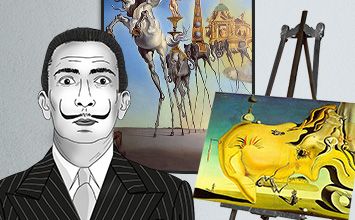
Salvador Dalí was a Spanish Surrealist painter who combined a hyperrealist style with dream-like, sexualized subject matter. His collaborations with Hollywood and commercial ventures, alongside his notoriously dramatic personality, earned him scorn from some Surrealist colleagues.
Giorgio de Chirico was a Greek-Italian painter and sculptor commonly associated with Surrealism. Initially discovered by Picasso and Apollinaire in France, de Chirico's best-known Surrealist paintings incorporated metaphysical subject matter and sculptural still-life. Instead of land- or cityscapes, de Chirico's art is more emblematic of a dreamscape.
Elaine de Kooning was an important Abstract Expressionist painter and collagist whose work combines gestural energy with formalist investigations. She was married to the famous New York painter Willem de Kooning.
Willem de Kooning, a Dutch immigrant to New York, was one of the foremost Abstract Expressionist painters. His abstract compositions drew on Surrealist and figurative traditions, and typified the expressionistic 'gestural' style of the New York School.
Painter, sculptor and poet Robert De Niro, Sr. was a substantial contributor to post-war American art for his dedication to
painterly representation. Vivid, innovative, and representational work distinguished De Niro as a distinct
figure in the Abstract Expressionist movement.
Edgar Degas was a French Impressionist painter, printmaker and sculptor with an extraordinarily long career from the mid 19th century until after WWI. As one of the original group of Impressionists, although he preferred to be called a Realist, he traveled widely and employed the use of photography in his creative process. He is most renowned for his painting and drawings of ballet dancers in rehearsal and performances in the theatre.
Richard Diebenkorn was an American painter who helped pioneer the California-based movement of Abstract Expressionism, and later the Bay Area Figurative Movement. In all his work, Diebenkorn used the natural environment as his chief inspiration and applied soft, naturalistic color fields to the canvas.
Otto Dix is one of modern painting's most savage satirists. After many artists had abandoned portraiture for abstraction in the 1910s, Dix injected sharp caricatures into his pictures of some of the leading lights of German society. His other narrative subjects are remembered for their indictment of corrupt and immoral life in the modern city.
Arthur Dove was an early American modernist painter and one of the first legitimate abstract painters of the 20th century. With influences ranging from Fauvism and Expressionism to Asian art and mixed media, Dove was an essential precursor to Abstract Expressionism.
Jean Dubuffet was a French painter and sculptor, and arguably one of the most famous French artists of the mid-to-late-20th century. Dubuffet's paintings employed the impasto technique, in which oil paints were thickened by materials such as sand, tar and straw. He coined the term "Art Brut," otherwise known as "raw art."
The French artist Marcel Duchamp was an instrumental figure in the avant-garde art worlds of Paris and New York. Moving through Dada, Surrealism, readymades, sculpture, and installation, his work involves conceptual play and an implicit attack on bourgeois art sensibilities.
Dan Flavin was an American artist best known for his Minimalist constructions of color and light. Often using nothing more than a few dozen fluorescent bulbs for his work, Flavin was a crucial figure in the Minimalism of the 1960s and 70s. His light installations altered the physical exhibition space, and were designed as experiential art rather than visual art.
Helen Frankenthaler was an American abstract painter in mid-20th-century New York. Along with Morris Louis and Kenneth Noland, Frankenthaler is considered a pioneer in the practice of color-field painting.
Paul Gauguin was a French Post-Impressionist artist who employed color fields and painterly strokes in his work. He is best known for his primitivist depictions of native life in Tahiti and Polynesia.
Arshile Gorky was an Armenian-born American painter and was a major influence on the development of Abstract Expressionism. In his own art he fused elements of Cubism, Surrealism and Expressionism, and was close with key figures central to New York's burgeoning abstrct art scene, such as John Graham, Stuart Davis and Willem de Kooning.
The Swiss artist Alberto Giacometti created semi-abstract sculptures that took up themes of violence, sex, and Surrealism. His famous later work is characterized by towering, elongated figures in bronze.
John Graham was a Russian-born American painter and a key figure in the development of Abstract Expressionism. Never adopting a singular style in his own art, Graham tutored many young abstract artists on the tenets of Cubism and Surrealism, of which he was an expert. Willem de Kooning credited Graham as the person who discovered Jackson Pollock.
George Grosz was a German Dada and Neue Sachlichkeit artist. He was enamored of America and highly critical of Weimar society. Grosz immigrated to the United States just as Hitler came to power and opened a private art school in Des Moines.
Philip Guston was a Canadian painter during the 20th century. Initially associated with the New York School of abstract art, Guston famously abandoned pure abstraction in the 1950s and turned to figurative art and quasi-abstract cartoon imagery. His later work, for which he is best known, was a major influence on the development of Neo-Expressionism in the U.S.
Grace Hartigan was an American painter and an important figure among the second generation of Abstract Expressionists. Her paintings are characterized by their rich color and bold mixture of abstract and figurative styles.
Eva Hesse was a major New York artist whose sculpture, assemblage, and installation brought issues of feminism and the body into Minimalism's formal vocabulary. She is heralded as one of the quintessential Post-Minimalist artists.
German-born American painter, art teacher and theorist. Hofmann matured as an artist in 1904-14 in Paris, where he met many of the greatest artists of that time. After he emigrated to America in the early 1930s he enjoyed a prominent career as a teacher, powerfully influencing many Abstract Expressionists with his understanding of European modernism.
Jasper Johns is an American artist who rose to prominence in the late 1950s for his multi-media constructions, dubbed by critics as Neo-Dada. Johns' work, including his world-famous targets and American flags series, were important predecessors to Pop art.
Donald Judd was an early and influential Minimalist artist who made large-scale geometric objects, often of industrial materials and serially arranged on the floor or wall. He helped found the Chinati Foundation in Marfa, Texas, where many key works of Minimalism are installed.
A member of the German Expressionist group Der Blaue Reiter, and later a teacher at the Bauhaus, Kandinsky is best known for his pioneering breakthrough into expressive abstraction in 1913. His work prefigures that of the American Abstract Expressionists.
Allan Kaprow was an American painter, collagist, assemblagist and performance artist. Kaprow was best known for trailblazing the artistic concept "happenings," which were experiential artistic events rather than single works of art.
Alex Katz is an American figurative artist associated with the Pop art movement. In particular, he is known for his paintings, sculptures, and prints and is represented by numerous galleries internationally. Since the 1950s, he worked to create art more freely in the sense that he tried to paint "faster than [he] can think." His works seem simple, but according to Katz they are more reductive, which is fitting to his personality. Katz has received numerous accolades throughout his career, and has been the subject of a documentary and numerous publications.
Ellsworth Kelly is an American color-field and Hard edge painter. Kelly got his start in the late 1950s with showings at the Betty Parsons Gallery and the Whitney Museum. His work often consists of shaped canvases, simple geometric shapes, and large panels of uniform color.
Ernst Ludwig Kirchner was one of the driving forces in the Die Brücke group that flourished in Dresden and Berlin before WWI, and one of the most talented and influential of the Expressionists.
The Swiss-born painter Paul Klee worked in a variety of styles, including expressionism, geometric abstraction, and collage. His most famous works have a mystical quality and make use of linear and pictorial symbols.
Yves Klein was a French Neo-Dadaist artist who produced a series of monochrome works in 1957. He is credited with creating an entirely new color of blue, eventually called International Klein Blue. He employed this color in his paintings made by covering naked bodies with pigment and using them as "paintbrushes," an important antecedent to later performance art.
Austrian painter Gustav Klimt was the most renowned advocator of Art Nouveau in Vienna, and is remembered as one of the greatest decorative painters of the twentieth century. He also produced one of the century's most significant bodies of erotic art.
Franz Kline was an American abstract painter and one of the pioneers of Abstract Expressionism. His signature black-and-white abstractions were inspired by Japanese calligraphy, and inspired a later generation of artists who created Minimalism.
Lee Krasner was an American abstract painter and a prominent first-generation Abstract Expressionist. A student of Hans Hofmann's, and a pioneer in the all-over technique of painting that later influenced color-field artists such as Frankenthaler, Louis, and her husband Jackson Pollock.
Barbara Kruger is an American conceptual artist. Much of Kruger's work merges found photographs taken from existing sources with pithy and aggressive text. Her captions engage the viewer in the work's greater struggle for power and control.
Dorothea Lange's images of Depression America made her one of the most acclaimed documentary photographers of the twentieth century. She went on to become a leading photo-journalist working for magazines such as Fortune and Life.
Ibram Lassaw was an American abstract sculptor, associated with multiple movements such as Cubism, Surrealism and Constructivism. Lassaw's sculpture famously incorporated mixed metals, intricately woven to create what many perceived as abstract paintings in three dimensions.
Influenced by Cubism and Futurism, the French painter Fernand Léger developed a style of conical and geometric forms with mechanically smooth edges. Often colorful and punctuated by circles and patterns, his paintings range from still lifes and figures to completely abstract compositions.
Sol LeWitt was an American artist commonly associated with the Minimalist and Conceptual movements. He rose to prominence in the 1960s with the likes of Rauschenberg, Johns and Stella, and his work was included in the famous 1966 exhibit Primary Structures at the Jewish Museum. LeWitt's art often employed simple geometric forms and archetypal symbols, and he worked in a variety of media but was most interested in the idea behind the artwork.
Roy Lichtenstein was an American painter and a pioneer of the Pop art movement. His signature reproductions of comic book imagery eventually redefined how the art world viewed high vs. lowbrow art. Lichtenstein employed a unique form of painting called the Benday dot technique, in which small, closely-knit dots of paint were applied to form a much larger image.
El Lissitzky was a Russian avant-garde painter, photographer, architect and designer. Along with his mentor Kazimir Malevich, Lissitzky helped found Suprematism. His art often employed the use of clean lines and simple geometric forms, and expressed a fascination with Jewish culture. Lissitzky was also a major influence on the Bauhaus school of artists and the Constructivist movement.
Morris Louis was an American painter and an original member of the so-called Washington Color School. Along with Noland, Frankenthaler and others, Louis pioneered the color-field school of painting, using a technique of soaking heavy oil paints into unprimed canvases. Louis's paintings in part inspired his friend Clement Greenberg to dub the second-generation AbEx artists Post-painterly Abstraction.
Rene Magritte has achieved great popular acclaim for his idiosyncratic approach to Surrealism. His beautiful and troubling images of bowler-hatted men and nature scenes are popular in art and general circles.
Kazimir Malevich was a Russian modernist painter who founded Suprematism. His mature works feature simple squares, rectangles, and other geometric shapes on blank grounds.
Edouard Manet was a French painter and a prominent figure in the mid-19th-century Realist movement of French art. Manet's paintings are considered among the first works of art in the modern era, due to his rough painting style and absence of idealism in his figures. Manet was a close friend of and major influence on younger artists who founded Impressionism such as Monet, Degas and Renoir.
Conrad Marca-Relli was a Boston-born painter and sculptor who belonged to the early generation of New York School Abstract Expressionist artists. Marca-Relli made a critical breakthrough with large-scale collage paintings that frequently drew inspiration from the human form to create abstract compositions of interlocking curves and angles.
Henri Matisse was a French painter and sculptor who helped forge modern art. From his early Fauvist works to his late cutouts, he emphasized expansive fields of color, the expressive potential of gesture, and the sensuality inherent in art-making.
Roberto Matta was a Chilean-born artist who lived and worked in New York in the 1940s. His interest in automatism and painterly effects helped forge a crucial link between Surrealism and Abstract Expressionism.
Active in Paris from the 1920s onward, and influenced by Surrealism, Miró developed a style of biomorphic abstraction which blended abstract figurative motifs, large fields of color, and primitivist symbols. This style would be an important inspiration for many Abstract Expressionists.
Joan Mitchell was a leading second-generation Abstract Expressionist who painted large works of gestural marks and overlapping, roiled color areas. She was famous for her acerbic personality, and her later work often earns comparison with the late painterly style of Impressionist Claude Monet.
Amedeo Modigliani was a Jewish-Itailan painter working in Paris from 1906 onwards. His unique style was influenced by Post-Impressionism, Brancusi and Cézanne, and featured ovaloid faces, elongated forms, and the use of brushy, modulated color fields.
Laszlo Moholy-Nagy was a Hungarian painter, photographer and teacher at the Bauhaus School. Moholy-Nagy was influential in promoting the Bauhaus's multi- and mixed-media approaches to art, advocating for the integration of technological and industrial design elements.
Claude Monet was a French artist who helped pioneer the painterly effects and emphasis on light, atmosphere, and plein air technique that became hallmarks of Impressionism. He is especially known for his series of haystacks and cathedrals at different times of day, and for his late Waterlilies.
Piet Mondrian, a founding member of the De Stijl movement, was a Dutch modern artist who used grids, perpendicular lines, and the three primary colors in what he deemed "Neoplastic" painting.
Henry Moore was an English sculptor and artist. He was best known for his abstract monumental bronze sculptures. His forms are usually abstractions of the human figure, typically depicting mother-and-child or reclining figures.
Robert Morris is an American artist whose early L-beam and column sculptures were key works in Minimalism. His work also includes felt and fabric pieces, performance, body art, and earthworks, often with an emphasis on process and theatricality.
Robert Motherwell was a first-generation Abstract Expressionist whose paintings use hulking shapes, large-scale strokes and calligraphy, and wide expanses of muted color. Eloquent and well-educated, he wrote extensively on theories of art.
Norweigan painter and printmaker Edvard Munch was a pioneer of the German Expressionist movement. His works such as The Scream explored deeply psychological concepts in a Symbolist style.
Bruce Nauman is a contemporary American artist concerned with language, process, manipulation, and the registers of irony. His work includes performance, video, installation, neon sculpture, and other materials.
Louise Nevelson was a Russian-born American artist who worked in the WPA and was a member of the Abstract Expressionist scene. She is best known for her black-painted constructions of assembled crates, boxes, headboards, and other wooden materials.
Barnett Newman was an Abstract Expressonist painter in New York who painted large-scale fields of solid color, interrupted by vertical lines or "zips." His sometimes narrow or boxy canvases, part painting and part sculpture, were influential for Minimalism.
Isamu Noguchi was a Japanese-American modern artist. Best known for his organic, biomorphic sculpture works, Noguchi was also a furniture designer and landscape artist.
Kenneth Noland was an American painter who helped pioneer the Color Field movement in the 1960s. His most famous works consist of circular ripples of paint poured directly onto the canvas.
Georgia O'Keeffe was an American painter best known for her depictions of flowers, animal skulls, landscapes, and still lifes. Married to photographer Alfred Stieglitz, she was an important member of the "Stieglitz circle" and early American modernism.
Jules Olitski was a Russian-born American painter and key figure in the mid-century movements of color-field painting and Post-painterly Abstraction. Olitski is most famous for his innovation of painting using multiple spray guns, applied to unprimed and unstrethed canvases.
Francis Picabia was a French artist who worked in Dada, Surrealist, and abstract modes, often employing language and mechanical imagery. He published the Dada journal 391 in Barcelona and America.
Picasso dominated European painting in the first half of the last century, and remains perhaps the century's most important, prolifically inventive and versatile artist. Alongside Georges Braque he pioneered Cubism. He also made significant contributions to Surrealist painting, and media such as collage, welded sculpture, and ceramics.
Jackson Pollock was the most well-known Abstract Expressionist and the key example of Action Painting. His work ranges from Jungian scenes of primitive rites to the purely abstract "drip paintings" of his later career.
Fairfield Porter was a 20th-century American realist painter and noted art critic. Although friends with and staunch admirer of many abstractionists from The New York School, Porter was something of a black sheep, opting to paint figurative forms and landscapes, which are only now gaining significant recognition.
Richard Pousette-Dart's early work, marked by thick black contour lines and primitive themes, gave way to a freer abstract style in the 1940s, and to light-infused, pointillist paintings in the 1950s and 60s. Although initially associated with the classic Abstract Expressionist angst, his work maintained a more transcendent and positive quality to it, increasingly focused on the expression of spiritual ideals in paint and color.
Robert Rauschenberg, a key figure in early Pop Art, admired the textural quality of Abstract Expressionism but scorned its emotional pathos. His famous "Combines" are part sculpture, part painting, and part installation.
Man Ray was an American artist in Paris whose photograms, objects, drawings, and other works played an important role in Dada, Surrealism, modern photography, and avant-garde art at large.
Ad Reinhardt was an American abstract artist whose monochromatic canvases show side-by-side rectangles painted in subtle variations of the same color. Very much part of the New York scene in the 1940s, he nonetheless scorned the label and gestural ethos of Abstract Expressionism.
Gerhard Richter is a preeminent German painter having matured in the historical aftermath of World War II, whose work commented and analyzed found, or mass-circulated, consumer imagery.
Diego Rivera was the principal actor in the Mexican Muralism movement and one of Mexico's greatest artists. His large-scale fresco cycles tell the histories of labor, industry, society, and other themes.
Alexander Rodchenko was one of the influential founders of the Constructivist movement, a leading member of the Productivist movement, and a revolutionary modern photographer.
The French artist Auguste Rodin is often considered the father of modern sculpture. His diverse ouevre includes traditonal styles, strongly allegorical work, and the fragments and textured physicality that are hallmarks of modernism.
Mark Rothko was an Abstract Expressionist painter whose early interest in mythic landscapes gave way to mature works featuring large, hovering blocks of color on colored grounds.
Henri Rousseau was a French self-taught painter. His most famous works, done in his characteristic flat figurative style, show surreal and dream-like scenes in primitive or natural settings.
Egon Schiele was an Austrian Art Nouveau painter. Schiele was initially taken under the wing of Gustav Klimt, but soon discovered a painterly style that was solidly expressionistic in form. While his style was reminiscent of Van Gogh, Klimt, Munch and others, Schiele shaped the female form in a uniquely non-representational manner, often twisting the body and face, making him an early proponent of European Expressionism.
Julian Schnabel is an American painter, interior decorator and filmmaker. In addition to being a major figure in the Neo-Expressionist movement, he is most well known as the director of such films as Basquiat and The Diving Bell and the Butterfly.
Carolee Schneemann is an American visual artist, known for her discourses on the body, sexuality and gender. Her work is primarily characterized by research into visual traditions, taboos, and the body of the individual in relationship to social bodies. Schneemann's works have been associated with a variety of art classifications including Fluxus, Neo-Dada, the Beat Generation, and happenings.
Richard Serra is an American Process and Minimalist artist. His sculptures have ranged from hurled drips of molten lead to gigantic steel pieces installed in public places.
Georges Seurat was a French painter who gave rise to the Post- and Neo-Impressionist artistic styles of the late 19th century. Seurat's greatest contribution to modern art was his development of Pointillism, a style of painting in which small dots of paint were applied to create a cohesive image. Combining the science of optics with painterly emotion, Pointillism evoked a visual harmony never before seen in modern art.
Aaron Siskind was a 20th-century American photographer whose catalog of work bears the mark of Abstract Expressionism. Siskind's photographs of found objects were often closely focused on simple shapes in the object, reflecting the artist's preoccupation with basic form, line and texture. Siskind was a significant pioneer is turning photography into an abstract medium.
Cindy Sherman is an American photographer and film director, best known for her conceptual portraits. Sherman has raised challenging and important questions about the role and representation of women in society, the media and the nature of the creation of art.
David Smith was an American artist who combined Surrealism and formal abstraction in his sculptures. His early works, small and with a craft-like aesthetic, give way later on to giant constructions of welded and burnished steel.
Robert Smithson was an American artist best known for his innovations in Land and Earth Art. Smithson's large-scale projects employed earth and other natural resources to construct works that both manipulated and preserved the natural landscape. His most famous work is Spiral Jetty in Utah, constructed entirely from basalt, earth and salt.
Chaim Soutine was a Jewish Expressionist painter whose textured, impasto style was influential for later gestural painters. He is especially known for his portraits, landscapes, and studies of flayed meat.
Frank Stella is an American artist whose geometric paintings and shaped canvases underscore the idea of the painting as object. A major influence on Minimalism, his iconic works include nested black and white stripes and concentric, angular half-circles in bright colors.
Alfred Stieglitz was an American photographer who published the pioneering journal Camera Work. His gallery 291 was a locus for modern artists in America.
Clyfford Still was a leading first-generation Abstract Expressionist. His mature works are large-scale paintings with gaping chasms and stains of jagged color, often in dark earth tones.
Cy Twombly is an American artist whose large-scale paintings incorporate writing, scrawls, and graffiti on their surfaces. He combines the gestural quality of Abstract Expressionism with a contemporary interest in language and registers of meaning.
Vincent van Gogh was a Dutch painter, commonly associated with the Post-Impressionist period. As one of the most prolific and experimental artists of his time, van Gogh was a spontaneous painter and a master of color and perspective. Troubled by personal demons all his life, many historians speculate that van Gogh suffered from a bipolar disorder.
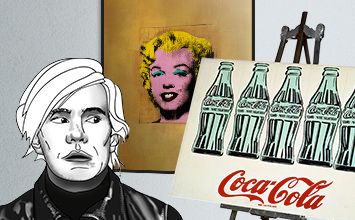
Andy Warhol was an American Pop artist best known for his prints and paintings of consumer goods, celebrities, and photographed disasters. One of the most famous and influential artists of the 1960s, he pioneered compositions and techniques that emphasized repetition and the mechanization of art.