Ask The Art Story AI







Summary of Post-Impressionism
Post-Impressionism encompasses a wide range of distinct artistic styles that all share the common motivation of responding to the opticality of the Impressionist movement. The stylistic variations assembled under the general banner of Post-Impressionism range from the scientifically oriented Neo-Impressionism of Georges Seurat to the lush Symbolism of Paul Gauguin, but all concentrated on the subjective vision of the artist. The movement ushered in an era during which painting transcended its traditional role as a window onto the world and instead became a window into the artist's mind and soul. The far-reaching aesthetic impact of the Post-Impressionists influenced groups that arose during the turn of the 20th century, like the Expressionists, as well as more contemporary movements, like the identity-related Feminist Art.
Key Ideas & Accomplishments
- Symbolic and highly personal meanings were particularly important to Post-Impressionists such as Paul Gauguin and Vincent van Gogh. Rejecting interest in depicting the observed world, they instead looked to their memories and emotions in order to connect with the viewer on a deeper level.
- Structure, order, and the optical effects of color dominated the aesthetic vision of Post-Impressionists like Paul Cézanne, Georges Seurat, and Paul Signac. Rather than merely represent their surroundings, they relied upon the interrelations of color and shape to describe the world around them.
- Despite the various individualized styles, most Post-Impressionists focused on abstract form and pattern in the application of paint to the surface of the canvas. Their early leanings toward abstraction paved the way for the radical modernist exploration of abstraction that took place in the early-20th century.
- Critics grouped the various styles within Post-Impressionism into two general, opposing stylistic trends - on one side was the structured, or geometric style that was the precursor to Cubism, while on the other side was the expressive, or non-geometric art that led to Abstract Expressionism.
Key Artists


Overview of Post-Impressionism

Though Paul Cézanne famously said, "I will astonish Paris with an apple," he turned away from Paris (but not from fruits) for a quiet life in Provence where he painted, as he said, "nature by means of the cylinder, the sphere and the cone." His artistic approach launched one of the four major trends in movement now defined as Post-Impressionism. And his move to the countryside became a model for other Post-Impressionist leaders including Signac, Gauguin, and van Gogh, who also worked and lived in the South of France.
Artworks and Artists of Post-Impressionism
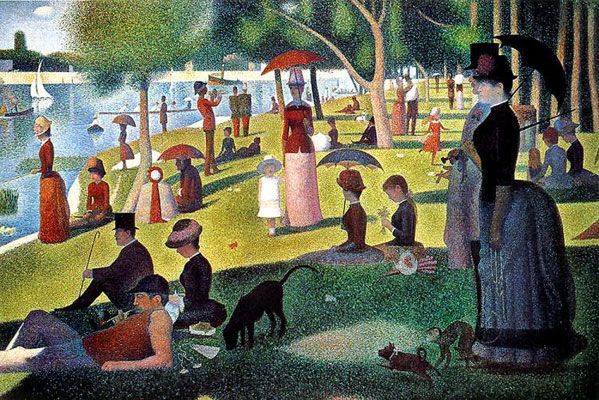
Sunday Afternoon on the Island of La Grande Jatte
Seurat's Sunday Afternoon is perhaps the most famous example of the painting technique known as Pointillism. Although the picture contains the impressionistic elements of light and shadow and depicts the leisure activities of the Parisian bourgeoisie, it is an early example of the artistic reaction to the Impressionist movement. Seurat composed the entire scene from a series of small, precise dots of color. If viewed closely, the painting becomes nothing more than a quasi-abstract array of colors, similar to a needlepoint. When viewed at an appropriate distance, however, Sunday Afternoon comes into focus. Seurat carefully placed each dot in relation to the ones around it in order to create the desired optical effect. He did so in order to bring structure and rationality to what he perceived were the triviality and disorganization rampant in Impressionism.
Oil on canvas - The Art Institute of Chicago
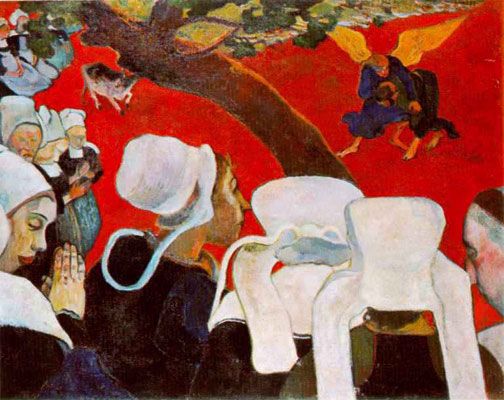
Vision After the Sermon
Gauguin studied in Brittany in the north of France where the unique history and customs represented a certain degree of spiritual freedom and primitive candor for Gauguin. While there, he painted Vision After the Sermon.
The painting, which depicts a revelatory vision of Jacob wrestling with an angel, clearly delineates reality and spiritual manifestation through aesthetic form. While the crowd of churchgoers who experience the vision is in the foreground, the Biblical struggle appears in the background, surrounded by a two-dimensional and vibrantly colored plane. Gauguin relied upon the abstraction of the red ground to communicate the space of the vision as well as the heightened emotions present at a religious revelation. As this work demonstrates, Gauguin rejected the conventions of industrialized modern society, in both his art and his life, through romanticized evocations of the primitive, the incorporeal, and the mystical. In doing so, he helped initiate the individualized expressionistic vein of avant-garde art that influenced generations of artists throughout the 20th century.
Oil on canvas - National Gallery of Scotland, Edinburgh
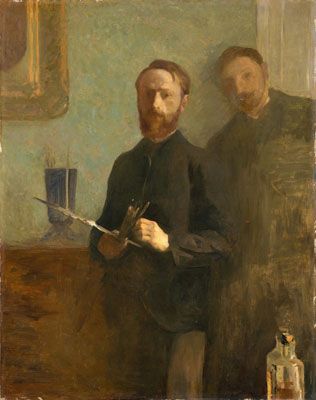
Self-Portrait with Waroquy
Vuillard, one of the most renowned members of Les Nabis, is known for his intimate portraits of family members and friends as well as his fixation upon decorative patterns. In this bold self-portrait, however, he centers upon the artist by placing his intense gaze front and center. He synthesizes the influences of Japanese woodblock printing, Pointillism, and the artistic tradition of self-portraiture with his personal ideals and goals for painting in this vivid self-representation. The broad brushstrokes and sketchy depiction of Vuillard's features draw our attention to the materiality of the canvas, while the muted colors of the palette signal the artist's departure from observed nature.
Oil on board - The Metropolitan Museum of Art, New York City
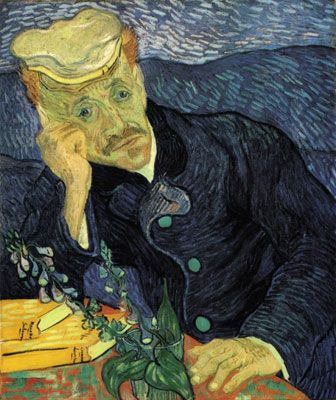
Portrait of Doctor Gachet
Van Gogh was one of the modern era's most gifted and emotionally troubled artists. Although grossly underappreciated in his lifetime, Van Gogh was an impulsive and often spontaneous painter who embodied many of the ideals of the Post-Impressionist movement. In Portrait of Doctor Gachet, Van Gogh strove to elicit a complex mixture of emotions within the viewer, rather than portray a naturalistic description of the sitter. Van Gogh created painterly rhythms and swirling forms within the arrangement of the figure in order to convey elements of strength, intelligence, and melancholy. Through such intimate and personalized interpretations, Van Gogh epitomized the rejection of Impressionistic optical observation in favor of an emotionally laden representation that appealed to the viewer's heart, rather than his mind.
Oil on canvas - Private Collection
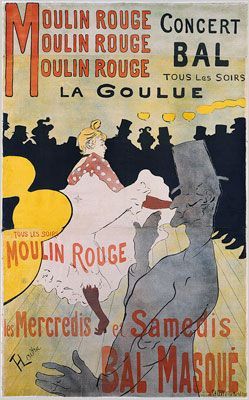
Moulin Rouge: La Goulue
A frequent visitor of the notorious Moulin Rouge, Henri de Toulouse-Lautrec immortalized the Montmartre dance hall in his highly stylized images of dancers and patrons. This, his earliest lithographic poster for the Moulin Rouge demonstrates his uniquely graphic approach and proclivity for representations of urban life. All figures except the female dancer in the center are silhouettes, while the perspective tilts sharply, lending the scene the impression of three-dimensionality. Although Toulouse-Lautrec focused upon scenes of the modern city like the Impressionists, he revolutionized the subject matter. He used crisp silhouettes and sharply abbreviated the depth of the picture plane to convey the rapid pace of contemporary life.
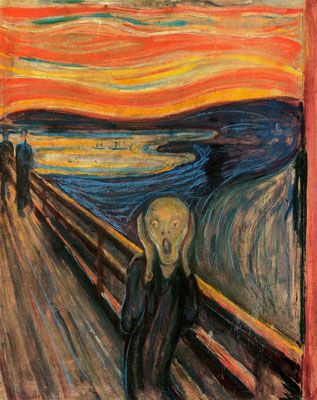
The Scream
Through its saturated hues and expressive content, Munch's most famous painting, The Scream, articulates the central tenets of his aesthetic mode. While many critics interpret the work as an expression of the modern condition, Munch himself called it a "study of the soul, that is to say the study of my own self." Through the nightmarish image of the anguished individual and the abstract rendering of form, the artist created this highly provocative and personal painting. Unlike the Impressionists' idyllic images of rural scenes, Munch poses an alternate view of man's relationship with nature. Here, the protagonist's emotions are reflected throughout the surrounding scenery, which create a symbolic plane for the expression of internal being.
Oil, tempera, and pastel on cardboard - National Gallery, Oslo

The Large Bathers
Many consider Cézanne's The Large Bathers his defining masterpiece. In it, Cézanne employed the technique of constructing visually complex images composed of simple shapes, lines, and geometric forms built up from the canvas with thick impasto. He composed the bathers, trees, and landscape from planes of color and applied the paint with a palette knife, not a brush. These color planes highlighted the fact that the viewer's eye observed a scene both simultaneously and consecutively. This visual effect caused the forms of the bathers' bodies in the foreground to merge into the branches of the trees in the landscape behind them. This visual slippage heralded the future of modernist painting. The spatial ambiguity of the Bathers and Cézanne's emphasis on formal structure paved the way for the visual experimentations of Cubism.
Oil on canvas - The Philadelphia Museum of Art
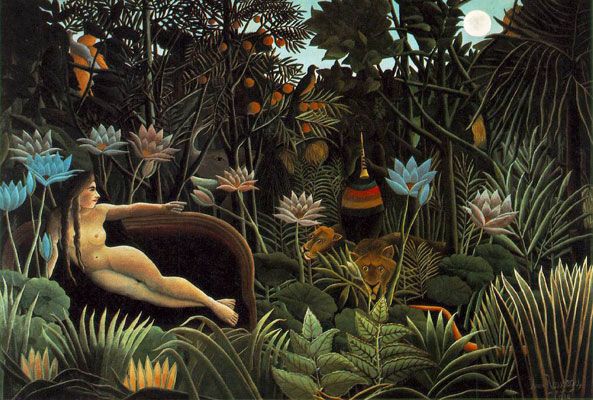
The Dream
In The Dream, his last and largest painting, Rousseau presented a unique interpretation of the traditional theme of the reclining nude. She is resting on her side, surrounded by the tropical flora and fauna of the mysterious depths of a jungle. Curiously, the woman reclines on a couch, not a patch of grass, observing her exotic surroundings as if at a great remove. Rousseau explained that he depicted the woman as she sat on her sofa in her Parisian apartment, dreaming of the tropical jungle that surrounded her. The lack of perspectival depth, use of bright color, and distorted representations accentuate the dream-like quality of the painting. Although Rousseau repeatedly painted images of jungles, he never even left Paris. Instead, his exoticized images of the non-industrialized world were creations of his own imagination that emphasized his rejection of modernity as well as the preeminence of his individual artistic vision. Like many of his other works, Rousseau's The Dream displays the artist's disregard for naturalistic depiction and realistic content in favor of surreal renderings.
Oil on canvas - The Museum of Modern Art, New York
Beginnings of Post-Impressionism
Impressionism and the Rise of Post-Impressionism
In 1872, Claude Monet radically altered the path of painting, ushering in a revolutionary mode of visual expression in which artists responded to their modern surroundings. This was achieved in the painting Impression, Sunrise (1872), in which Monet used each visible brushstroke to record exactly how the light from the sun fell upon the steamships and water below. The critic Louis Leroy derisively dubbed their style of painting "Impressionist" because of the visible brushstrokes, and unwittingly gave the group their collective identity. Although the core membership consisted of Claude Monet, Berthe Morisot, Auguste Renoir, and Edgar Degas, many other artists associated with the group. Among them was Paul Cézanne, who exhibited with the Impressionists during the 1870s and early 1880s.
By the last Impressionist exhibition in 1886, younger artists and critics demanded a shift in the focus of the representational arts. They felt the Impressionists allowed their preoccupations with technique and the effects of natural light to overshadow the importance of subject matter. Eventually these dissenting artists became known as the Post-Impressionists, a term that grouped together widely varying individual artistic styles. Indeed, many of the movement's foremost figures were rivals in method and approach. Gauguin and Seurat both detested one another and shared a low opinion of each other's styles, and while van Gogh revered the work of the Impressionist Edgar Degas and fellow Post-Impressionist Henri Rousseau, he was skeptical of Cézanne's rigorously ordered style.
While Paris was unquestionably the fount of Post-Impressionism, the emphasis on symbolic and expressive content meant that the life of the city no longer was the dominant subject for artists. Subsequently, many painters developed their individual aesthetic style outside of Paris. Cézanne spent most of his career in Provence; Van Gogh arrived at his mature style in Arles in the south of France; and, in an infamous renunciation of Paris, Gauguin expatriated to Tahiti.
Post-Impressionism: Concepts, Styles, and Trends
Seurat and Pointillism

The earliest herald of the new trend that broke with Impressionism was Georges Seurat. He developed the style of painting known as Pointillism, which refers to the use of a point, or dot, as the basis for the construction of a painting. The larger stylistic movement of Seurat's followers is known as Neo-Impressionism, but the movement is also identified as "chromo-luminarism" or Divisionism. Seurat explored a new, scientific approach to the representation of color and extended the Impressionists' interests in optics. The marks that made up the painting were each executed in a singular color. Those individual marks and colors then visually blended in the eye of the viewer, as dictated by the prevailing tenets of then-current color-theory. In works such as A Sunday Afternoon on the Island of La Grande Jatte (1884-86), Seurat applied color in dense fields of tiny dots in order to mimic the vivid and vibrating appearance of natural light, which is also the result of the blending of the various colors of the spectrum. Paul Signac closely followed in Seurat's footsteps in these explorations.
Van Gogh and Japonisme

Vincent van Gogh relied upon saturated colors and broad brushstrokes to evoke the inner turmoil of the artist. Along with Gauguin, he experimented with new approaches to painting and rejected academic representation, fine finish, and the Impressionists' fixation on opticality. He was influenced by a variety of sources, not the least of which was his love of the stylized representations of Japanese Ukiyo-e prints. In the late-19th century, an influx of Japanese goods and art into the European market initiated Japonism - the European interpretation of Japanese artistic styles in Western art objects. Similar influences are also evident in the work of Henri de Toulouse-Lautrec. Toulouse-Lautrec was an observer of the cabaret world with a unique perspective; he was born into the French nobility, but was physically disabled, and thus embodied the perspective of both an insider and an outsider. His unique view of Parisian nightlife resulted in paintings and lithographs of dance halls and cabarets that relied upon the strong outlines and flat planes of color of the ukiyo-e.
Gauguin and Synthetism
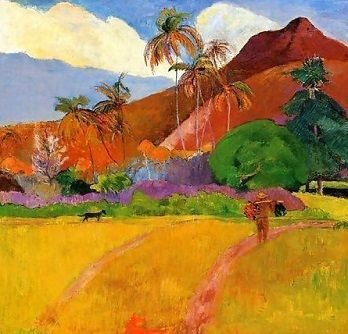
In the fall of 1888, Van Gogh and Gauguin shared a small apartment and studio space in Arles, in the south of France. During those months, the two artists forged a rocky, but mutually beneficial relationship. While they both shared an interest in symbolic content and images that were abstracted from their natural appearances, Gauguin developed these ideas further in his theory of "Synthetism." According to its tenets, the final, visual form is determined by a synthesis of the outward appearance of the natural form, the artist's feelings about the subject matter, and the aesthetic considerations of color, line, and form. In his work, Gauguin frequently discarded shading, modeling, and single-point perspective, and instead used pure color, strong lines, and flat two-dimensionality to elicit a visceral emotional impact. These works were also oftentimes derived "de tête" - from memory or imagination - and expressed a strong connection with the subject matter that inspired the work, whether that subject derived from religion, literature, or mythology.
Cézanne and the Structure of Pictorial Form
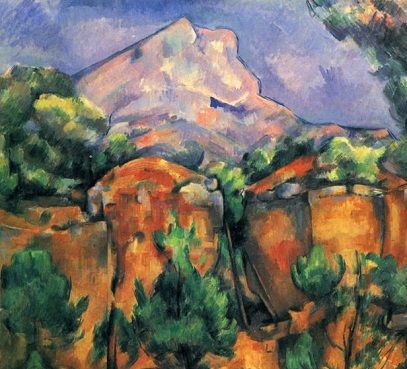
In his painting, Paul Cézanne focused on an exploration of the underlying formal structure of still lifes, portraits, and landscapes. Rather than describe the overall impression of a scene, Cézanne sought to articulate its underlying organization and suggested that the landscape was built up from the simplest geometric components. As he once famously wrote in a letter to the Symbolist painter Emile Bernard, "Treat nature in terms of the cylinder, the sphere, the cone." By using planes of color to create these shapes, he partially merged parts of figures in the foreground with elements of the background, joining surface and depth. Perhaps the most influential of the Post-Impressionists, Cézanne forged a link between Impressionism and Cubism. His innovations were tremendously influential for the masters of modernity, like Henri Matisse and Pablo Picasso. Picasso even went so far as to call Cézanne "the father of us all."
Rousseau and Primitivism

Many Post-Impressionists were drawn to Primitivism in their search for more vivid styles and symbolic content. In this instance, Primitivism refers to the "naive," self-taught style exemplified by Henri Rousseau who was championed as a pioneer, but it can also refer to the borrowing of non-Western art forms by artists like Picasso and Gauguin. Rousseau circuitously came to art through sketching to occupy himself at his job with the Parisian toll service operating the gates to the city. By 1884, he avidly copied the works in the Louvre's collection and arrived at a style that dominated his entire oeuvre. While Rousseau's paintings at first glance appear to present conventional subject matter, the simplified, abstracted forms and surface patterns that merge within the painted images derived solely from his imagination. Although he lacked any academic training, his evocative landscapes and jungle scenes, such as The Sleeping Gypsy (1897) and The Dream (1910), relied upon his interpretations of his subconscious, rather than the surrounding world. His representation of the realm of dreams in a uniquely intuitive style proved highly influential for the Fauves, Cubists, and Surrealists.
Les Nabis

Influenced by Japonisme, Symbolist painting, and the English Pre-Raphaelites, the group of artists known as Les Nabis firmly adhered to idea that the artist must synthesize nature and personal expression within the work of art. The name, "Les Nabis," derived from the Hebrew word for "prophet," and heralded the group's core ideology - a blend of mysticism and the inner spirituality of the artist. Paul Sérusier founded the group and refined the style that came to dominate their production. Influenced by Gauguin, they used paint right from the tube in broad, unmodulated areas of color, with patterned designs and stylized contours that reflected the subjective vision of the artist. Painter and theorist Maurice Denis published the essay Definition of Neo-Traditionism in 1890, in which he stated, "remember that a picture - before being a war-horse or a nude or a genre scene - is primarily a flat surface covered with colors arranged in a certain order." Les Nabis exhibited together from 1892 through 1899, and embraced a variety of media including painting, prints, stained glass, and stage sets. The core membership of the group consisted of Paul Sérusier and Maurice Denis, as well as Pierre Bonnard and Édouard Vuillard. Several other artists exhibited and worked with the group at varying times, among them Aristide Maillol and Henri de Toulouse-Lautrec.
International Post-Impressionism
Although Post-Impressionism was centered in France, the artistic styles and theories that emerged from the movement quickly spread to other countries. The Norwegian painter Edvard Munch expanded upon the ideas of Symbolism to create his own personal and highly expressive artistic style. Through abstracted renderings and the use of bold color and sinewy lines, he sought to connote the internal strife of the artist as well as the burgeoning anxiety of modern man. Others, such as the Belgian painter and printmaker James Ensor, implemented vibrant hues and flattened perspective in an anti-realist manner in order to convey the widespread tension and angst of the spirit of the "fin de siecle." Ensor's subject matter oftentimes derived from the annals of legend and allegory, however, he frequently portrayed the grotesque as a rebellion against the classically beautiful themes of academic art.
Later Developments - After Post-Impressionism
Although name of the Post-Impressionist movement is widely known today, English artist and critic Roger Fry only coined the term in 1910 for an exhibition he organized at London's Grafton Galleries, Manet and the Post-Impressionists. In the catalogue, he acknowledged that the imprecision of the label "Post-Impressionism" highlighted the disparity in the different styles and interests of the artists it encompassed. Despite the variations of styles, the overall guiding logic behind the show traced the progression away from Impressionism. Fry felt this began with Manet, but the exhibition focused on the work of Cézanne, Van Gogh, and Gauguin.
By 1910, movements like Fauvism, Expressionism, and Cubism already dominated the European avant-garde. Each new development in these major movements was built upon the symbolism and structure advocated by the different Post-Impressionist styles.
Useful Resources on Post-Impressionism

-
![Vincent van Gogh Overview]() 0 viewsVincent van Gogh OverviewOur PickGeographical reconstruction of his life in this biographical video
0 viewsVincent van Gogh OverviewOur PickGeographical reconstruction of his life in this biographical video -
![Henry De Toulouse-Lautrec Biography]() 18k viewsHenry De Toulouse-Lautrec BiographyOur PickBy Goodbye-Art Academy
18k viewsHenry De Toulouse-Lautrec BiographyOur PickBy Goodbye-Art Academy -
![Georges Seurat]() 35k viewsGeorges SeuratIncludes insights from specialist on the artist
35k viewsGeorges SeuratIncludes insights from specialist on the artist -
![Georges Seurat and Pointillism by ArtRageous]() 0 viewsGeorges Seurat and Pointillism by ArtRageousA hip video explaining the art and ideas
0 viewsGeorges Seurat and Pointillism by ArtRageousA hip video explaining the art and ideas -
![Paul Cézanne - Origins of Modern Art 1]() 35k viewsPaul Cézanne - Origins of Modern Art 1Introduction and look at how his presentation of multiple perspectives influenced Modern Art such as Picasso's Cubism
35k viewsPaul Cézanne - Origins of Modern Art 1Introduction and look at how his presentation of multiple perspectives influenced Modern Art such as Picasso's Cubism -
![Paul Gauguin in Tahiti]() 6k viewsPaul Gauguin in TahitiIncludes photographs of Tahiti at the time of Gauguin's visits
6k viewsPaul Gauguin in TahitiIncludes photographs of Tahiti at the time of Gauguin's visits


-
![Post-Impressionism by Otis Modern Art]() 29k viewsPost-Impressionism by Otis Modern ArtDr. Parme Giuntini, Director of Art History at Otis College of Art and Design, presents series on the Post-Impressionists including Cézanne, Seurat, Gauguin, and Van Gogh
29k viewsPost-Impressionism by Otis Modern ArtDr. Parme Giuntini, Director of Art History at Otis College of Art and Design, presents series on the Post-Impressionists including Cézanne, Seurat, Gauguin, and Van Gogh -
![Wicked Paris]() 10k viewsWicked ParisOur PickHenri de Toulouse-Lautrec's Paris - a lecture by S. Hollis Clayson, professor of art history at Northwestern University
10k viewsWicked ParisOur PickHenri de Toulouse-Lautrec's Paris - a lecture by S. Hollis Clayson, professor of art history at Northwestern University