Ask The Art Story AI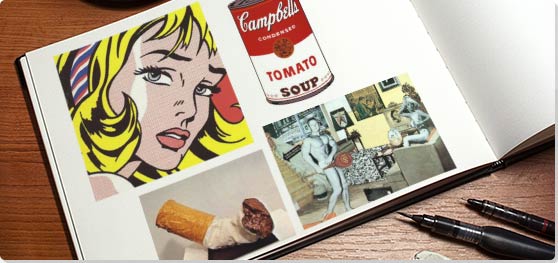







Summary of Pop Art
Pop Art's refreshing reintroduction of identifiable imagery, drawn from media and popular culture, was a major shift for the direction of modernism. With roots in Neo-Dada and other movements that questioned the very definition of “art” itself, Pop was birthed in the United Kingdom in the 1950s amidst a postwar socio-political climate where artists turned toward celebrating commonplace objects and elevating the everyday to the level of fine art. American artists Andy Warhol, Roy Lichtenstein, James Rosenquist and others would soon follow suit to become the most famous champions of the movement in their own rejection of traditional historic artistic subject matter in lieu of contemporary society’s ever-present infiltration of mass manufactured products and images that dominated the visual realm. Perhaps owing to the incorporation of commercial images, Pop Art has become one of the most recognizable styles of modern art.
Key Ideas & Accomplishments
- By creating paintings or sculptures of mass culture objects and media stars, the Pop Art movement aimed to blur the boundaries between "high" art and "low" culture. The concept that there is no hierarchy of culture and that art may borrow from any source has been one of the most influential characteristics of Pop Art.
- It could be argued that the Abstract Expressionists searched for trauma in the soul, while Pop artists searched for traces of the same trauma in the mediated world of advertising, cartoons, and popular imagery at large. But it is perhaps more precise to say that Pop artists were the first to recognize that there is no unmediated access to anything, be it the soul, the natural world, or the built environment. Pop artists believed everything is inter-connected, and therefore sought to make those connections literal in their artwork.
- Although Pop Art encompasses a wide variety of work with very different attitudes and postures, much of it is somewhat emotionally removed. In contrast to the "hot" expression of the gestural abstraction that preceded it, Pop Art is generally "coolly" ambivalent. Whether this suggests an acceptance of the popular world or a shocked withdrawal, has been the subject of much debate.
- Pop artists seemingly embraced the post-World War II manufacturing and media boom. Some critics have cited the Pop Art choice of imagery as an enthusiastic endorsement of the capitalist market and the goods it circulated, while others have noted an element of cultural critique in the Pop artists' elevation of the everyday to high art: tying the commodity status of the goods represented to the status of the art object itself, emphasizing art's place as, at base, a commodity.
- Some of the most famous Pop artists began their careers in commercial art: Andy Warhol was a highly successful magazine illustrator and graphic designer; Ed Ruscha was also a graphic designer, and James Rosenquist started his career as a billboard painter. Their background in the commercial art world trained them in the visual vocabulary of mass culture as well as the techniques to seamlessly merge the realms of high art and popular culture.
Key Artists


Overview of Pop Art
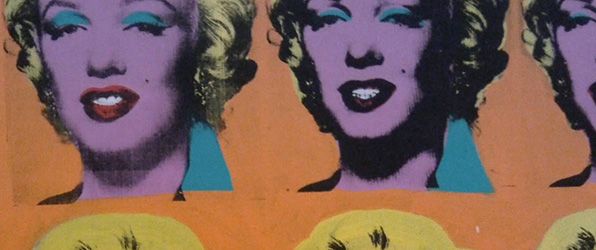
From early innovators in London to later deconstruction of American imagery by the likes of Warhol, Lichtenstein, Rosenquist - the Pop Art movement became one of the most thought-after of artistic directions.
Artworks and Artists of Pop Art

I Was a Rich Man's Plaything
Paolozzi, a Scottish sculptor and artist, was a key member of the British post-war avant-garde. His collage I Was a Rich Man's Plaything proved an important foundational work for the Pop Art movement, combining pop culture documents like a pulp fiction novel cover, a Coca-Cola advertisement, and a military recruitment advertisement. The work exemplifies the slightly darker tone of British Pop Art, which reflected more upon the gap between the glamour and affluence present in American popular culture and the economic and political hardship of British reality. As a member of the loosely associated Independent Group, Paolozzi emphasized the impact of technology and mass culture on high art. His use of collage demonstrates the influence of Surrealist and Dadaist photomontage, which Paolozzi implemented to recreate the barrage of mass media images experienced in everyday life.
Collage - Collection of the Tate, United Kingdom
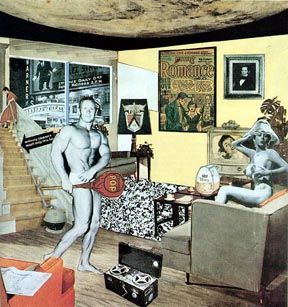
Just What Is It That Makes Today's Homes So Different, So Appealing?
Hamilton's collage was a seminal piece for the evolution of Pop Art and is often cited as the very first work of the movement. Created for the exhibition This is Tomorrow at London's Whitechapel Gallery in 1956, Hamilton's image was used both in the catalogue for the exhibition and on posters advertising it. The collage presents viewers with an updated Adam and Eve (a body-builder and a burlesque dancer) surrounded by all the conveniences modern life provided, including a vacuum cleaner, canned ham, and a television. Constructed using a variety of cutouts from magazine advertisements, Hamilton created a domestic interior scene that both lauded consumerism and critiqued the decadence that was emblematic of the American post-war economic boom years.
Collage - Kunsthalle Tubingen, Germany
President Elect
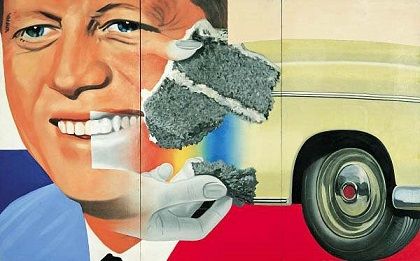
Like many Pop artists, Rosenquist was fascinated by the popularization of political and cultural figures in mass media. In his painting President Elect, the artist depicts John F. Kennedy's face amidst an amalgamation of consumer items, including a yellow Chevrolet and a piece of cake. Rosenquist created a collage with the three elements cut from their original mass media context, and then photo-realistically recreated them on a monumental scale. As Rosenquist explains, "The face was from Kennedy's campaign poster. I was very interested at that time in people who advertised themselves. Why did they put up an advertisement of themselves? So that was his face. And his promise was half a Chevrolet and a piece of stale cake." The large-scale work exemplifies Rosenquist's technique of combining discrete images through techniques of blending, interlocking, and juxtaposition, as well as his skill at including political and social commentary using popular imagery.
Oil on masonite - Centre Georges Pompidou, Paris

Pastry Case, I
Oldenburg is known as one of the few American Pop Art sculptors, notorious for his playfully absurd creations of food and inanimate objects. The collection of works in Pastry Case, I were originally displayed in the artist's famous 1961 installation titled The Store, located on New York's Lower East Side. For the project, Oldenburg created plaster sculptural objects including a strawberry shortcake and a candied apple. In addition to replicating consumer items, Oldenburg organized his installation like a typical variety shop and sold his items at low prices, commenting on the interrelation between art objects and commodities. Although sold as if they were mass-produced, the sculptures in The Store were carefully hand-built and the lavish, expressive brushstrokes that cover the items in Pastry Case, I seem to mock the seriousness of Abstract Expressionism, a common theme in Pop Art. Oldenburg combines the evocative expressionist gesture with the commodity item in a highly ironic environment.
Painted plaster sculptures on ceramic plates, metal platter and cups in glass-and-metal case - The Museum of Modern Art, New York
Drowning Girl
In the early 1960s, Lichtenstein gained renown as a leading Pop artist for paintings sourced from the popular comics. Although artists such as Robert Rauschenberg and Jasper Johns had previously integrated popular imagery into their works, no one hitherto had focused on cartoon imagery as exclusively as Lichtenstein. His work, along with that of Andy Warhol, heralded the beginning of the Pop Art movement, and, essentially, the end of Abstract Expressionism as the dominant style.
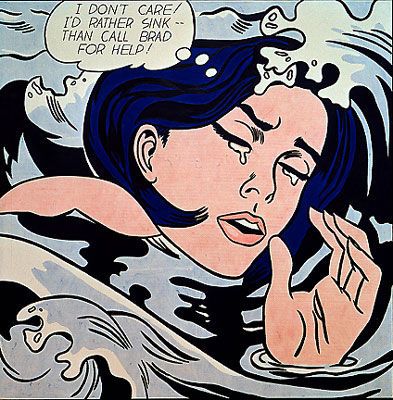
Lichtenstein did not simply copy comic pages directly, he employed a complex technique that involved cropping images to create entirely new, dramatic compositions, as in Drowning Girl, whose source image included the woman's boyfriend standing on a boat above her. Lichtenstein also condensed the text of the comic book panels, locating language as another, crucial visual element; re-appropriating this emblematic aspect of commercial art for his paintings further challenged existing views about definitions of "high" art.
As with the rest of Pop Art, it is often unclear whether Lichtenstein is applauding the comic book image, and the general cultural sphere to which it belongs, or critiquing it, leaving interpretation up to the viewer. But in Drowning Girl, the ridicule of the woman's situation (as is made clear by her ridiculous statement) is evident.
Oil on canvas - Oil and synthetic polymer paint on canvas, © Estate of Roy Lichtenstein
Campbell's Soup I
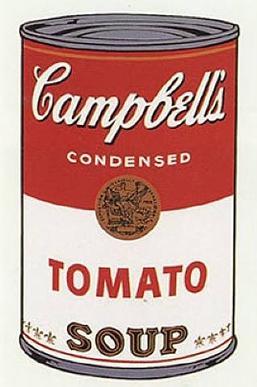
Warhol's iconic series of Campbell's Soup Cans paintings were never meant to be celebrated for their form or compositional style, like that of the abstractionists. What made these works significant was Warhol's co-opting of universally recognizable imagery, such as a Campbell's soup can, Mickey Mouse, or the face of Marilyn Monroe, and depicting it as a mass-produced item, but within a fine art context. In that sense, Warhol wasn't just emphasizing popular imagery, but rather providing commentary on how people have come to perceive these things in modern times: as commodities to be bought and sold, identifiable as such with one glance. This early series was hand-painted, but Warhol switched to screenprinting shortly afterwards, favoring the mechanical technique for his mass culture imagery. 100 canvases of Campbell's soup cans made up his first solo exhibition at the Ferus Gallery in Los Angeles, and put Warhol on the art world map almost immediately, forever changing the face and content of modern art.
Screenprint - Fair Use

Bunnies
After Polke co-founded Capitalist Realism in 1963 in Düsseldorf, Germany, with Gerhard Richter and Konrad Leug, he began to create paintings of popular culture, evoking both genuine nostalgia for the images and mild cynicism about the state of the German economy. He began simulating the dot patterns of commercial four-color printing (Raster dots) around the same time as Lichtenstein started replicating Ben-Day dots on his canvases. In Bunnies, Polke uses an image from the Playboy Club depicting four of their "bunnies" in costume. By recreating the Raster dot printing technique in this painting, Polke disrupts the mass-marketing of sexual appeal, because the closer the viewer gets to the work, the less they see. Bunnies and the rest of Polke's Raster dot paintings, do not invite a deep, personal identification with the image but rather the images become allegories for the self as it lost amidst the flood of commecial imagery. The dissonance between the inviting sexuality of the appropriated image of the Playboy bunnies and the distancing effect of the Raster dots echoes the interplay of feelings and emotions felt by the artist, both yearning for the mass-culture advertised life and repelled by it at the same time. Polke's vision of popular culture is far more critical than any of the New York artists, and is rooted in the skeptical attitude held by the Capitalist Realists. Rather than the "cool" detachment of New York, Polke cleverly critiques popular culture and how it affects the individual using the same mass-market image-making techniques.
Oil on cavas - Hirshorn Museum and Sculpture Garden, Washington, D.C., USA

Standard Station
The printmaker, painter, and photographer Ed Ruscha was an important proponent of West Coast Pop Art that blended the imagery of Hollywood with colorful renderings of commercial culture and the landscape of the southwest. The gasoline station is one of Ruscha's most iconic motifs, appearing repeatedly in his book Twentysix Gasoline Stations (1963), a documentation of deadpan photographs from a road trip through the American Southwestern countryside. In Standard Station, the artist transforms the banal image of the gasoline station into an emblematic symbol of American consumer culture. Here, through the medium of screenprinting, Ruscha flattens the perspective into a single plane to create an image that evokes the aesthetic of commercial advertising. The work also demonstrates Ruscha's early experiments with language and textual interplay, which would be a principal concern in much of his later, more conceptually oriented work.
Screenprint - The Museum of Modern Art, New York
A Bigger Splash
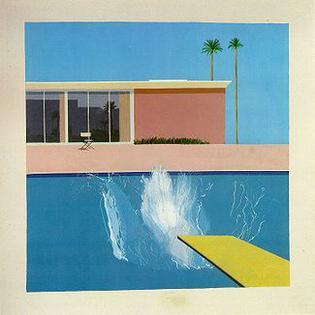
This large canvas, measuring approximately 94 by 94 inches, was derived from a photograph of a swimming pool Hockney had seen in a pool manual. Hockney was intrigued by the idea that a painting might recapture a fleeting event frozen in a photograph: “I loved the idea of painting this thing that lasts for two seconds: it takes me two weeks to paint this event that lasts for two seconds.” The dynamism of the splash contrasts strongly with the static and rigid geometry of the house, the pool edge, the palm trees and the striking yellow diving board, all carefully arranged in a grid containing the splash. This gives the painting a disjointed effect that is absolutely intentional, one of the hallmarks of Hockney’s style. The effect of stylization and artificiality draws on the aesthetic vocabulary of Pop Art.
Acrylic on canvas - Collection of the Tate, United Kingdom
Beginnings of Pop Art
Great Britain: The Independent Group
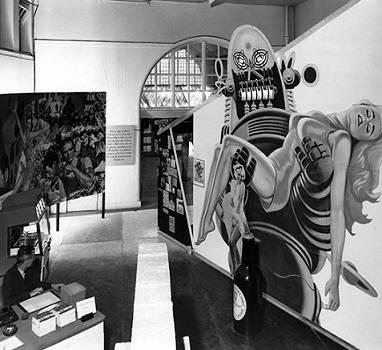
In 1952, a gathering of artists in London calling themselves the Independent Group began meeting regularly to discuss topics such as mass culture's place in fine art, the found object, and science and technology. Members included Eduardo Paolozzi, Richard Hamilton, architects Alison and Peter Smithson, and critics Lawrence Alloway and Reyner Banham. Britain in the early 1950s was still emerging from the austerity of the post-war years, and its citizens were ambivalent about American popular culture. While the group was suspicious of its commercial character, they were enthusiastic about the rich world pop culture seemed to promise for the future. The imagery they discussed at length included that found in Western movies, science fiction, comic books, billboards, automobile design, and rock and roll music.
The actual term "Pop Art" has several possible origins: the first use of the term in writing has been attributed to both Lawrence Alloway and Alison and Peter Smithson, and alternately to Richard Hamilton, who defined Pop in a letter, while the first artwork to incorporate the word "Pop" was produced by Paolozzi. His collage I Was a Rich Man's Plaything (1947) contained cut-up images of a pinup girl, Coca-Cola logo, cherry pie, World War II bomber, and a man's hand holding a pistol, out of which burst the world "POP!" in a puffy white cloud.
New York City: The Emergence of Neo-Dada
By the mid 1950s, the artists working in New York City faced a critical juncture in modern art: follow the Abstract Expressionists or rebel against the strict formalism advocated by many schools of modernism. By this time, Jasper Johns was already troubling conventions with abstract paintings that included references to: "things the mind already knows" - targets, flags, handprints, letters, and numbers. Meanwhile, Robert Rauschenberg's "combines" incorporated found objects and images, with more traditional materials like oil paint. Similarly, Allan Kaprow's "Happenings" and the Fluxus movements chose to incorporate aspects from the surrounding world into their art. These artists, along with others, later became grouped in the movement known as Neo-Dada. The now classic New York Pop Art of Roy Lichtenstein, Claes Oldenburg, James Rosenquist, and Andy Warhol emerged in the 1960 in the footsteps of the Neo-Dadaists.
Pop Art: Concepts, Styles, and Trends
Once the transition from the found-object constructions of the Neo-Dada artists to the Pop movement was complete, there was widespread interest on the part of artists in the incorporation of popular culture into their work. Although artists in the Independent Group in London initiated the use of "pop" in reference to art, American artists soon followed suit and incorporated popular culture into their artwork as well. Although the individual styles vary widely, all of the artists maintain a commonality in their choice of popular culture imagery as their fundamental subject. Shortly after American Pop Art arrived on the art world scene, mainland European variants developed in the Capitalist Realist movement in Germany and the Nouveau Réalisme movement in France.
Richard Hamilton, Eduardo Paolozzi, and the Tabular Image
The Pop Art collages of Paolozzi and Hamilton convey the mixed feelings Europeans maintained toward American popular culture; both exalting the mass-produced objects and images while also criticizing the excess. In his collage, Just what is it that makes today's homes so different, so appealing? (1956), Hamilton combined images from various mass media sources, carefully selecting each image and composing the disparate elements of popular imagery into one coherent survey of post-war consumer culture. The members of the Independent Group were the first artists to present mass media imagery, acknowledging the challenges to traditional art categories occurring in America and Britain after 1945.
Roy Lichtenstein and Pulp Culture
Lichtenstein proved that he could fulfill demands for a "great" composition even though his subject matter derived from comic books. In addition to using the imagery from these mass-produced picture books, Lichtenstein appropriated the techniques used to create the images in comic books to create his paintings. He not only adopted the same bright colors and clear outlines as popular art, his most innovative contribution was his use of Ben-Day dots: small dots used to render color in mass-manufactured comics. Focusing on a single panel within a comic strip, Lichtenstein's canvases are not an exact facsimile, but are rather the artist's creative re-imaging of the composition in which elements may have been added or eliminated, scale could shift, and text might be edited. By hand-painting the usually machine-generated dots, and recreating comic book scenes, Lichtenstein blurred the distinction between mass reproduction and high art.
James Rosenquist and the Monumental Image
Rosenquist also directly appropriated images from popular culture for his paintings. However, rather than produce rote copies, Rosenquist exerted creative control through his surrealistic juxtapositions of products and celebrities, often inserting political messages. As part of his method, Rosenquist collaged magazine clippings from advertisements and photo spreads, and then used the results as studies for his final painting. Rosenquist's training in billboard painting transitioned perfectly into his realistic renderings of those collages expanded onto a monumental scale. With works often much larger and wider than 20 feet, Rosenquist imbued the mundane with the same status previously reserved for high, sometimes royal, art subjects.
Andy Warhol and Repetition
Andy Warhol is most famous for his vividly colored portraits of celebrities, but his subject matter has varied widely throughout his career. The common theme amidst the different subjects is their inspiration in mass consumer culture. His earliest works depict objects like Coca-Cola bottles and Campbell's soup cans, reproduced ad infinitum, as if the gallery wall were a shelf in a supermarket. Warhol transitioned from hand painting to screenprinting to further facilitate the large-scale replication of pop images. Warhol's insistence on mechanical reproduction rejected notions of artistic authenticity and genius. Instead, he acknowledged the commodification of art, proving that paintings were no different from cans of Campbell's soup; both have material worth and could be bought and sold like consumer goods. He further equated the mass-produced status of consumer goods with that of celebrities in portraits like Marilyn Diptych (1962).
Claes Oldenburg and Pop Sculpture
Renowned for his monumental public sculptures of everyday objects and his "soft" sculptures, Claes Oldenburg began his career on a much smaller scale. In 1961 he rented a storefront in New York City for a month where he installed and sold his wire and plaster sculptures of mundane objects, ranging from pastries to men's and women's undergarments, in an installation he dubbed The Store. Oldenburg charged a nominal fee for each piece, which underscored his commentary on the role of art as a commodity. He began his soft sculptures shortly after The Store, constructing large, everyday objects, like a slice of cake, an ice cream cone, or a mixer, out of fabric and stuffing so the end result collapses in on itself like a deflating balloon. Oldenburg would continue to focus on commonplace objects throughout his career, moving from soft sculptures to grand public art, like the 45-foot-high Clothespin (1974) in downtown Philadelphia. Regardless of the scale, Oldenburg's work always maintains a playful attitude toward re-creating mundane things in an unconventional way in order to upend viewer's expectations.
Los Angeles Pop
As opposed to New York City, the art world of Los Angeles was much less rigid, lacking the established galleries, critics, and hierarchies of the east coast; this openness is reflected in the styles of the artists who lived and worked there. The first museum survey of Pop Art, New Painting of Common Objects, was held at the Pasadena Art Museum in 1962, and showcased Warhol and Lichtenstein as well as many artists living in Los Angeles including Ed Ruscha, Joe Goode, Phillip Hefferton, Wayne Thiebaud, and Robert Dowd. Other Los Angeles artists, like Billy Al Bengston, incorporated a different kind of aesthetic into their version of Pop, utilizing new materials such as automobile paint and referencing surfing and motorcycles in works that make the familiar strange through new and unexpected combinations of images and media. By shifting the focus away from specific consumer goods, these artists allowed Pop Art to move beyond replication to incorporate experience and evoke a particular feeling, attitude, or idea, while also pushing the boundaries between high art and popular culture.
Ed Ruscha and Signage
On the roster at Ferus Gallery, Ed Ruscha was one of the pivotal artists of Los Angeles Pop who worked in a variety of media, with the majority of these typically printed or painted. Emphasizing the omnipresence of signage in Los Angeles, Ruscha used words and phrases as subjects in his earliest Pop Art paintings. His first reference to popular culture was the painting Large Trademark with Eight Spotlights (1962), where he appropriated the 20th Century Fox logo in a simplified composition with the hard edges and clear palette of a cartoon, echoing the similar billboards. His subsequent paintings of words further blurred the lines between advertising signage, painting, and abstraction, undermining the divisions between the aesthetic world and the commercial realm, some even incorporating three-dimensional objects like pencils and comic books on the canvases. Ruscha's work presages the Conceptual art of the later 1960s, driven by the idea behind the artwork rather than the specific image. Ruscha's exploration of a variety of commonplace images and themes went beyond merely reproducing them, but to examining the interchangeability of image, text, place, and experience.
Capitalist Realism in Germany
In Germany, the counterpart to the American Pop Art movement was Capitalist Realism, a movement that focused on subjects taken from commodity culture and utilized an aesthetic based in the mass media. The group was founded by Sigmar Polke in 1963 and included artists Gerhard Richter and Konrad Lueg as its central members. The Capitalist Realists sought to expose the consumerism and superficiality of contemporary capitalist society by using the imagery and aesthetic of popular art and advertising within their work. Polke explored the creative possibilities of mechanical reproduction and Lueg examined pop culture imagery, while Richter dissected the photographic medium.
Nouveau Réalisme in France
In France, aspects of Pop Art were present in Nouveau Réalisme, a movement launched by the critic Pierre Restany in 1960, with the drafting of the "Constitutive Declaration of New Realism," that proclaimed, "Nouveau Réalisme - new ways of perceiving the real." The declaration was signed in Yves Klein's workshop by nine artists who were united in their direct appropriation of mass culture, or in Restany's words, "poetic recycling of urban, industrial, and advertising reality." This principle is evident in the work of Villeglé, whose technique of "décollage" involved cutting through layers of posters to create a new image. While the movement echoed the American Pop artists' concerns with commercial culture, many of the Nouveau Réalistes were more concerned with objects than with painting, as is the case with Spoerri, whose "snare-pictures" used food, cutlery, and tabletops as artistic media. Other key proponents of the movement included Yves Klein, Jean Tinguely, Arman, François Dufrêne, Raymond Hains, Niki de Saint Phalle, and Christo and Jean-Claude.
Later Developments - After Pop Art
Pop Art would continue to influence artists in later decades, with artists like Warhol maintaining a larger-than-life presence within the New York art world into the 1980s. Pop fell out of favor during the 1970s as the art world shifted focus from art objects to installations, performances, and other less tangible art forms. However, with the revival of painting at the end of the 1970s and in the early 1980s, the art object came back into favor once again, and popular culture provided subject matter that was easy for viewers to identify and understand. One of the leading figures of the Neo-Pop movement was Jeff Koons, whose appropriation of pop culture icons such as Michael Jackson and mass-produced objects like Hoover vacuum cleaners further pushed the boundaries of high art. In Japan, the work of Takashi Murakami has been cited as a more recent example of Neo-Pop, due to his use of popular anime imagery in his Superflat style and his successful partnering with fashion labels like Louis Vuitton. Such artists continue to break down the barrier between high and low art forms, while reevaluating the role of art as a commodity in and of itself.
Useful Resources on Pop Art
-
![The Shock of the New - Pop Art]() 45k viewsThe Shock of the New - Pop ArtOur PickArt historian Robert Hughes series - episode 7 - Culture as Nature
45k viewsThe Shock of the New - Pop ArtOur PickArt historian Robert Hughes series - episode 7 - Culture as Nature - Pop Go the Women The Other Story of Pop ArtBritish historian Alistair Sooke tracks down the forgotten women artists of pop, finding their art and their stories ripe for rediscovery. Artists include Pauline Boty, Marisol, Rosalyn Drexler, Idelle Weber, Letty Lou Eisenhauer, and Jann Haworth

-
![Andy Warhol Documentary: The Complete Picture]() 1.2M viewsAndy Warhol Documentary: The Complete PictureOur PickThe definitive, carefully composed, 3 hour documentary on Warhol - and his part in Pop Art
1.2M viewsAndy Warhol Documentary: The Complete PictureOur PickThe definitive, carefully composed, 3 hour documentary on Warhol - and his part in Pop Art -
![Roy Lichtenstein at the Tate Modern (2013)]() 43k viewsRoy Lichtenstein at the Tate Modern (2013)Our PickOverview of the artist
43k viewsRoy Lichtenstein at the Tate Modern (2013)Our PickOverview of the artist -
![James Rosenquist]() 3k viewsJames RosenquistBrief overview by British art critic Alastair Sooke
3k viewsJames RosenquistBrief overview by British art critic Alastair Sooke -
![Claes Oldenburg]() 87k viewsClaes OldenburgBrief overview by MoMA
87k viewsClaes OldenburgBrief overview by MoMA -
![Gerhard Richter]() 544k viewsGerhard RichterGerhard Richter talks about his life and work with Nicholas Serota, Director of Tate
544k viewsGerhard RichterGerhard Richter talks about his life and work with Nicholas Serota, Director of Tate

-
![Critic Christopher Knight @ Smithsonian American Art Museum (SAAM)]() 1k viewsCritic Christopher Knight @ Smithsonian American Art Museum (SAAM)Our PickProposes that Warhol's subjects are not about popular culture, they are chosen for their very particular, art specific themes
1k viewsCritic Christopher Knight @ Smithsonian American Art Museum (SAAM)Our PickProposes that Warhol's subjects are not about popular culture, they are chosen for their very particular, art specific themes -
![Leo Castelli: The First Global Gallerist]() 1k viewsLeo Castelli: The First Global GalleristOur PickProfessor and historian Annie Cohen-Solal overviews the life and brilliance of Leo Castelli, the gallerist that brought many Pop artists to fame from Rauschenberg to Rosenquist
1k viewsLeo Castelli: The First Global GalleristOur PickProfessor and historian Annie Cohen-Solal overviews the life and brilliance of Leo Castelli, the gallerist that brought many Pop artists to fame from Rauschenberg to Rosenquist