Ask The Art Story AI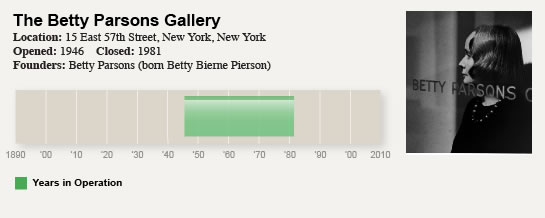
Summary of The Betty Parsons Gallery
Once referred to as "the den mother of Abstract Expressionism," Betty Parsons was an early advocate of the great Abstract Expressionists, including Pollock, Rothko, Reinhardt, Still and Newman, long before they all achieved notoriety. Her midtown gallery, which opened in 1946 (and closed every summer so that Parsons could focus on her own art), gave the Abstract Expresionist artists their first large-scale exposure, making it one of the most prestigious art galleries in New York. In its later years, the Parsons Gallery did much to promote the works of many gay, lesbian and bisexual artists, including Agnes Martin, Ellsworth Kelly, Jasper Johns and Robert Rauschenberg.
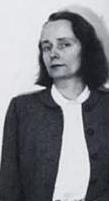
She returned to New York City in 1936. A small exhibit of her artwork was shown at the Midtown Galleries, where she was also offered an apprenticeship. In the early 1940s Parsons ran a small art gallery in the Wakefield Bookshop on 64 East 55th St. In 1944, she left the Wakefield Gallery to work at the Mortimer Brandt Gallery on East 57th St., the site of her own gallery which would open just 2 years later.
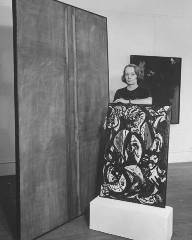 The Betty Parsons Gallery opened in September 1946, in the gallery space once occupied by art dealer Mortimer Brandt. The opening exhibit, Northwest Coast Indian Painting, was organized by Barnett Newman and Tony Smith. Newman, who wrote for many of the catalogs on behalf of the Gallery, noted, "It is becoming more and more apparent that to understand Modern art, one must have an appreciation of the primitive arts, for just as modern art stands as an island of revolt in the stream of western European aesthetics, the many primitive art traditions stand apart as authentic aesthetic accomplishments.."
By 1948 the Parsons Gallery was representing not only Newman but other AbEx greats like Pollock, Rothko and Still. Parsons herself once affectionately referred to them as her "four horsemen of the apocalypse."
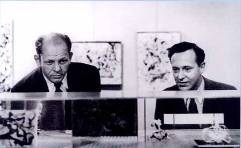 Of all things, the Parsons Gallery soon became known for its impressive exhibition schedule. The Gallery regularly exhibited 12 shows a season, from September to May, with each show lasting only 2-3 weeks apiece. This rapid turnaround was both a communication to and reflection of the swiftly changing landscape of the New York art scene. The democratic spirit of the New York School was alive and well at the Parsons Gallery as new styles and approaches to art appeared in the gallery on a weekly, if not daily, basis.
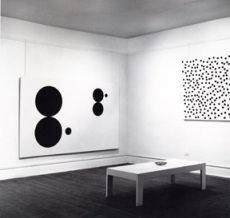 Betty Parsons strove to turn her gallery into more than just a home for New York's avant-garde. Following the departure of her "four horsemen," Parsons set out to create a haven for those artists who received less recognition - particularly women and homosexuals - during a time when the art world remained dominated by straight men. While her gallery was not among the wealthiest of New York galleries, or among the most elite, it did develop a reputation for being the definitive place where some the 20th-century's greatest artists got their start. Even after some of them left for bigger galleries and dealers (about which she was reportedly offended), Parsons remained proud of the legacy she worked to create. Allegedly, she kept a U.S. map in her office that was covered with red pins from coast to coast, marking the location of museum exhibitions where her gallery's artists were showing.
- Betty Parsons
"She was resentful. She had struggled so long to get them established, and other dealers capitalized on her efforts."
- B.H. Friedman, commenting on Parsons' reaction to the many artists who left her gallery for larger ones with more exposure
"Betty and her gallery helped construct the center of the art world. She was one of the last of her breed."
- Helen Frankenthaler
"In a sense like that in which a painter is referred to as a painter's painter or a poet as a poet's poet, Mrs. Parsons' is an artist's - and critic's - gallery: a place where art goes on and is not just shown and sold."
- Clement Greenberg, commemorating the Betty Parsons Gallery's 10th anniversary in December 1955

Beginings and the 1913 Armory Show
Betty Pierson was born into a wealthy New York family in the year 1900. The young Betty Pierson visited the New York Armory Show in 1913, the exhibit that is often credited with introducing Modern art to the United States. While visitors were enthralled by the paintings of Goya, Courbet and other mid-19th-century Realists, Parsons recalled being quite taken with the more "shocking" and spirited paintings of Picasso, Matisse and Duchamp. It was at the Armory Show that she decided to devote her life to the arts. Betty Parsons in Paris
She moved to Paris as a young woman, and for 3 years was married to Schuyler Livingston Parsons. The couple divorced in 1923, but Betty kept her married name. While living in Paris for the next decade, Parsons lived off her alimony and kept company with some of the expatriate lesbian community of Paris, among them Gertrude Stein and Sylvia Beach. Parsons returns to the U.S.
Hard hit by the Great Depression, Parsons returned to the U.S. in 1933. She spent some time on the West coast, mostly in southern California where she became fascinated with the vastness of the terrain and the sense of freedom it conveyed. She soon began experimenting in her own art, playing with color, movement and emotion, unknowingly dabbling in what Rosenberg would later dub "Action painting." In this sense, Parsons seems to have discovered Abstract Expressionism on her own. She returned to New York City in 1936. A small exhibit of her artwork was shown at the Midtown Galleries, where she was also offered an apprenticeship. In the early 1940s Parsons ran a small art gallery in the Wakefield Bookshop on 64 East 55th St. In 1944, she left the Wakefield Gallery to work at the Mortimer Brandt Gallery on East 57th St., the site of her own gallery which would open just 2 years later.
The Betty Parsons Gallery Opens
The Betty Parsons Gallery opened in September 1946, in the gallery space once occupied by art dealer Mortimer Brandt. The opening exhibit, Northwest Coast Indian Painting, was organized by Barnett Newman and Tony Smith. Newman, who wrote for many of the catalogs on behalf of the Gallery, noted, "It is becoming more and more apparent that to understand Modern art, one must have an appreciation of the primitive arts, for just as modern art stands as an island of revolt in the stream of western European aesthetics, the many primitive art traditions stand apart as authentic aesthetic accomplishments.." By 1948 the Parsons Gallery was representing not only Newman but other AbEx greats like Pollock, Rothko and Still. Parsons herself once affectionately referred to them as her "four horsemen of the apocalypse."
Looking for the "New Spirit"
Parsons always welcomed avant-garde art that contained what she referred to as a "New Spirit," recalling her life-changing experience at the 1913 Armory Show. By the 1950s, the "four horsemen" and other AbEx giants had outgrown the more modest Parsons Gallery and were picked up by wealthier art dealers such as Sidney Janis, who managed to convince both Pollock and Rothko to sign with his gallery. However, over the next three decades Parsons continued to promote artists who possessed that "New Spirit," most notably people like Kelly, Rauschenberg, Alfonso Ossario and Forrest Bess. Of all things, the Parsons Gallery soon became known for its impressive exhibition schedule. The Gallery regularly exhibited 12 shows a season, from September to May, with each show lasting only 2-3 weeks apiece. This rapid turnaround was both a communication to and reflection of the swiftly changing landscape of the New York art scene. The democratic spirit of the New York School was alive and well at the Parsons Gallery as new styles and approaches to art appeared in the gallery on a weekly, if not daily, basis. Parsons' Retirement and Death
After 36 years at the Gallery, Parsons died in 1982. The gallery held a a memorial show of Miss Parsons artworks, and operated for a few years longer. Legacy
Betty Parsons strove to turn her gallery into more than just a home for New York's avant-garde. Following the departure of her "four horsemen," Parsons set out to create a haven for those artists who received less recognition - particularly women and homosexuals - during a time when the art world remained dominated by straight men. While her gallery was not among the wealthiest of New York galleries, or among the most elite, it did develop a reputation for being the definitive place where some the 20th-century's greatest artists got their start. Even after some of them left for bigger galleries and dealers (about which she was reportedly offended), Parsons remained proud of the legacy she worked to create. Allegedly, she kept a U.S. map in her office that was covered with red pins from coast to coast, marking the location of museum exhibitions where her gallery's artists were showing. Most Important Exhibitions:
Jackson Pollock: Recent Paintings
Run time:
January 5 - 23, 1948Artists Represented:
Jackson PollockImportance:
Pollock joined the Betty Parsons Gallery in 1947, after his previous dealer, Peggy Guggenheim, left New York for Italy. This exhibition is what prompted Clement Greenberg to write an extensive review of the artist for Partisan Review, lauding him at the "greatest American painter of the twentieth century," - words that eventually ended up as a Life magazine headline in 1949: "Jackson Pollock: Is He the Greatest Living Painter in the United States?" Although others like Meyer Schapiro and Peggy Guggenheim had noted Pollock's natural gift for painting early on, and Greenberg is the critic often credited with making the artist's career, it was the solo exhibition at Betty Parsons that generated interest in Pollock outside the insulated art world.Ellsworth Kelly
Run time:
September 23 - October 12, 1957Artists Represented:
Ellsworth KellyImportance:
Kelly's very first New York solo exhibition took place at the Parsons Gallery in May 1956, and received tepid critical response for the artist's supposed European, pseudo-Expressionistic tendencies. His second show at Parsons, in 1957, received much more favorable reviews. Three of his paintings from this show were selected for an exhibition at the Whitney Museum, Young America 1957. Kelly's selected paintings, including his much praised, and at the time revolutionary, Painting in Three Panels, were the standouts among the 30 artists represented at the Whitney. Kelly's career soon skyrocketed due to subsequent praise from the likes of Greenberg and Fried, but it was at Betty Parsons where Kelly received his first of several opportunities in New York to exhibit his work. Quotes
"I give them walls. They do the rest." - Betty Parsons
"She was resentful. She had struggled so long to get them established, and other dealers capitalized on her efforts."
- B.H. Friedman, commenting on Parsons' reaction to the many artists who left her gallery for larger ones with more exposure
"Betty and her gallery helped construct the center of the art world. She was one of the last of her breed."
- Helen Frankenthaler
"In a sense like that in which a painter is referred to as a painter's painter or a poet as a poet's poet, Mrs. Parsons' is an artist's - and critic's - gallery: a place where art goes on and is not just shown and sold."
- Clement Greenberg, commemorating the Betty Parsons Gallery's 10th anniversary in December 1955
Content written by:
Justin Wolf
Justin Wolf
THIS PAGE IS OLD
The Art Story Foundation continues to improve the content on this website. This page was written over 4 years ago, when we didn't have the more stringent/detailed editorial process that we do now. Please stay tuned as we continue to update existing pages (and build new ones). Thank you for your patronage!
WORKS OF ART:
 |  |  |
| FEATURED BOOKS: Written about Parsons  Lesbian Identity and the Politics of Representation in Betty Parson's Gallery Lesbian Identity and the Politics of Representation in Betty Parson's Gallery Written by Betty Parsons Betty Parsons: Paintings, gouaches and sculpture Contemporary art from the estate of Betty Parsons RESOURCES: Articles about Parsons Betty Parsons: A Painting Retrospective Hamptons.com August 15, 2006 The Painted Sculpture of Betty Parsons CUNY Newswire August 23, 2006 Betty Parsons and the Women at Anita Shapolsky Art in America February 2006 Records and Archives Betty Parsons Gallery Records and Betty Parsons Papers, 1927-1985 1927-1985 Smithsonian Archives of American Art Now fully digitized and available online Interview Oral History Interview with Betty Parsons Conducted by Gerard Silk June 11, 1981 |