Ask The Art Story AI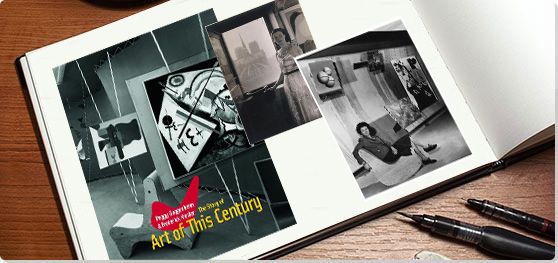



Summary of The Art of This Century Gallery
The Art of This Century Gallery, although short-lived, played a key role in launching the careers of many Abstract Expressionists. Opened by Peggy Guggenheim, who was first and foremost a collector of Surrealism and Dadaism, the gallery showcased the works of European artists, including Kandinsky, Arp, Miró, Braque, and many others. Not long after its opening, however, Art of This Century became a champion of many American artists, most of whom were experimenting with abstraction and had been working and struggling for years in New York and elsewhere. Art of This Century gave many of the soon-to-be celebrated Abstract Expressionists their first solo exhibitions, most notably Jackson Pollock.
Key Ideas & Accomplishments
- While largely showcasing Guggenheim’s own collection, she and her advisors saw the gallery as a laboratory for exhibiting the most avant-garde European and American art of the time. A painting “library” and innovative installations created a way for viewers to physically interact with the art instead of distantly observing it.
- Art of this Century Gallery was one of the few places where one could see European and American artists displayed on the same walls, thus boosting the importance of American art in many critics’ and collectors’ eyes.
- Guggenheim’s willingness to show young American artists working in a mostly abstract vein instilled a confidence within the burgeoning Abstract Expressionists, who were beginning to understand that they could create a dynamic and innovative art here in the United States without relying on Europe.
Important Art Related to The Art of This Century Gallery

The Blind Swimmer (1934)
In addition to being Peggy Guggenheim's husband and acquisitions adviser, Ernst also showed several of his works during the first few years Art of This Century was open. His Blind Swimmer was among these exhibited. The mysterious image in the center of the canvas recalls a plant or human biological part, perhaps in cross section. Its placement at the center of concentric circles and radiating lines adds to the sense of looking at a biological specimen. Similar to some of his early Dada-ist collages, Ernst’s painting moves into the Surrealist realm with its unknown, perplexing imagery.
While Surrealism had been seen in New York before Guggenheim’s gallery opened, many of the earliest shows at Art of this Century focused on Surrealism and became a sort of meeting place for those exiled Surrealists, thus introducing the younger American artists to their European idols. While originally in the collection of Art of This Century, one of Henri Matisse’s heirs purchased the painting from Guggenheim and eventually donated it to the Museum of Modern Art.
Oil and graphite on canvas - The Museum of Modern Art, New York

Mural (1943)
Peggy Guggenheim commissioned this mural for her new apartment on 61st street. Piet Mondrian encouraged Guggenheim’s patronage of Pollock when he told her at the 1943 Spring Salon at Art of This Century upon seeing his work, “I have the feeling I’m looking at some of the most exciting art that I’ve seen so far in America.” Subsequently she signed a contract with Pollock and paid him a monthly stipend that allowed him to quit his job as a carpenter at the Museum of Non-Objective Painting, as the Solomon R. Guggenheim Museum was then known.
She originally planned for the mural to be painted on the wall of her entrance hall, but Duchamp recommended canvas, since it could be moved. The work was supposed to be finished for her exhibition of his work in November 1943, but the artist felt, as he said, “completely blocked.” As months went by, Guggenheim said that he needed to finish it by her birthday in February or she would cut off his stipend. While rumors suggest that Pollock completed the work in one night, just in time to deliver it for her birthday, conservation examination has shown that he had already been working on the painting. The work appeared to great acclaim. Critic Clement Greenberg saw it as the arrival of “a great artist,” and the story of its making became part of the legend that surrounded Pollock. Before leaving for Venice, Guggenheim donated the work to the University of Iowa Museum, marking just one of the many times she donated a number of Pollock’s celebrated works to various institutions.
Oil on canvas - University of Iowa Art Museum

Red and Black (1945)
In 1945, Art of This Century showed The Women, a follow-up to Exhibition by 31 Women in 1943. Many of the original artists participated, but the new exhibition also included works by sculptor Louise Bourgeois and painters Lee Krasner and Charmion von Wiegand. Nell Blaine, a student of Hans Hoffman and one of the younger members of the Abstract Expressionists, was included, exhibiting Red and Black along with several other paintings. While known for her more realistic paintings of landscapes and still lifes, Blaine’s early work explored abstraction. Here, the hard edges of the red, blue, and black forms read as indecipherable shapes on a sign board. Resolutely grounded in the late work of Henri Matisse as well as Fernand Leger, Piet Mondrian, and Jean Arp, Blaine’s work would have been at home on the wall of Art of this Century Gallery, with its twin emphasis on Surrealism and pure abstraction. Also, in 1945, Blaine had her first solo show at the Jane Street Gallery, one of the first cooperative galleries in Greenwich Village, and other artists such as Leland Bell, Judith Rothschild, and Larry Rivers regularly exhibited there.
The responses to the show reveal the gendered biases of art critics at the time. The chief art critic for the New York Times wrote, "There is nothing save the catalogue to indicate that these artists are women. The work might just as well have been produced by 'The Men.'" And a reviewer in Art News remarked, “The women who Peggy Guggenheim has picked for her string have definitely something on the ball. The most surprising trait here is an almost masculine vigor of ideas ... the works as a whole balance satisfactorily in the Art of This Century Galleries promoting new conception of the weaker sex. Other all-female organizations should have a look-in at a show which is so refreshingly un-ladylike.” While seemingly meant to be compliments, such remarks remind us of the entrenched biases that women — artists and gallerists — have faced through the decades of the 20th century.
Oil on canvas - Tibor de Nagy Gallery
History
Beginning
In 1898, Marguerite Guggenheim was born into wealth and prosperity. Her father, Benjamin Guggenheim, was director of the Guggenheim family's industrial mining and smelting interests, and her uncle Solomon R. Guggenheim was the founder of the Museum of Non-Objective Art, which came to be known as the Solomon R. Guggenheim Museum.
Home schooled and sheltered from the outside world for most of her childhood, Peggy cultivated an independent and bohemian life that transgressed the upper-class norms of her family. In 1919, Guggenheim inherited a large sum of money from her family trust and moved to Paris, where she began subsidizing the work of several artists and writers.
By 1938, Peggy was living in London and opened the Guggenheim Jeune Gallery, a modern art gallery that became famous for an exhibit of the artist Jean Cocteau curated by Marcel Duchamp. Receiving much curatorial guidance from Duchamp, the Guggenheim Jeune Gallery also exhibited works by Kandinsky, Calder, Arp, Ernst, Picasso, and Miró.
Guggenheim had plans to start a museum of her own in London, but after the outbreak of World War II, she decided the venture would be too difficult. Nonetheless, she continued traveling to Paris to collect works of art from the likes of Giacometti, Magritte, and Braque. In 1940, only days before the German invasion of Paris, Guggenheim left for New York City along with hundreds of her artworks and her soon-to-be husband Max Ernst.
Art of This Century Opens
Using the many works of art she had acquired in Paris, Guggenheim opened her Art of This Century Gallery in October 1942 in the heart of the uptown gallery world on West 57th Street. Three of the rooms held Guggenheim’s personal collection and were divided into the “Kinetic Gallery,” the “Surrealist Gallery,” and the “Abstract Gallery.” The “Daylight Gallery” was home to rotating, temporary exhibitions. The gallery's initial displays showcased the work of European Surrealists and Cubists. According to the press release on the gallery’s opening, it was to be a “research laboratory for new ideas” and to “serve the future instead of recording the past.”
Guggenheim entrusted Austrian architect Frederick Kiesler with designing the interior of the gallery. He created concave walls and protruding, razor-thin wooden frames in the middle of the gallery space, which gave the hanging canvases a free-floating effect. Guggenheim and Kiesler believed that each painting should literally stand on its own and not be bound to the wall. A review of the opening in Time magazine described the inventive interior: “Beyond the painting library, gallery-goers enter a kind of artistic Coney Island. Here are shadow boxes, peepholes, in one of which, by raising a handle, is revealed a brilliantly lighted canvas by Swiss painter Paul Klee. Another peep show, manipulated by turning a huge ship's wheel, shows a rotating exhibit of reproductions of all the works, including a miniature toilet for MEN, by screwball Surrealist Marcel Duchamp. Beyond these gadgets mankind swarms into what seems to be a decorated subway. There spectators gaze at large canvases by England's Leonora Carrington, Spain's Joan Miró, Chile's Roberto Matta, all their works unframed, suspended in the air from wooden arms protruding from concave plywood walls. Every two minutes, while onlookers enjoy the spectacle, a roar as of an approaching train is heard, lights go out on one side of the gallery, pop on at the other.”
Kiesler felt that with the chaos of the modern world, we “must be architects of a new unity.” This physically interactive display of art works has seldom been replicated, but it was an enormous revelation to the young artists struggling to find their voices in New York City.
The Uptown Group
With the advice from her advisor Howard Putzel, whom she befriended while in Paris in the company of Duchamp, the gallery soon began representing young American artists like Jackson Pollock, Clyfford Still, and Robert Motherwell. For a number of reasons, many American artists did not participate in World War II and struggled to make their ways as artists after the shuttering of the WPA’s Federal Fine Arts Program. In the early 1940s, a small and largely disorganized group of artists found themselves without suitable venues to show their work, until the opening of Peggy Guggenheim's gallery. Sometimes called The Uptown Group by downtown artists who did not have gallery representation, its unofficial membership included Pollock, Lee Krasner, Adolph Gottlieb, Motherwell, Mark Rothko, Clyfford Still, and Ad Reinhardt.
Perhaps most consequentially, on the advice of Marcel Duchamp and Piet Mondrian, her trusted advisors, Guggenheim became Pollock’s patron. Paying him a monthly stipend, Guggenheim had first choice of the paintings he made. This arrangement allowed Pollock and Krasner to leave the city and buy a house in Springs, the working-class enclave in East Hampton on the south fork of Long Island, in 1945. Guggenheim also commissioned Pollock to paint a mural for the entryway to her apartment and gave him his first one-person show in 1943, which many critics, including Clement Greenberg, received favorably.
Important Exhibitions
During its short existence, The Art of This Century Gallery hosted a number of important exhibitions. In January 1943, artists such as Alice Trumbull Mason, Gypsy Rose Lee, Frida Kahlo, Dorothea Tanning, Hedda Sterne, and many others were included in Exhibition by 31 Women. This show was the first of its kind, devoting the gallery space exclusively to Modern women artists, most of whom were operating in New York. When Guggenheim dispatched Max Ernst, her husband at the time, to select paintings for the exhibition, one of Ernst's favorites was a self-portrait by Dorothea Tanning, which he named Birthday. Ernst and Tanning had a love affair, which led to Ernst resigning from his advisory role at Art of This Century and his eventual divorce from Guggenheim in 1946. The show did not garner much press, and one critic reportedly refused to cover it because he didn’t think there were any women artists worthy of attention.
Pollock’s first solo show ran in November of 1943, and he was the first of his generation of Abstract Expressionist artists to exhibit regularly and earn a living solely from his art. Museum of Modern Art curator James Thrall Soby visited the exhibition and was instantly amazed by Pollock's work. Consequently, the painting She-Wolf was purchased by the Acquisitions Committee at the Museum of Modern Art and placed in its permanent collection. Guggenheim was so enamored with Pollock's paintings that when she transferred representation of her artists over to Betty Parsons in 1947, she wrote Parsons a letter to personally thank her for taking on Pollock and giving him his own show at the new gallery. Guggenheim did this service for no other artist.
Additionally, early shows for William Baziotes, Robert De Niro, Sr., Mark Rothko, Clyfford Still, and Richard Pousette-Dart helped to establish the nascent Abstract Expressionist group.
Guggenheim Returns to Europe
In 1947, wanting a fresh start, Guggenheim closed down The Art of This Century and moved back to Europe, settling in Venice. Before leaving New York for good, Guggenheim found new representation for her many American artists at the Betty Parsons Gallery, which had opened one year prior on East 57th Street, not far from Art of This Century. In 1948, Guggenheim’s collection was given a privileged place in the Venice Biennale, and her collection, housed in a Venetian palazzo, eventually opened to the public in the early 1950s and remains one of the most popular destinations in Venice.
Legacy
Throughout her life, Peggy Guggenheim gave away much of her private collection. The works she acquired in the 1930s and 40s in particular, with the counsel of Duchamp and Ernst, were among the finest modern artworks of the 20th century. Her Art of This Century Gallery, despite being open for only five years, was renowned for being the primary gallery that gave many Abstract Expressionists their very first opportunity to show their art to the public.
Kiesler’s interior design did not seem to have immediate effects on other galleries, and in fact the curving walls were sold to a clothing store. Curving gallery walls wouldn’t be seen again until the late 1950s when the new building created by Frank Lloyd Wright for the Solomon R. Guggenheim Museum opened its doors.