Ask The Art Story AI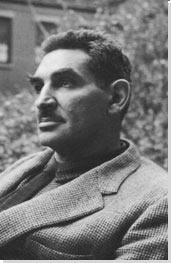

Summary of Harold Rosenberg
Harold Rosenberg is remembered as one of the most incisive and supportive critics of Abstract Expressionism. His famous 1952 essay, "The American Action Painters," effectively likened artists such as Willem de Kooning and Franz Kline to heroic existentialists wrestling with self-expression. And his stress on the expressive and thematic content of their art ultimately made his writing more popular - at least in the 1950s - than the formalist criticism of his rival, Clement Greenberg. Originally a contributor to fringe, leftist magazines such as The Partisan Review, Rosenberg went on to the influential post of art critic for The New Yorker. His reading of gestural abstraction as Action Painting also proved important for early promoters of happenings and performance art, such as Allan Kaprow.
Accomplishments
- Harold Rosenberg was the most influential critic and supporter of the Abstract Expressionists in the 1950s. His description of them as "action painters," and his stress on their dramatic and personal confrontation with the canvas, provided a compelling image of their creative process, and one that also proved popular with the artists themselves. He believed that the action painters worked almost without regard for conventional standards of beauty: their achievement was an authentic expression of individuality and humanity.
- Rosenberg saw Abstract Expressionism as a major rupture within the history of modern art. As he put it, "At a certain moment the canvas began to appear to one American painter after another as an arena in which to act... What was to go on the canvas was not a picture but an event." Rather than strive to produce a perfect finished picture, Rosenberg believed the new American painters threw all their energies into the charged moment of creation - what was registered on the canvas was merely a record of that moment.
- Even though Rosenberg proclaimed that with the advent of the New York School Paris had been eclipsed as the fount of new art, his writing was strongly marked by the Existentialist philosophy prominent in Paris at the time.
- Although Rosenberg was the dominant New York critic in the 1950s, he lost out to Greenberg in the following decade, when the artists he championed, such as de Kooning, began to be sidelined in favor of Color Field Painting.
Ideas and Analysis by Harold Rosenberg of Important Artists and Artworks

Girl before a Mirror (1932)
This mid-life painting by Picasso, while made before "Abstract Expressionism" or "Action Painting" were ever part of our vocabulary, is an apt example of painting as an event. Rosenberg often writes about the artist getting inside an image and developing a relationship with his canvas, and in Girl before a Mirror, Picasso is not only jumping into the canvas, but depicting his woman (possibly his beloved Marie-Thérèse) doing likewise with her reflection.
Oil on canvas - The Museum of Modern Art, New York
Organisation (1933-36)
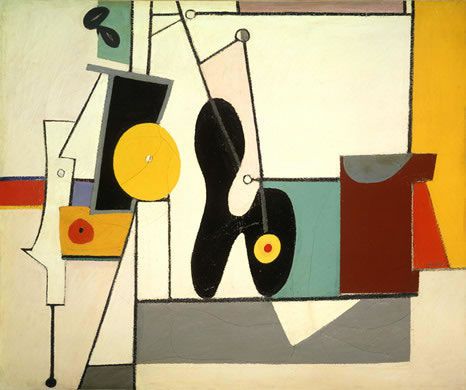
The artist Arshile Gorky is a complex figure; born in Turkish Armenia, he later adopted the surname of a Russian writer, and schooled himself in the works of Joan Miró, Paul Cézanne, and Pablo Picasso before immersing himself in Surrealism and later, Abstract Expressionism. Gorky's artistic evolution, as it were, provides a wonderful example for Rosenberg's discussion of "Redcoatism" and "Coonskinism" in the essay 'Parable of American Painting.' It suggests that Gorky has so fully digested the history of modern painting that he is no longer encumbered by the need to learn, and to follow its rules - he can begin anew.
Oil on canvas - The National Gallery of Art, Washington DC
Trafalgar Square (1939-43)
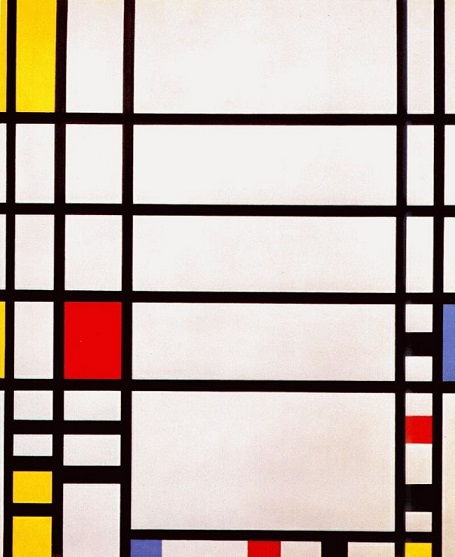
One topic that fascinated Rosenberg was radicalism and revolution in art; not an easy thing to grasp. He didn't believe that radical art had anything to do with political radicalism, but with the artist's ability to "express his entire personality" in the canvas. When he looked upon Mondrian's strange and minimalist cityscapes, like the one seen above, he saw Mondrian "conceiving 'healthy and beautiful cities by opposing buildings and empty spaces in an equilibrated way.'" This was, according to Rosenberg, a New Order of painting.
Oil on canvas - The Museum of Modern Art, New York

Fire Island (1946)
When Rosenberg first identified Action Painting as an event in and of the canvas, he was almost certainly considering the works of Willem de Kooning. In Fire Island, there is an event, or a series of them, in progress. In his essay 'Everyman a Professional,' Rosenberg writes that "The public receives the work in the form of ideas into which it has been translated. Thus every modern work of art is in essence criticism; the artist paints it as an assertion in paint about painting, and the audience admires it as an assertion in paint about words." When Rosenberg looks at a de Kooning work, he sees the artist not only communicating with the canvas, but with the act of painting itself, as well as with his audience.
Oil on paper - The Margulies Family Collection

Harold Rosenberg (1956)
This Rosenberg portrait by Elaine de Kooning is among the finest of all the artist's portraits. She was renowned among friends and fellow artists (among them Pollock, poet Frank O'Hara, and of course, Rosenberg) for painting her portraits while simultaneously conducting social salons. She would throw paint onto the canvas in that frantic, Abstract Expressionist manner, to the point where each work was an event in its own right. One writer commented, "It looked more like me than the real thing." We can interpret that Elaine de Kooning was creating events that brought her subjects closer to themselves, or what Rosenberg called "the exhilaration of an adventure over depths in which he [artist and/or subject] might find reflected the true image of his identity."
Oil on canvas - National Portrait Gallery, Smithsonian Institution, Washington DC
Red Balloon (1922)
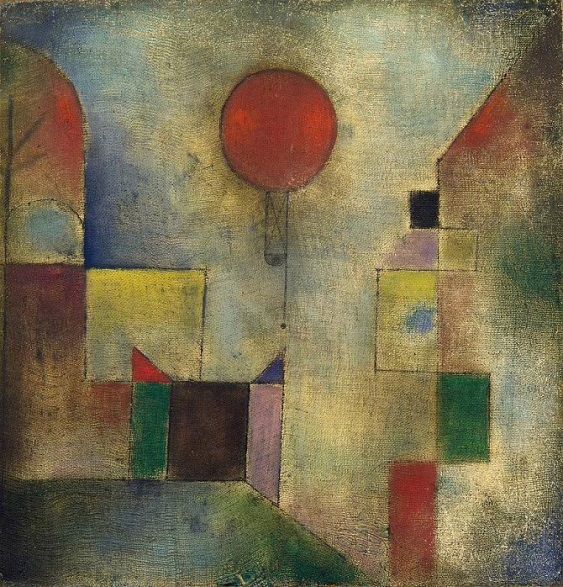
In Rosenberg's essay "Revolution and the Concept of Beauty," the critic cites Paul Klee's quote: "I want to be as though newborn, knowing nothing, absolutely nothing about Europe .. to be almost primitive." According to Rosenberg, Klee is not expressing a desire to revert to his innocent, childhood self; what he desires is an ignorance of all the "revolutionary" moments in art that have come before him. He wants his art to be its own revolution, and not some dot in the time line of revolutionary European artists. Klee's Red Balloon is one of many works that, although it may appear innocent, was labeled "degenerate" by the Nazis in the artist's native Germany. The colors are indeed playful, and the geometric shapes seem to dance, as if from a "newborn" artist discovering his gift for the first time, but due to the small-mindedness of the Third Reich, Klee's work became revolutionary seemingly by accident.
Oil on muslin primed with chalk - The Solomon R. Guggenheim Museum, New York
Biography of Harold Rosenberg
Childhood and Education
Born to Abraham Benjamin and Fanny Edelman Rosenberg, Rosenberg spent his childhood in Brooklyn. For a brief time, he attended classes at City College (1923-24) before enrolling in St. Lawrence University (Canton, New York). He graduated with a law degree in 1927. Shortly thereafter, he contracted osteomyelitis, a bone infection that would force him to walk with the assistance of a cane for the rest of his life, and which also kept him from military service during World War II.
Early Years
Not long after law school, Rosenberg became a New York bohemian - studying the writing and philosophy of Karl Marx, writing poetry, and publishing in The Partisan Review. He would later recall this early period by saying that he was "educated on the steps of the New York Public Library."
During the Depression, Rosenberg found work writing about the arts for the government-supported Works Progress Administration (WPA). It was during this time that he first met Willem de Kooning, with whom he often discussed abstract art. His encounter and ensuing friendship with de Kooning was a major turning point in his life and career.
Through the WPA, Rosenberg was able to keep working almost constantly, even though many of his writings were censured by the WPA early on. In 1938, he moved to Washington, D.C. to assume the arts editorship for the WPA American Guides, a series of books and pamphlets funded by the Federal Writers' Project, which were designed to supply travel guides to all 48 states, as well as various cities.
The first major piece of writing to lend Rosenberg any notoriety was his 1940 essay 'The Fall of Paris.' Originally published in The Partisan Review, it announced the demise of Paris as the leading center of experimentation and innovation in modern art, and claimed that New York had moved into its place.
As World War II continued, Rosenberg published a book of his poetry in 1943 titled Trance Above the Streets. At this time he was also working for the Office of War Information and the War Advertising Council.
In the late 1940s, Rosenberg, along with Robert Motherwell, Pierre Chareau and John Cage, edited and released the one and only issue of the journal Possibilities, which promoted many abstract artists known throughout Greenwich Village (such as Barnett Newman, Robert Motherwell and Willem de Kooning) and the bohemian getaway of East Hampton, New York.
Middle Years
It was in 1952 that Rosenberg really gained the art community's attention with the publication of 'American Action Painters' in the magazine Art News. The piece, which introduced the term "Action Painting" to the American public, is still recognized as a seminal work.
In 1959, Rosenberg's first collection of essays was published as The Tradition of the New, for which Willem de Kooning provided the cover art. In a sense, Tradition was Rosenberg's manifesto on modern art. The title of the book, along with the term Action Painting, quickly became part of the popular vocabulary of art.
The publication of The Tradition of the New garnered several awards for Rosenberg, and made the academic world take notice of him. After working as a lecturer on behalf of Princeton University and Southern Illinois University, Rosenberg was offered the position of Professor of Art at the University of Chicago in 1966. Despite his dislike for the convergence of modern art and academia - what he perceived as an old world (the university's) attempts to grasp and theorize the new (modern art) - Rosenberg accepted the position.
Rosenberg also ascended further in the world of journalism. He began writing for The New Yorker in 1962, and in 1967, the magazine made him their resident art critic.
Later Years and Death
In 1973 Rosenberg resigned from his post on the Advertising Council (formerly the War Advertising Council) after nearly thirty years of being on the U.S. government's payroll.
Between 1969 and 1975 he published five different essay collections, with titles such as Artworks and Packages, Act and the Actor, and Discovering the Present. There are also various collections of his writings that were compiled posthumously.
In 1978, shortly before his death, he completed a book-length study of the artist Barnett Newman, and helped curate a show at The Whitney Museum of American Art looking at the work of his friend and colleague on The New Yorker, Saul Steinberg.
Rosenberg continued writing for The New Yorker throughout the '60s and '70s. In 1978, he suffered a stroke and contracted pneumonia, which resulted in his death in his Long Island home that same year.
The Legacy of Harold Rosenberg
Above all, Rosenberg's legacy is his creation of the term Action Painting. No other label was so widely embraced in the 1950s as a description of the style and attitudes of gestural painters such as Willem de Kooning and Franz Kline. With it, he instilled the idea that in Abstract Expressionist painting the marks on the surface of the canvas are a record of immediate experience.
Most Important Essays
"The Fall of Paris"
Originally published in Art News, 1940
From The Tradition of the New
This 1940 essay proclaimed that the time had passed when Paris could be a home to artists, writers and social progressives of every nation; it could no longer be the home of the avant-garde. With the advent of World War II and Hitler's Third Reich, Europe could no longer be the cradle of modern culture. "Modernism in art was suppressed in order to seal the secret of the tyrant's spirit," writes Rosenberg . "At the stroke of the Hitler gong, the last tremors in art, literature, science, politics, cease as if at a signal."
He writes: "No folk lost integrity there [Paris]; on the contrary, artists of every region renewed by this magnanimous milieu discovered in the depths of themselves what was most alive in the communities from which they had come. In Paris, American speech found its measure of poetry and eloquence." This last comment refers to writers like T.S. Eliot and Ernest Hemingway, American expatriates who found their artistic muse in 1920s Paris. But it was also the place where Picasso, a Spaniard, first discovered his artistic genius. The international community of the vanguard arts, once settled in Paris, was now quickly settling in New York City.
The Fall of Paris proclaimed a new stage in American world dominance. The country had attained leadership in economics, politics, and even military culture, but not until the early years of World War II was it conceivable that a U.S. city could be home to the world's vanguard culture.
"The American Action Painters"
Originally published in Art News, 1952
From The Tradition of the New
This is the essay that came to define Rosenberg's career as a critic and writer. It was also the first time he coined the term 'Action Painters' to refer to the Abstract Expressionists. Indeed he preferred the term because he argued that what artists were expressing on the canvas wasn't abstract, but something deeply personal and familiar.
Rosenberg argues that the very act of painting an abstract painting is a personal journey for the artist. They are leaping into the canvas, in a sense, and acting on pure instinct; in the end what we're left with is a product of the painter as actor. "The big moment came when it was decided to paint," writes Rosenberg, "..just to PAINT. The gesture on the canvas was a gesture of liberation."
Rosenberg does not specify which artists he understands to be 'Action Painters,' but the term always best described the work of gestural painters such as his friends de Kooning, and Franz Kline, rather than Color Field painters such as Barnett Newman and Mark Rothko.
Rosenberg shuns the notion that the Action Painters are deliberately attempting to make great art; Rosenberg understood the undertaking as more than that. He writes that "A painting that is an act is inseparable from the biography of the artist." When Rosenberg would look at a painting by de Kooning, for example, he would see the artist pouring the essence of himself onto the canvas.
"Parable of American Painting", 1954
From The Tradition of the New
In this essay Rosenberg set out to explain what he believed to be definitively American about Abstract Expressionism. He did so by drawing on the American Revolutionary War for his metaphors, likening the new Americans to the coonskin trappers whose knowledge of their terrain enabled them to pick off the British soldiers (Redcoats), who followed the dictates of their military training. The professionally-trained soldiers were defeated because, as Rosenberg states, "They were such extreme European professionals ... they did not even see the American trees."
"Redcoatism" was, Rosenberg argued, a symptom of the old European world's stubborn rejection of the new. It did at one time also "[dominate] the history of American art," he wrote, but with the advent of Abstract Expressionism, times had changed. And just as the Coonskins were victorious because they stood apart from the professional military, so the new American art was triumphant because, as Rosenberg saw it, it marked a profound break with the traditions of European art.
"Revolution and the Concept of Beauty", 1959
From The Tradition of the New
"The decision to be revolutionary usually counts for very little," writes Rosenberg. "The most radical changes have come from personalities who were conservative and even conventional."
Rosenberg uses this essay to highlight not so much the art, but the approaches to making art of Paul Cézanne, Piet Mondrian, Paul Klee and others; artists who became revolutionaries not because they were part of any movement but, paradoxically, because they didn't want to be revolutionary.
The artist who gets caught up in a revolution of the arts is also caught up in a political revolution; the two cannot be mutually exclusive. And, according to Rosenberg, a political revolution "wants to finish with the past, to 'bring history to an end'."
With such conflict at hand, Rosenberg concludes the following: art should concern itself with art itself, not politics. Radical changes in the art world must not be anticipated or deliberately strived for; such action is folly. "The painting must be shown as standing in relation to the values of painting, not to the value of ending values."
Art Theory
Introduction to Rosenberg's Art Theory
Harold Rosenberg viewed modern art in the 20th century as a giant laboratory where experiments took place, and like any good experiment, there must be trial and error. Action Painting as he saw it was a prime example of such experiment, since it was premised more on spontaneous, felt expression than on coldly preconceived designs. The experiment of abstract art was an occasion for spontaneous action. In this laboratory, Rosenberg proffers that "The painter was no longer concerned with producing a certain kind of object, the work of art, but with living on the canvas." This perspective, from his essay "The American Action Painters," marked a major turning point in how the art world viewed modern painting. Rosenberg's theory challenged Clement Greenberg's belief that contemporary American art had evolved out of European modernism in a constant process of renewal.
Rosenberg on Marxism and Abstraction
Rosenberg was first introduced to theories of abstract art upon meeting Willem de Kooning. At first, he struggled with them because they ran counter to his Marxism, which advocated that art should be put in the service of society. But his friendship with de Kooning led to a change in his thinking.
He continued to believe that art and society were interlinked, but he began to view art as a way of countering the values he deplored in wider society. And as he absorbed the Existentialism of writers such as John-Paul Sartre and Albert Camus, he came to an understanding of abstract art as an urgent means to assert the authentic self, to express individual identity, in the face of the anonymity of the modern world.
Indeed, Rosenberg eventually grounded his support for Action Painting in his belief that it represented a way of confronting what he saw as a crisis in culture, society, and politics. Unlike his rival, Clement Greenberg, who believed artists needed to turn away from this crisis in order to preserve the values inherent in high art, Rosenberg argued that it was necessary to confront the crisis.
Rosenberg on Paris, New York, and the "New Globalism"
One of Rosenberg's most famous early essays, 'The Fall of Paris,' (1940) argued that with the arrival of World War II, Paris's role as the "laboratory of the 20th century" had ended, and the job of cultural leadership had passed to New York. While the observation would later be proven true that New York came to dominate post-war art - his opinion was typical of the chauvinism that infected many American critics at this time, and Rosenberg later modified his attitude. In a 1963 New Yorker review, subtitled 'International Art and the New Globalism,' he wrote: "The early-20th-century internationalism in art has been dead for thirty years - since the ending of the Paris art movements and the closing down of its capital by the Depression, the War, and the Occupation. It has been superseded by a global art whose essence is precisely the absence of qualities attached to any geographical center. In the present globalism, there is no opening for a 'new Paris.'"
On the significance of "American Action Painters"
Rosenberg's essay 'American Action Painters' (originally published in Art News in 1952, then republished in his essay collection The Tradition of the New in 1959) introduced a new theory on how and why abstract artists made their art. The title Action Painting was used in place of the less-favored "Abstract Expressionism," which he derided because he believed what was expressed on the canvas wasn't exactly abstract, but something deeply personal and familiar. Rosenberg's label became a favored alternative to "Abstract Expressionism," most likely due to the fact that it made modern art feel more accessible to the public. Action Painting was far more descriptive and gave the viewer a clearer idea of what the artist was doing.
Interestingly enough, Rosenberg makes no mention of specific artists to whom the term Action Painting would apply (in fact, it's still debated to this day whether Pollock or de Kooning was the inspiration for the term). The essay and its title were designed to emphasize the art world's need to look at each Action Painting as an individual event. De Kooning's Woman series or Pollock's drip paintings, for example, are not depicting specific images or scenes from the artists' minds, but rather the events of their consciousness. Just as the reader of a novel develops a relationship with the characters within, the Action Painters have a similar relationship with the canvas on which they paint, and if this is true, then the viewer will develop a relationship with the canvas as well. Conveying an image or picture of the world, but striving for the most authentic expression of their individuality and humanity: this, as Rosenberg put it, "is not a picture but an event." It also suggests a new way to look at pictures: rather than meaning arising from the way the artist has carefully arranged the forms and figures, Rosenberg suggests we should think about the flurry of activity that produced those forms, and the artist's state of mind when he went to work.
Rosenberg on the Academy of Art
While he held several professorships and college lecturing posts throughout his later career, Rosenberg was generally distrustful of academia. He saw great value in the study of art history since it could help inform artists and art lovers alike about where great art comes from; but he believed the relationship should end there.
According to Rosenberg, the academy's attempt to define art, particularly abstract art, was in itself a crime, because it sought to pigeonhole artistic achievements into specific contexts - be they social, political, psychological, geographic or otherwise. Rosenberg believed these attempts undermined the individual achievements of the artists, who in all likelihood had no grand political or social aspirations, but just wanted to paint something profound.
Rosenberg on Color Field and Hard-Edge Painting
Unlike his key critical rival, Clement Greenberg, Rosenberg was not supportive of some of the developments in painting in the late 1950s and '60s, namely those associated with Color Field and hard-edge painting, such as the work of Ellsworth Kelly and Frank Stella. Rosenberg viewed these artists' work as simply trying to capitalize on earlier modes of abstraction; worse, he believed them to be taking an academic approach to more important work of predecessors like de Kooning, Pollock and Rothko.
Rosenberg and Existentialism
Although the roots of Existentialism can be traced back to the 17th century, it became a particularly voguish movement in the 1940s and '50s. Essentially the philosophy insists on the importance of personal, individual experience. It prizes human experience and all its profundities, and sees it as constantly at odds with an otherwise absurd and meaningless world; the course of one's life is completely dictated by individual choices, and there are no invisible outside forces that determine the course of events. It also supposes that nothing in the world of mankind can be viewed objectively.
Rosenberg's understanding of Abstract Expressionism was closely tied to these ideas. When de Kooning or Pollock approached a canvas, he saw them as entering an encounter with the canvas, and the marks they left on the canvas were the traces of that supremely personal encounter. There is an existential drama occurring for such artists, because the style of action painting reveals the very process of painting (drips, heavy brush strokes), and this process is synonymous with the painter's personality. According to Rosenberg, the act of creating these paintings is an existential exercise, a brutally honest form of self-expression.
Writing Style
The art critic Jed Perl has written of Rosenberg: "out of his powerful body emerged an endless stream of words. Rosenberg began his essays with grand assertions and aimed to keep them so much to the fast-talking, big-thinking level that the reader, gulping for air and a little relief, may have felt assaulted by an almost scattershot intellectual grandeur."
Rosenberg was an emotional writer, yet his style is philosophical without becoming too academic or bogged down by theoretical meandering. With each essay or review he wrote, Rosenberg's aim wasn't so much to draw conclusions about art, but to raise questions about the importance of art and its history.
Influences and Connections
-
![Paul Cézanne]() Paul Cézanne
Paul Cézanne -
![Pablo Picasso]() Pablo Picasso
Pablo Picasso -
![Arshile Gorky]() Arshile Gorky
Arshile Gorky -
![Willem de Kooning]() Willem de Kooning
Willem de Kooning ![Saul Steinberg]() Saul Steinberg
Saul Steinberg


-
![Charles Baudelaire]() Charles Baudelaire
Charles Baudelaire -
![Guillaume Apollinaire]() Guillaume Apollinaire
Guillaume Apollinaire ![Edgar Allan Poe]() Edgar Allan Poe
Edgar Allan Poe![Karl Marx]() Karl Marx
Karl Marx![Samuel Taylor Coleridge]() Samuel Taylor Coleridge
Samuel Taylor Coleridge


-
![Willem de Kooning]() Willem de Kooning
Willem de Kooning -
![Elaine de Kooning]() Elaine de Kooning
Elaine de Kooning ![Al Held]() Al Held
Al Held![Jack Reilly]() Jack Reilly
Jack Reilly


-
![John Russell]() John Russell
John Russell -
![Thomas B. Hess]() Thomas B. Hess
Thomas B. Hess ![Tom Wolfe]() Tom Wolfe
Tom Wolfe![Herbert Read]() Herbert Read
Herbert Read![Barbara Rose]() Barbara Rose
Barbara Rose


-
![Postmodernism]() Postmodernism
Postmodernism ![Abstract Illusionism]() Abstract Illusionism
Abstract Illusionism