Ask The Art Story AI



Summary of Andy Warhol
Andy Warhol was the most successful and highly paid commercial illustrator in New York even before he began to make art destined for galleries. Nevertheless, his screenprinted images of Marilyn Monroe, soup cans, and sensational newspaper stories, quickly became synonymous with Pop art. He emerged from the poverty and obscurity of an Eastern European immigrant family in Pittsburgh, to become a charismatic magnet for bohemian New York, and to ultimately find a place in the circles of High Society. For many his ascent echoes one of Pop art's ambitions, to bring popular styles and subjects into the exclusive salons of high art. His crowning achievement was the elevation of his own persona to the level of a popular icon, representing a new kind of fame and celebrity for a fine artist.
Accomplishments
- Warhol's early commercial illustration has recently been acclaimed as the arena in which he first learned to manipulate popular tastes. His drawings were often comic, decorative, and whimsical, and their tone is entirely different from the cold and impersonal mood of his Pop art.
- Much debate still surrounds the iconic screenprinted images with which Warhol established his reputation as a Pop artist in the early 1960s. Some view his Death and Disaster series, and his Marilyn pictures, as frank expressions of his sorrow at public events. Others view them as some of the first expressions of 'compassion fatigue' - the way the public loses the ability to sympathize with events from which they feel removed. Still others think of his pictures as screens - placed between us and horrifying events - which attempt to register and process shock.
- Although artists had drawn on popular culture throughout the 20th century, Pop art marked an important new stage in the breakdown between high and low art forms. Warhol's paintings from the early 1960s were important in pioneering these developments, but it is arguable that the diverse activities of his later years were just as influential in expanding the implications of Pop art into other spheres, and further eroding the borders between the worlds of high art and popular culture.
- Although Warhol would continue to create paintings intermittently throughout his career, in 1965 he "retired" from the medium to concentrate on making experimental films. Despite years of neglect, these films have recently attracted widespread interest, and Warhol is now seen as one of the most important filmmakers of the period, a forefather of independent film.
- Critics have traditionally seen Warhol's career as going into decline in 1968, after he was shot by Valerie Solanas. Valuing his early paintings above all, they have ignored the activities that absorbed his attention in later years - parties, collecting, publishing, and painting commissioned portraits. Yet some have begun to think that all these ventures make up Warhol's most important legacy because they prefigure the diverse interests, activities, and interventions that occupy artists today.
The Life of Andy Warhol

Warhol famously said that "business art is the step that comes after Art. I started as a commercial artist, and I want to finish as a business artist." He became one of the world most successful artists, and made screen prints, sculptures, films, managed a band, and even designed wallpaper - projects that were often highly lucrative (and always built his brand).
Important Art by Andy Warhol
Campbell's Soup I
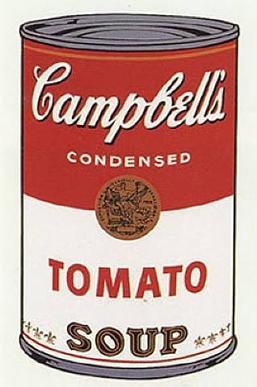
By the 1960s, the New York art world was in a rut, the very original and popular canvases of the Abstract Expressionists of the 1940s and '50s had become cliché. Warhol was one of the artists that felt the need to bring back imagery into his work. The gallery owner and interior designer Muriel Latow gave Warhol the idea of painting soup cans, when she suggested to him that he should paint objects that people use every day (it is rumored that Warhol ate the soup for lunch every single day). He painted Campbell's soup cans, Brillo boxes, and Coca-Cola bottles from 1962 onward.
Warhol started his career and became an extremely successful consumer ad designer. Here, he used the techniques of his trade to create an image that is both easily recognizable, but also visually stimulating. Consumer goods and ad imagery were flooding the lives of Americans with the prosperity of that age and Warhol set out to subtly recreate that abundance, via images found in advertising. He recreated on canvas the experience of being in a supermarket. So, Warhol is credited with envisioning a new type of art that glorified (and also criticized) the consumption habits of his contemporaries and consumers today.
Screenprint - Multiple museums, galleries, and collections

Coca-Cola (3)
"I just paint things I always thought were beautiful, things you use every day and never think about." Warhol's statement epitomizes his ethos; his works put ordinary items front and center. This idea applies to the hand-painted portrait of a Coca-Cola bottle. Another challenge to the domination of Abstract Expressionism, Warhol's Coca-Cola is equal in size to many of the popular canvases of the time (6ft x 5ft) but is devoid of their abstractions. However, there are some other similarities here. As in Barnett Newman's popular Stations of the Cross series of works, Coca-Cola is comprised of a large, black mass on a white background. The bottle jumps out at the viewer; demanding the kind of attention Motherwell's profound canvases received - yet now the sense of irony reigns.
Casein on cotton - Private Collection

Gold Marilyn Monroe
After her sudden death from an overdose of sleeping pills in August 1962, superstar Marilyn Monroe's life, career, and tragedy became a worldwide obsession. Warhol, being infatuated with fame and pop culture, obtained a black-and-white publicity photo of her (from her 1953 film Niagara) and used the photo to create several series of images. A common idea to all the Marilyn works was that her image was reproduced over and over again as one would find it reprinted in newspapers and magazines at the time. After viewing dozens, or hundreds of such images, a viewer stops seeing a person depicted, but is left with an icon of popular, consumer culture. The image (and the person) become another cereal box on the supermarket shelf, one of hundreds of boxes - which are all exactly the same.
In Gold Marilyn Monroe, Warhol further plays on the idea iconography, placing Marilyn's face on a very large golden-colored background. The background is reminiscent of Byzantine religious icons that are the central focus in Orthodox faiths to this day. Only instead of a god, we are looking at an image (that becomes a bit garish upon closer inspection) of a woman that rose to fame and died in horrible tragedy. Warhol subtly comments on our society, and its glorification of celebrities to the level of the divine. Here again the Pop artist uses common objects and images to make very pointed insights into the values and surroundings of his contemporaries.
Silkscreen - The Museum of Modern Art, New York

Sleep
In the early 1960s, during a period of immense creativity, Warhol continued to challenge the status quo through a different medium, film. Over his career Warhol made over 650 films spanning a wide range of subjects. His films were lauded by the art world, and their influence is seen in performance art and expiremental filmmaking to this day. In 2013 the actress Tilda Swinton participated in an installation where she slept in a glass box at MoMA and the writer, actress, and director Lena Dunham recently expressed her desire to remake Warhol's Sleep shot for shot, but with herself as the subject.
Sleep is one of the artist's earliest films and his first foray into durational film, a style that became one of his signatures. This six-hour movie is a detailed exploration of John Giorno sleeping. Warhol's lover at the time, the viewer sees Giorno through Warhol's eyes, a strip of Giorno's naked body is in every scene. Although this seems to be a series of continuous images, it is actually six one hundred foot rolls of film layered and spliced together, played on repeat. Repetition was at the heart of Warhol's oeuvre, as well as his fascination with the mundane. All people need to sleep; Warhol once again transformed banality into artistic expression.
Empire and Eat succeeded Sleep in the canon of Warhol's duration films. Empire chronicles eight hours of the Empire State Building at dusk and Eat is a 45 minute film about a man eating a mushroom. Warhol's themes were as expansive as his filmography, delving into more explicit areas such as homosexuality and gay culture, such as Blowjob, a continuous shot of DeVeren Bookwalter's face while he receives oral sex from filmmaker Willard Maas, and Lonesome Cowboys, a raunchy western. His films are widely recognized as Pop masterpieces, enshrined in film institutes and modern art archives across the world.
Black and White 16mm film - The Museum of Modern Art, New York

Orange Car Crash Fourteen Times
Orange Car Crash is from the Death and Disaster series that consumed much of Warhol's attention in this period. Often using gruesome and graphic images taken from daily newspapers, he would use the photo-silkscreening method to repeat them across the canvas. The repetition of the image, and its fragmentation and degradation, are important in creating the impact of the pictures, but also in sterilizing the image. To see the graphic photo once leaves the viewer distraught and shaken - but to see that photo reproduced over and over again (as seen every day in the press) undermines the image's power as the scene of horror becomes another mass-market image.
There is an alternative way to view this and other works from Warhol's Death and Disaster series proposed by the Los Angeles Times art critic Christopher Knight. The car crash shown is very similar to the photo of the Long Island car crash in which Jackson Pollock died in 1956. Warhol is reminding the viewers that Abstract Expressionism (championed by Pollock) is now dead. So maybe Warhol is not so much involved in popular art, but rather providing very specific and elite art world commentary. Similarly, Warhol's Electric Chair series has a "Silence" sign at the back of the depicted electrocution room, which Warhol connects to John Cage's modernist work with sound (and Cage's 1961 book of essays). And even further, Warhol's Race Riot series is a response to the many popular abstract works that are each labeled Black Series from modern artists such as Jackson Pollock, Robert Rauschenberg, Ad Reinhardt, and Frank Stella.
Silkscreen print on canvas - The Museum of Modern Art, New York

Brillo Boxes
Still using the silkscreen technique, this time on plywood, Warhol presented the viewer with exact replicas of commonly used products found in homes and supermarkets. This time, his art pieces are stackable, they are sculptures that can be arranged in various ways in the gallery - yet each box is exactly the same, one is no better than another. Rather than the series of slightly different paintings that have been made by many famous artists (think Monet's haystacks or cathedrals) Warhol makes the point that these products are all the same and (in his opinion) they are beautiful! Making these items in his "factory" Warhol again makes fun of (or brilliantly provokes) the art world and the artist-creator.
With Brillo Boxes, Warhol also has a personal connection. Warhol was originally from Pittsburg - steel city, the commodity that made the city prosperous and later quite depressed. Brillo is steel wool, a product stereotypically used by housewives to keep cookware shining in their lovely American homes. Did Warhol like the product itself, think the store displays for the product ridiculous, or as a gay man, did he enjoy the contrast of steel and wool, in one friendly package?
Acrylic silkscreen on wood - Norton Simon Museum, Pasadena, California

Mao
Warhol combines paint and silkscreen in this image of Mao Zedong, a series that he created in direct reaction to President Richard Nixon's 1972 visit to China. Warhol took the black and white image of Mao from his Little Red Book (Mao's famous communist publication), and created hundreds of different sized canvases of the totalitarian ruler. Some of these paintings are as large as 15 feet x 10 feet, a scale evoking the dominating nature of Mao's rule over China and the awesome cult of personality Mao wielded. This monumental size also echoes the towering propagandistic representations that were being displayed throughout China during the Cultural Revolution. But by creating hundreds of such images, and lining them up on the wall, Warhol made the image of Mao into a supermarket product - like Coca-Cola bottles - lined up on the shelves (and available in small, medium, and large). Warhol's Mao is now a consumer product, a basic building block of capitalism - or the very idea that communism is against.
Warhol goes even further. The graffiti-like splashes of color, the red rouge and blue eye shadow, literally 'de-faces' Mao's image - an act of rebellion against the Communist propaganda machine by using its own heralded image against itself. Warhol uses modernist art devices such as expressionistic brushstrokes around Mao's face as a further pun: the brushstrokes are a sign of personal expression and artistic freedom - the very ideas that Mao's Cultural Revolution was against.
Synthetic polymer paint and silkscreen ink on canvas - The Art Institute of Chicago

Oxidation Painting
Created late in Warhol's career, Oxidation Painting is part of a series of works that was produced by the artist alone, or with a group of his friends, and made by urinating on a canvas of copper paint that was placed horizontally on the floor and then allowing the result to oxidize. The result was a metallic sheen with a surprising depth of color and texture; a surface reminiscent of works by Abstract Expressionists such as Jackson Pollock. Warhol put much thought and design into these works, and is quoted as saying, "[these paintings] had technique, too. If I asked someone to do an Oxidation painting, and they just wouldn't think about it, it would just be a mess. Then I did it myself -- and it's just too much work -- and you try to figure out a good design."
Urine on metallic pigment in acrylic pigment on canvas - Museum of Fine Arts, Boston

Rorschach
Although Warhol's earliest work declared a dramatic break with Abstract Expressionism, he remained interested in abstraction throughout his career, and, in 1984, focused his ideas into his large series of Rorschach paintings. They were inspired by the so-called Rorschach test, devised by the Swiss psychologist Hermann Rorschach. The test requires patients to say what they see in a set of ten standardized ink blots; in this way Rorschach believed we might gain access to unconscious thoughts. Warhol believed that much abstract painting functioned in a similar way: instead of artists being able to communicate thoughts through abstract form, as many believed, he thought that viewers simply projected their own ideas on to the pictures. His Rorschach pictures were therefore a kind of parody of abstract painting: they were mirrors which reflected the viewer's own thoughts, and at times they seemed to resemble genitalia or wallpaper designs.
Synthetic polymer paint on canvas - The Museum of Modern Art, New York

General Electric with Waiter
It was at the suggestion of art dealer Bruno Bischofsberger that Warhol began collaborating on paintings. He worked first with the Italian Francesco Clemente, and with the much younger, Haitian-American painter Jean-Michel Basquiat; later he produced work with Keith Haring. Warhol's reputation was flagging in the early 1980s, and he had painted little since the 1960s, but his collaboration with Basquiat, which spanned two years between 1984-5, energized him and placed him amidst a young and more fashionable generation. General Electric with Waiter is typical of the pictures the pair produced together: Warhol contributed enlarged headlines, brand names and fragments of advertisements; Basquiat added his expressive graffiti. The success of the series rested on the cartoon qualities inherent in both Pop art and graffiti.
Acrylic and oil on canvas - Collection unknown

Self-Portrait
Warhol's self portraits that he created throughout his career reveal an underlying theme. It can be argued that Warhol's most successful artwork was the image of himself, invented and reinvented over his body of work. Simply consider the fact that Warhol started his art career as a nerdy, shy, balding designer and ended it as a star whose popularity could match his greatest depictions (Monroe, Elvis, Mao).
In this particular work, the focus is on Warhol's head and wig (one of dozens he wore over the years). By using repetitive images, each slightly different to the next, and then overlapping the images, Warhol produces the illusion of movement. Created towards the end of his life, Self-Portrait displays the artist in his signature wig, and also makes dramatic use of shadow and light.
Synthetic polymer paint and silkscreen ink on canvas - The National Gallery of Art, Washington DC

The Last Supper
Behind Warhol's silver wig and black glasses (of Campbells Soup, Marylin, and drug/sex film fame) was a devout Catholic who went to mass and volunteered at homeless shelters regularly. Warhol's mother was a very religious woman who instilled in him a connection to the church.
Warhol's religiosity is most exemplified by the late works that he created based on Leonardo Da Vinci's The Last Supper (1495–1498). Warhol based his works on a black and white photograph of a popular 19th century engraving and ended up producing over a hundred drawings, paintings, and silkscreens of the Renaissance masterpiece. From superimposing brand names over the faces of the apostles, to cutting up the unity of the scene, Warhol honored the original painting while adding it into his business enterprise.
Synthetic polymer paint and silkscreen ink on canvas - The Brant Foundation, Greenwich, Connecticut
Biography of Andy Warhol
Childhood
Andy was the third child born to Czechoslovakian immigrant parents, Ondrej and Ulja (Julia) Warhola, in a working class neighborhood of Pittsburgh. He had two older brothers, John and Paul. As a child, Andy was smart and creative. His mother, a casual artist herself, encouraged his artistic urges by giving him his first camera at nine years old. Warhol was known to suffer from a nervous disorder that would frequently keep him at home, and, during these long periods, he would listen to the radio and collect pictures of movie stars around his bed. It was this exposure to current events at a young age that he later said shaped his obsession with pop culture and celebrities. When he was 14, his father passed away, leaving the family money to be specifically used towards higher learning for one of the boys. It was decided by the family that Andy would benefit the most from a college education.
Early Training
After graduating from high school at the age of 16 in 1945, Warhol attended Carnegie Institute of Technology (now Carnegie Mellon University), where he received formal training in pictorial design. Shortly after graduating, in 1949, he moved to New York City, where he worked as a commercial illustrator. His first project was for Glamour magazine for an article entitled, "Success is a Job in New York." Throughout the 1950s Warhol continued his successful career in commercial illustration, working for several well-known magazines, such as Vogue, Harper's Bazaar and The New Yorker. He also produced advertising and window displays for local New York retailers. His work with I. Miller & Sons, for which his whimsical blotted line advertisements were particularly noticed, gained him some local notoriety, even winning several awards from the Art Director's Club and the American Institute of Graphic Arts.
In the early 1950s, Andy shortened his name from Warhola to Warhol, and decided to strike out on his own as a serious artist. His experience and expertise in commercial art, combined with his immersion in American popular culture, influenced his most notable work. In 1952, he exhibited Fifteen Drawings Based on the Writings of Truman Capote in his first individual show at the Hugo Gallery in New York. While exhibiting work in several venues around New York City, he most notably exhibited at the Museum of Modern Art, where he participated in his first group show in 1956. Warhol took notice of new emerging artists, greatly admiring the work of Robert Rauschenberg and Jasper Johns, which inspired him to expand his own artistic experimentation.
In 1960, Warhol began using advertisements and comic strips in his paintings. These works, examples of early Pop art, were characterized by more expressive and painterly styles that included clearly recognizable brushstrokes, and were loosely influenced by Abstract Expressionism. However, subsequent works, such his Brillo Boxes (1964), would mark a direct rebellion against Abstract Expressionism, by almost completely removing any evidence of the artist's hand.
Mature Period
In September 1960, after moving to a townhouse at 1342 Lexington Avenue, on the Upper East Side of Manhattan, he began his most prolific period. From having no dedicated studio space in his previous apartment, where he lived with his mother, he now had plenty of room to work. In 1962 he offered the Department of Real Estate $150 a month to rent a nearby obsolete fire house on East 87th Street. He was granted permission and used this space in conjunction with his Lexington Avenue space until 1964.
Continuing with the theme of advertisements and comic strips, his paintings throughout the early part of the 1960s were based primarily on illustrated images from printed media and graphic design. To create his large-scale graphic canvases, Warhol used an opaque projector to enlarge the images onto a large canvas on the wall. Then, working freehand, he would trace the image with paint directly onto the canvas without a pencil tracing underneath. As a result, Warhol's works from early 1961 are generally more painterly.
Late in 1961, Warhol started on his Campbell's Soup Can paintings. The series employed many different techniques, but most were created by projecting source images on to canvas, tracing them with a pencil, and then applying paint. In this way Warhol removed most signs of the artist's hand.
In 1962 Warhol started to explore silkscreening. This stencil process involved transferring an image on to a porous screen, then applying paint or ink with a rubber squeegee. This marked another means of painting while removing traces of his hand; like the stencil processes he had used to create the Campbell's Soup Can pictures, this also enabled him to repeat the motif multiple times across the same image, producing a serial image suggestive of mass production. Often, he would first set down a layer of colors which would complement the stencilled image after it was applied.
His first silkscreened paintings were based on the front and back faces of dollar bills, and he went on to create several series of images of various consumer goods and commercial items using this method. He depicted shipping and handling labels, Coca-Cola bottles, coffee can labels, Brillo Soap box labels, matchbook covers, and cars. From autumn 1962 he also started to produce photo-silkscreen works, which involved transferring a photographic image on the porous silkscreens. His first was Baseball (1962), and those that followed often employed banal or shocking imagery derived from tabloid newspaper photographs of car crashes and civil rights riots, money, and consumer household products.
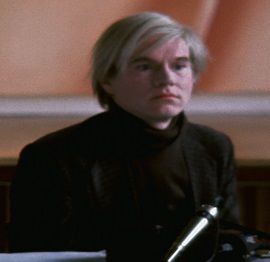
In 1964 Warhol moved to 231 East 47th Street, calling it "The Factory." Having achieved moderate success as an artist by this point, he was able to employ several assistants to help him execute his work. This marked a turning point in his career. Now, with the help of his assistants, he could more decisively remove his hand from the canvas and create repetitive, mass-produced images that would appear empty of meaning and beg the question, "What makes art, art?" This was an idea first introduced by Marcel Duchamp, whom Warhol admired.

Warhol had a lifelong fascination with Hollywood, demonstrated by his series of iconic images of celebrities such as Marilyn Monroe and Elizabeth Taylor. He also expanded his medium into installations, most notably at the Stable Gallery in New York in 1964, replicating Brillo boxes in their actual size and then screenprinting their label designs onto blocks made of plywood.
Wanting to continue his exploration of different mediums, Warhol began experimenting with film in 1963. Two years later, after a trip to Paris for an exhibition of his work, he announced that he would be retiring from painting to focus exclusively on film. Although he never completely followed through with this intention, he did produce many films, most starring those whom he called the Warholstars, an eccentric and eclectic group of friends who frequented the Factory and were known for their unconventional lifestyle.
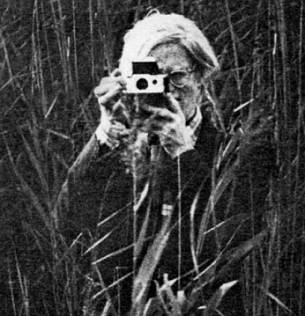
He created approximately 600 films between 1963 and 1976, ranging in length from a few minutes to 24 hours. He also developed a project called The Exploding Plastic Inevitable, or EPI, in 1967. The EPI was a multi-media production combining The Velvet Underground rock band with projections of film, light and dance, culminating in a sensory experience of Performance Art. Warhol had also been self-publishing artist's books since the 1950s, but his first mass produced book, Andy Warhol's Index, was published in 1967. He later published several other books, and founded Interview Magazine with his friend Gerard Malanga in 1969. The magazine is dedicated to celebrities and is still in production today.
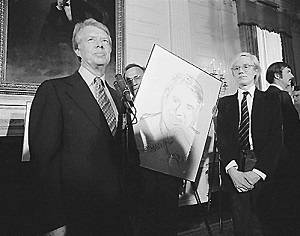
After an attempt on his life in 1968, by acquaintance and radical feminist, Valerie Solanas, he decided to distance himself from his unconventional entourage. This marked the end of the 1960s Factory scene. Warhol subsequently sought out companionship in New York high society, and throughout most of the 1970s his work consisted of commissioned portraits derived from printed Polaroid photographs. The most notable exception to this is his famous Mao series, which was done as a comment on President Richard Nixon's visit to China. Lacking the glamour and commercial appeal of his earlier portraits, critics saw Warhol as prostituting his artistic talent, and viewed this later period as one of decline. However, Warhol saw financial success as an important goal. At this point, he had made the successful shift from commercial artist to business artist.
Late Years and Death

In the late 1970s and 1980s, Warhol made a return to painting, and produced works that frequently verged on abstraction. His Oxidation Painting series, which were made by urinating on a canvas of copper paint, echoed the immediacy of the Abstract Expressionists and the rawness of Jackson Pollock's drip paintings. By the 1980s, Warhol had regained much of his critical notoriety, due in part to his collaboration with Jean-Michel Basquiat and Francesco Clemente, two much younger and more cutting-edge artists. And, in the final years of Warhol's life, he turned to religious subjects; his version of Leonardo da Vinci's Last Supper is particularly renowned. In these works, Warhol melded the sacred and the irreverent by juxtaposing enlarged logos of brands against images of Christ and his Apostles.
After suffering postoperative complications from a routine gall bladder procedure, Warhol died on February 22, 1987 at the age of 58. He was buried in his hometown of Pittsburgh. His memorial service was held in St. Patrick's Cathedral in New York City and attended by more than 2,000 people.
The Legacy of Andy Warhol

Andy Warhol was one of the most influential artists of the second half of the 20th century, creating some of the most recognizable images ever produced. Challenging the idealist visions and personal emotions conveyed by abstraction, Warhol embraced popular culture and commercial processes to produce work that appealed to the general public. He was one of the founding fathers of the Pop art movement, expanding the ideas of Duchamp by challenging the very definition of art. His artistic risks and constant experimentation with subjects and media made him a pioneer in almost all forms of visual art. His unconventional sense of style and his celebrity entourage helped him reach the mega-star status to which he aspired.
Warhol's will dictated that his estate fund the Warhol Foundation for the advancement of the visual arts, which was subsequently created later that year. Through the joint efforts of The Andy Warhol Foundation for the Visual Arts, Carnegie Museums of Pittsburgh, Carnegie Institute, and Dia Center for the Arts the Warhol Museum was opened in Pittsburgh, Pennsylvania in 1994, housing a large collection of Warhol's work.
Influences and Connections


-
![Damien Hirst]() Damien Hirst
Damien Hirst -
![Jeff Koons]() Jeff Koons
Jeff Koons -
![Christopher Wool]() Christopher Wool
Christopher Wool -
![Gilbert and George]() Gilbert and George
Gilbert and George ![Stella Vine]() Stella Vine
Stella Vine


-
![Jean-Michel Basquiat]() Jean-Michel Basquiat
Jean-Michel Basquiat -
![Francesco Clemente]() Francesco Clemente
Francesco Clemente -
![Keith Haring]() Keith Haring
Keith Haring -
![Stephen Shore]() Stephen Shore
Stephen Shore ![Lawrence Alloway]() Lawrence Alloway
Lawrence Alloway


Useful Resources on Andy Warhol
-
![Warhol by Bailey]() 46k viewsWarhol by BaileyDocumentary made by David Bailey, a contemporary. The film is an attempt to capture the spirit of Warhol using some of the techniques he has pioneered
46k viewsWarhol by BaileyDocumentary made by David Bailey, a contemporary. The film is an attempt to capture the spirit of Warhol using some of the techniques he has pioneered -
![Andy Warhol: A Master of the Modern Era]() 286k viewsAndy Warhol: A Master of the Modern EraWarhol's impact on the art world by British art critic Alastair Sooke
286k viewsAndy Warhol: A Master of the Modern EraWarhol's impact on the art world by British art critic Alastair Sooke


-
![Andy Warhol & Edie Sedgwick on The Merv Griffin Show, 1965]() 938k viewsAndy Warhol & Edie Sedgwick on The Merv Griffin Show, 1965Our PickEntertaining show where Warhol reacts to questions of popular art and emotion in art-making
938k viewsAndy Warhol & Edie Sedgwick on The Merv Griffin Show, 1965Our PickEntertaining show where Warhol reacts to questions of popular art and emotion in art-making -
![Warhol Interview (1971)]() 519k viewsWarhol Interview (1971)Short clip mentioning Pop art and comic books
519k viewsWarhol Interview (1971)Short clip mentioning Pop art and comic books -
![Warhol in Miami (1980)]() 63k viewsWarhol in Miami (1980)For the exhibition "Jews of the 20th Century" at Lowe Art Museum
63k viewsWarhol in Miami (1980)For the exhibition "Jews of the 20th Century" at Lowe Art Museum


-
![Dr. Brad Collins @ Columbia Museum of Art]() 758 viewsDr. Brad Collins @ Columbia Museum of ArtGood overview lecture, especially the discussion of Chairman Mao series
758 viewsDr. Brad Collins @ Columbia Museum of ArtGood overview lecture, especially the discussion of Chairman Mao series -
![Critic Christopher Knight @ Smithsonian American Art Museum]() 1k viewsCritic Christopher Knight @ Smithsonian American Art MuseumOur PickPointing out that Warhol's subjects are often chosen for their very particular, art specific themes
1k viewsCritic Christopher Knight @ Smithsonian American Art MuseumOur PickPointing out that Warhol's subjects are often chosen for their very particular, art specific themes -
![Warhol's Silver Car Crash (Double Disaster) (1963)]() 15k viewsWarhol's Silver Car Crash (Double Disaster) (1963)A Conversation with Sir John Richardson
15k viewsWarhol's Silver Car Crash (Double Disaster) (1963)A Conversation with Sir John Richardson -
![Brief History of Andy Warhol: Pop Art King - Artrageous with Nate]() 281k viewsBrief History of Andy Warhol: Pop Art King - Artrageous with Nate
281k viewsBrief History of Andy Warhol: Pop Art King - Artrageous with Nate -
![Andy Warhol: A Master of the Modern Era - MIKOS ARTS]() 286k viewsAndy Warhol: A Master of the Modern Era - MIKOS ARTSOur Pick
286k viewsAndy Warhol: A Master of the Modern Era - MIKOS ARTSOur Pick -
![Andy Warhol in 8 Minutes: Pop Art Legend or Fashion Guru? - Curious Muse]() 11k viewsAndy Warhol in 8 Minutes: Pop Art Legend or Fashion Guru? - Curious MuseOur Pick
11k viewsAndy Warhol in 8 Minutes: Pop Art Legend or Fashion Guru? - Curious MuseOur Pick -
![The Case For Andy Warhol - The Art Assignment (PBS Digital Studios)]() 388k viewsThe Case For Andy Warhol - The Art Assignment (PBS Digital Studios)Our Pick
388k viewsThe Case For Andy Warhol - The Art Assignment (PBS Digital Studios)Our Pick -
![Andy Warhol's Prints of Marilyn Monroe - Christie’s]() 16k viewsAndy Warhol's Prints of Marilyn Monroe - Christie’s
16k viewsAndy Warhol's Prints of Marilyn Monroe - Christie’s



-
![Scene from Chelsea Girls (1966)]() 18k viewsScene from Chelsea Girls (1966)Film shot in the famous Chelsea Hotel
18k viewsScene from Chelsea Girls (1966)Film shot in the famous Chelsea Hotel -
![Flesh (1968) (Trailer)]() 165k viewsFlesh (1968) (Trailer)The famous film stars Joe Dallesandro, directed by Paul Morrissey, and produced by Warhol
165k viewsFlesh (1968) (Trailer)The famous film stars Joe Dallesandro, directed by Paul Morrissey, and produced by Warhol -
![Lonesome Cowboys (1968)]() 231k viewsLonesome Cowboys (1968)SF International Film Festival award-winning film highlighting Warhol's homoeroticism
231k viewsLonesome Cowboys (1968)SF International Film Festival award-winning film highlighting Warhol's homoeroticism


-
![Edie Sedgwick]() 11k viewsEdie SedgwickOur PickHer life with and after Warhol
11k viewsEdie SedgwickOur PickHer life with and after Warhol -
![Take a Walk on the Wild Side: The Warhol Superstars]() 337k viewsTake a Walk on the Wild Side: The Warhol SuperstarsOur PickThe group of famous New York stars that Warhol promoted in his films
337k viewsTake a Walk on the Wild Side: The Warhol SuperstarsOur PickThe group of famous New York stars that Warhol promoted in his films -
![Lou Reed about Velvet Underground and Andy Warhol]() 120k viewsLou Reed about Velvet Underground and Andy WarholOur PickLou Reed recalls working in the Pop art era and with Andy Warhol
120k viewsLou Reed about Velvet Underground and Andy WarholOur PickLou Reed recalls working in the Pop art era and with Andy Warhol -
![David Bowie: On Andy Warhol (1987)]() 70k viewsDavid Bowie: On Andy Warhol (1987)
70k viewsDavid Bowie: On Andy Warhol (1987)