Ask The Art Story AI

Summary of Cy Twombly
Although at first glance the graffiti-like scribbles and scratches of Cy Twombly's work might resemble art made by a naughty child of Jackson Pollock, it is nothing of the kind: it is the work of an erudite, sophisticated, and emotional painter. Whereas the work of Pollock and the Abstract Expressionists emerged in 1940s New York, where their existential inner dramas were enacted against the acutely felt backdrop of World War II, Twombly's work was part of the next generation, emerging during the 1950s in Europe - a Europe that was trying to forget and rebuild. Twombly, based for the most part in Rome, thus focused on his immediate surroundings, responding to the history and beauty he found there, combining aspects of both traditional European sources and the new American painting.
Accomplishments
- Much of Twombly's work is a direct reflection of, response to, and re-working of the ancient Greco-Roman past that surrounded him in his chosen home in Rome. Inspirations came from Greek and Roman mythology, history, and places, French Neoclassicism, and contemporary graffiti on ancient local walls. Twombly was able to balance the seemingly static history of the past with his own sensual and emotional responses to it.
- In both the content and process of his art, Twombly was interested in the layering of time and history, of painting and drawing, and of various meanings and associations. His art situates itself in the context of the history of Western civilization as well as the process-oriented aspects of Abstract Expressionism.
- Writing and language also served as major conceptual foundations for Twombly's mostly abstract art. In addition to the written word - in the form of poems, myths, and histories - he also focused on the process of writing, both by sketching unidentifiable doodles and splotches or words directly onto the canvas and by creating line-based compositions, often inspired by handwriting. Through these methods, he was often able to suggest subtle narratives that lay beneath the surfaces of his paintings.
Important Art by Cy Twombly

Untitled
While in the army, Twombly modified the Surrealist technique of automatic drawing by creating compositions in the dark - after lights out. These "blind" drawings resulted in the kind of elongated, distorted forms and curves that we see in this work. Biomorphic imagery is also apparent in the figurative scrawls giving way to more non-figurative scribbles and markings.
Colored pencil - Collection Cy Twombly Foundation
Leda and the Swan
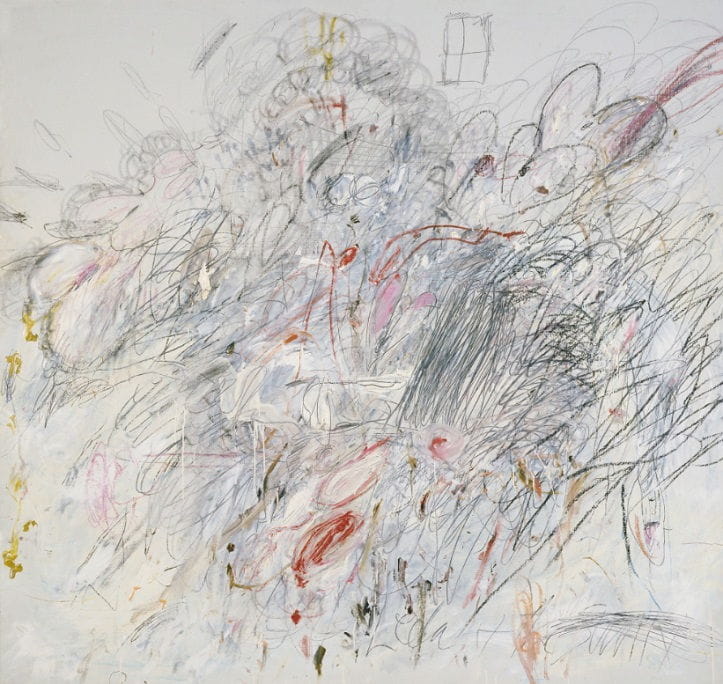
Leda and the Swan (the title is written in the lower right corner), one of Twombly's most accomplished works, illustrates his career-long attraction to the stories, literature, and events of classical antiquity, an interest that expanded further after he moved to Rome in 1957. The title refers to the Roman myth in which Jupiter, transformed into a swan, seduces Leda, who would later give birth to Helen of Troy. Rather than depict the conventional and erotic imagery of a graceful nude languidly entangled with a swan, Twombly combines diverse media, with the violent and forceful swirls, scratches, and zig-zags flying out in all directions suggesting the presence of Jupiter and the fleshy pinks and ovoid forms suggesting Leda and the eggs that were produced from the union. Amidst these colliding, graffiti-like elements, Twombly included recognizable hearts, a phallus/swan neck, and a window-like rectangle. This "window" provides a stabilizing effect on this otherwise explosive painting, but also amplifies content in its witty paradox of being part of graffiti on a flat wall vs. a window that might offer passage through the flatness to the world of the painting (and the myth of the title) or in the opposite direction to the real world outside. The work as a whole reconciles themes of male/female, destructive/creative, and earthly/divine. As in much of his work, Twombly transformed an ancient myth by becoming Jupiter himself: ravaging the canvas and producing beauty. As Roberta Smith has commented, "the crux of his achievement was not so much to overturn [Abstract Expressionism]," ... but to connect Abstract Expressionism to other forms of culture."
Oil paint, lead pencil, wax crayon on canvas. 75 x 78 3/4 in. - The Museum of Modern Art, New York

Discourse on Commodus
For this nine-part series, Twombly took inspiration from Commodus, Emperor of the Roman Empire and son of Marcus Aurelius, who was later assassinated. The series was also painted following the assassination of President John F. Kennedy. Twombly's frenzied splatters and layers of color against the grey background reflect the volatility and civil war that stemmed from Commodus' oppressive rule that ultimately led to his assassination. Yet, these works also have a structured composition, and each is based around a grid form, perhaps summoning ideas of the imposed order of the Roman Empire. The series as a whole, and perhaps as a sort of narrative, begins with a conflict of two painted white masses that are still contained within the grid structure; it continues with increasing evidence of violence and its consequences, concluding with this panel, where the "victor" and the "vanquished" rise above a frail and single rectangle as if to say that all order has been abandoned. The "fallout" from such violent acts floating down in the long and empty vertical space below serves as a reminder of the past and a caution to the future; the famous historian Edward Gibbon saw the rule of Commodus as the beginning of the decline of the Roman Empire. When exhibited at the Leo Castelli Gallery in 1964, when the critical establishment was embracing Minimalism, the series did not receive positive reviews. It is now recognized as a major Twombly work.
Oil paint, wax crayon, lead pencil on canvas - Guggenheim Museum Bilbao, Bilbao, Spain

Untitled
For this work, Twombly's composition has taken inspiration and form from ideas of handwriting or mark-making. It is the largest of a group of grey-ground works he created from 1966 to 1972 evoking blackboards covered in chalk writing. It is said that the feeling of continuous flow in the marks is a product of the way Twombly executed this work as he sat on the shoulders of a friend who moved from side to side in front of the canvas. Yet although his continuous loops and scrawls were inspired, in part, by handwriting drills, Twombly's repetitive, rhythmic drawing does not create specific words. The painted background creates a luminous glow suggesting a potentially enlightened state of mind and being, as the artist - and by extension humanity - frantically, and perhaps futilely, summons the "logos" or word, making marks to name things and trying to understand them. Twombly has said that Leonardo da Vinci's notebook drawings of both structured diagrams, where Leonardo drew in order to learn, thus emphasizing the process of drawing, and tumultuous floods, with their rippling, spiraling motion, influenced him while he was producing these works.
Oil based house paint, wax crayon on canvas. 159 1/2 x 252 1/8 in. - The Museum of Modern Art, New York

Quattro Stagioni. Part I: Primavera
Each painting in the Quattro Stagioni (A Painting in Four Parts) depicts a different season within the ongoing cycle of life, a frequent theme in the Classical and Renaissance work that Twombly so admired. In Primavera (Spring), Twombly applies bright red and yellow paint layered over lighter whites to suggest the vitality of spring's renewal. The image as a whole resembles the stem, leaves, and blossom of a flower. Individually, the curved shapes in red recall Egyptian rowboats, a motif he integrated into several paintings and sculptures after spending time in Egypt in the 1980s. Such boats would be appropriate here, as they were used in ritual for the deceased's transport to the afterlife and were thus a symbol, like spring, for new beginnings. The artist also includes the word "Primavera," along with joyful excerpts of poetry that he used to inspire himself to paint the colorful forms.
Acrylic, oil paint [paint stick], wax crayon, colored pencil and lead pencil on canvas. 123 x 74 3/4 in. - Collection of the Tate, United Kingdom

Untitled
In this work, from a series of peony paintings, each on six connected panels, Twombly turned to bursts of vibrant, expressive color and recognizable imagery. For these works, he drew inspiration from Japanese art, which can be seen in the motif of the blossom and the six divisions of the large-scale panel recalling the painted screens of the Edo period. The peony's emblematic associations are rich. Like the chrysanthemum, it is an ancient symbol of aesthetic contemplation commonly associated with Japanese art. While Twombly's later work moved away from the graffiti-like scratches of his earlier paintings, writing and drawing remained integral to his work: the painting is also inscribed with haiku poetry: "Ah! The peonies for which Kusunoki took off his armour." Here Twombly refers to the 14th-century samurai warrior Takarai Kikaku, who, inspired by the beauty of the peonies, laid aside his armor for a moment of quietude and joy. The exuberantly painted deep red blossoms float calmly but authoritatively against a bright yellow background, and are cut by the edges of the painting, suggesting their proliferation and continuity. The red vertical lines help to visually support these blossoms (as would stems) at the same time that they suggest their disintegration and transient nature as part of the life cycle.
Acrylic, wax crayon, lead pencil on wooden panel. 99 1/4 x 217 1/4 in. - The Broad Art Foundation, Santa Monica
Biography of Cy Twombly
Childhood
Edwin Parker Twombly, Jr. was born in Lexington, Virginia in 1928. Like his father, who briefly pitched for the Chicago White Sox, Twombly was known as Cy, after Cy Young. His father later became a coach and athletic director at Washington and Lee University. Twombly's parents were from the Northeast, so he made frequent trips to Massachusetts and Maine, but the South, with its sense of history and autonomy, ultimately became an integral aspect of his identity. As a young boy, Twombly ordered and worked on art kits he ordered from the Sears Roebuck catalog. His parents encouraged his interest in art, and at twelve years old he started studying with the Spanish modern painter Pierre Daura.
Early Training
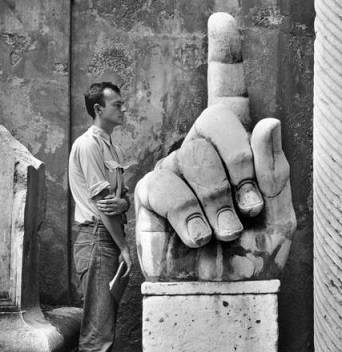
Following high school, Twombly began formal art training at the School of the Museum of Fine Arts in Boston (1947-49), where he became interested in the Dadaist and Surrealist work of artists such as Kurt Schwitters and Alberto Giacometti. At his parents' suggestion, Twombly then spent a year at Washington and Lee's newly created art program before moving to New York in 1950 to study at the Art Students League. Exposure to numerous New York gallery exhibitions of artists such as Franz Kline, Jackson Pollock, and Robert Motherwell began to shape Twombly's own aesthetic away from the figurative toward abstraction. While at the League, he met Robert Rauschenberg, who became a close friend and artistic influence. At Rauschenberg's encouragement, Twombly studied at Black Mountain College in North Carolina (1951-52). In 1952, Twombly traveled to Italy and North Africa with Rauschenberg on a grant from the Virginia Museum of Fine Art. Upon returning, the two artists had a joint 1953 exhibition at Stable Gallery in New York, which resulted in such a hostile and negative response from the public that gallery director Eleanor Ward had to remove the visitor comments book.
Twombly's work at this time was largely in black and white, influenced both by Rauschenberg's paintings and the monochromatic work of Willem de Kooning, Franz Kline, and Robert Motherwell. Twombly drew on ideas of the primitive, notions of ritual, and the psychoanalytic concept of the fetish, while taking inspiration from his European travels in these early works. From 1953 to 1954, Twombly was drafted into the army, where he served as a cryptographer at Camp Gordon near Augusta, Georgia, and at the Pentagon in Washington, D.C. On weekend leaves, Twombly rented an hotel room in Augusta. There, he modified the Surrealist technique of automatic drawing by creating biomorphic drawings at night in the dark. These "blind" drawings resulted in elongated, distorted forms and curves that became distinct stylistic motifs in his later work.
Mature Period
From 1955 to 1959, he worked on and off in New York, where he emerged as a significant artist within a group of artists that included Robert Rauschenberg and Jasper Johns. In 1957, Twombly returned to Rome where he met and married the Italian artist Baroness Tatiana Franchetti - sister of his patron Baron Giorgio Franchetti. They were married at City Hall in New York in 1959 prior to purchasing a palazzo on the Via di Monserrato in Rome, but later they preferred the seaside town of Gaeta near Rome and the Mediterranean Sea. Here, the artist was inspired by a more tranquil, light tone in his work that also began to allude to Classical culture and literature. Greco-Roman themes infused much of his work throughout his career. After spending time in Lexington, Virginia and New York, and joining gallery owner Leo Castelli's roster of artists, Twombly steadily lived in Rome and he lived between Italy and United States for the rest of his life. His first Castelli exhibition was the same year in New York. Around this time an article in Vogue magazine with photographs by Horst P. Horst of Twombly's elegantly appointed apartment in Rome suggested that his grand lifestyle "somehow betrayed the cause." Distrust of the press understandably set in. In Rome, Twombly's early 1960s work took on greater scale and more vibrant color, while also drawing on themes of eroticism and violence. Although Twombly's work was well-received in Italy, a New York Castelli show of Twombly's Nine Discourses on Commodus (1963) received brutal reviews. From 1966 to 1972, Twombly created a number of canvases that resembled blackboards, with light-colored loops and scrawls flowing across grey backgrounds.
Late Years and Death
Twombly worked less frequently in the late 1970s and 1980s, but continued creating important canvases. In the mid-1970s, he also returned to sculpture, a medium in which he had not worked for almost twenty years. These sculptures, often focusing on Classical themes, were largely assembled from found objects and painted white. Italy continued to influence Twombly's work; he spent much time in the medieval port city of Gaeta, and many of his paintings from the 1980s reflected his interest in the sea. Critical reception of his work became more positive in the 1980s as well, partially due to a new interest in modern European art. Yet, when the Museum of Modern Art mounted a retrospective of his work in 1994 the show's curator Kirk Varnedoe felt compelled to write an essay titled Your Kid Could Not Do This, and Other Reflections on Cy Twombly.
Classical references persisted in his later work, particularly in the form of Bacchus, the god of wine. Twombly's paintings in the next decades expanded his previous use of color, applied with gestural brushstrokes that occasionally depicted more recognizable forms, such as flowers and landscapes. Twombly died on the 5th of July in 2011 in Rome. He was survived by a son, Cyrus Alessandro Twombly, who is also a painter and resides in Rome.
The Legacy of Cy Twombly
In spite of his persistent disregard for fame and recognition, Cy Twombly, along with Robert Rauschenburg and Jasper Johns, is considered to be one of the greatest American painters after Abstract Expressionism. His distinctive aesthetic was both a continuation of Abstract Expressionist techniques in a post-war and European setting that internationalized contemporary art, and a new direction that used "low" art practices such as penciled words and scribbled crayon in the context of "high" art and art history. Twombly's artistic enterprise and its significance is rife with such contradictions: his work (along with that of Agnes Martin and Frank Stella) was part of one of the first exhibitions to explore the ideas of Minimalism and, on the other hand, the expressivity of his work that grew out of Abstract Expressionist roots influenced the more recent group of Neo-Expressionist painters.
Influences and Connections


Useful Resources on Cy Twombly
- Cy Twombly: Cycles and SeasonsOur PickBy Nicholas Serota, Richard Shiff, Nicholas Cullinan, and Cy Twombly
- Writings On Cy TwomblyBy Robert Motherwell, Francesco Clemente, Frank O'Hara, Dore Ashton, Gottfried Boehm, Brooks Adams, Roland Barthes, and Robert Pincus-Witten
- Cy Twombly: A RetrospectiveOur PickBy Kirk Varnedoe
- Cy Twombly: A MonographBy Richard Leeman
- Cy Twombly: The Natural WorldBy James Rondeau
- Cy Twombly: Catalogue Raisonne of the Paintings 1996-2007By Heiner Bastian
- Cy Twombly: Fifty Years of Works on PaperBy Julie Sylvester, Simon Schama, and Roland Barthes
- Cy Twombly: Blooming - A Scattering Of Blossoms And Other ThingsBy Robert Pincus-Witten
- Cy Twombly: The SculptureBy Katharina Schmidt, Cy Twombly, and Christian Klemm