Ask The Art Story AI


Summary of Ad Reinhardt
Ad Reinhardt was a prominent American abstract artist, writer, critic, and educator. Although commonly associated with the Abstract Expressionists, his work had its origins in geometric abstraction, and, increasingly seeking to purify his painting of everything he saw as extraneous to art, he rejected the movement's expressionism. Although he was in turn rejected by many of his peers, he was later hailed as a prophet by Minimalists. His Black Paintings, which occupied him from 1954 until his death, are regarded as his crowning achievement, while the many cartoons he created that made fun of the art world brought him fame as a wry commentator.
Accomplishments
- Ad Reinhardt is one of the few major American artists to have explored geometric abstraction and, unlike many of those Cubist- and Bauhaus-influenced artists who did, he firmly opposed attempts to put abstraction in the service of design - be it for the purposes of decoration, industrial design, or advertising.
- His most famous series, the Black Paintings (1954-67), are all uniform, five-foot squares and are composed such that a ghostly Greek cross hovers, barely visible, in a mist of barely distinguished black and gray hues. Reinhardt felt they represented the ultimate in abstract painting - paintings that were concerned with art alone and bore no reference to anything outside themselves - not even to the hints of soul and angst in Abstract Expressionist pictures.
- Although Reinhardt sought to remove all references to the external world from his pictures, he remained convinced that his art had the potential to affect social change. He also maintained an interest in various types of mysticism - something the viewer might appreciate in the struggle to comprehend the barely delineated forms in his Black Paintings (1954-67).
Important Art by Ad Reinhardt

Study for a Painting
This early composition by Ad Reinhardt exhibits the artist's profound interest and understanding of the Cubist art of Pablo Picasso and George Braque. The palette is typical of the style and is comprised of four colors essential for a Cubist painting: black, white, brown, and gray. The abstract shapes are dynamically arranged on the flat surface where the biomorphic curves intermingle with hard edges and straight lines. This small gouache presents Reinhardt as a talented young artist with a gift for absorption of the most relevant styles of painting of the time.
Gouache on paper - The Museum of Modern Art, New York

Untitled
Painted in the same year as the Cubist gouache, this canvas presents quite a stark contrast with Reinhardt's earlier artistic pursuits. Here he is obviously quoting Stuart Davis, the American artist who was a key influence on young Reinhardt. The booming palette employed by the artist has turned this arrangement of rectangular shapes into a feast of color - hot pink, orange, yellow, and red comprise a luminous symphony that inevitably engages the viewer. Later in his life Reinhardt abandoned such bright pigments. This example yet again testifies to the amazing versatility possessed by the young artist in terms of adopting and adapting various styles of modernist painting.
Oil on canvas - The Museum of Modern Art, New York

Abstract Painting, Red
This is one of the paintings belonging to the Red Series. Here the artist immersed himself completely into the exploration of the color red, one of the most expressive among the primary colors. This composition is abstraction par excellence; the squares are arrayed into a rigid pattern with the variations of red hues defining its strict geometry. The artist himself maintained throughout his life that these paintings were completely free of narrative. One cannot help but wonder, however, whether a list of references could be decoded in this canvas due to its expressive palette, impressive size (9'x3.5'), and the almost totemic outline of the squares.
Oil on canvas - The Museum of Modern Art, New York

Abstract Painting, Blue
The Blue Series followed the Red Series of paintings and this is one of its most successful examples. The rectangular shapes of various shades of blue and green are suspended within a resplendent azure surface. They are solid blocks of color and yet they seem quite mesmerizingly weightless. It feels as if the artist attempted an abstract revision of the famed Water Lilies series (1899-1926) by Claude Monet, creating a harmonious, modernist peace. The velvety surface, construed by the application of numerous layers of oil pigments, further softens the stern geometry of the floating blocks.
Oil on canvas - The Museum of Modern Art, New York

The Abstract Painting
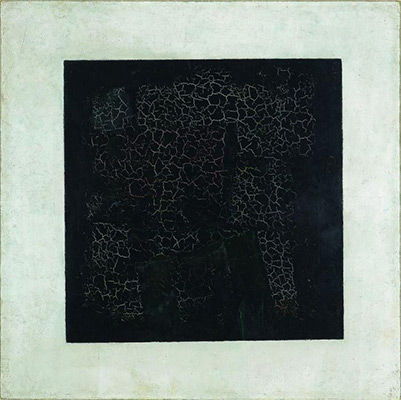
The artist devoted his late years almost exclusively to the creation of the Black Paintings (1953-67), the canvases of bewildering power that brought him the most fame. For Reinhardt, the color black in itself was an absolute point of abstraction. The purity of blackness consumes every other shape or color. The primary inspiration for the Black Paintings was the work of the Russian artist Kazimir Malevich, particularly his famed Black Square of 1914. None of the Reinhardt's Black Paintings (1953-67) were ever completely black, but, rather, consisted of a careful arrangement of tonalities that were meticulously applied in multiple layers. In this particular example, the blackness of the canvas is dissected by two rectangular shapes, which form a cross. The superimposed silhouettes carry the shades of gray and indigo blue. Reinhardt believed that his Black Paintings (1953-67) were the absolute zero of art. He developed this concept further in his theoretical writings, connecting it to such complex philosophies as Negation Theology, Neo-Platonism, and Zen Buddhism.
Oil on canvas - The Solomon R. Guggenheim Museum, New York

How to Look at Modern Art in America
In this famous cartoon of 1946 Ad Reinhardt tried to encapsulate the essence of the artistic modernism with its history and inherent conflicts within the American context. The tree of modern art has its roots deep in history - the Greeks are here, and so are Persian miniatures and Japanese prints. The roots represent the four pillars of Post-Impressionism: Vincent Van Gogh, George Seurat, Paul Cézanne, and Paul Gauguin. The tree is burdened by the weights of "subject matter" and "business as art patron," and a cartoon within the cartoon mocks the perpetual debate of representation versus abstraction. By juxtaposing business and art, Reinhardt aptly comments on the situation of the avant-garde in the United States, where the public and, more importantly, the patrons were rather biased against the abstract art, often calling it "degenerate" and "subversive."
N/A - Originally printed in P.M. in 1946; Re-printed in ARTnews in 1961
Biography of Ad Reinhardt
Childhood
Adolph Frederick Reinhardt was born in Buffalo, New York, to a family of immigrants. The family settled in New York City soon after his birth. He excelled at school and exhibited an interest in the visual arts from an early age; in high school, he worked as an illustrator for the school's newspaper. An inveterate reader, he set his sights on the elite universities of the east coast and turned down several scholarships from art schools, opting instead for undergraduate studies in art history at Columbia University in New York, which he commenced in 1931.
Early Training
At Columbia, Reinhardt studied under Meyer Schapiro, an iconic American historian of art. His two majors included literature and art history, giving him a solid background in the humanities, while informing him of the latest trends in visual arts and theory. Schapiro, known for his Marxist views, introduced Reinhardt to radical campus politics, which shaped the leftist views that he maintained throughout the rest of his life.
Upon graduation in 1935, Reinhardt began training as an artist, first at the National Academy of Design and later at the American Artists School on 14th Street in New York. At the AAS, he fell under the influence of two progressive painters, Francis Criss and Carl Holty, who were influenced by the European traditions of Cubism and Constructivism.
Mature Period
Between 1936 and 1941, Reinhardt was one of the few abstract artists employed by the Works Progress Administration of the Federal Arts Project (WPA/FAP) in its easel division. While engaged in this work he met other leading artists such as Willem de Kooning and Arshile Gorky, whose friendship would continue to be important to him.
During this period, Reinhardt's works were mainly influenced by the geometric abstraction he had learned as a student. At times his work took on aspects of gestural abstraction, yet his handling was restrained in comparison to that of some of his peers. In concert with this, he also worked as a freelance illustrator and cartoonist for several New York publications, including PM and ARTnews.
Reinhardt's mature work is characterized by his search for an absolute form of abstraction. He considered Abstract Expressionism to be plagued with suggestive biomorphism, an abundance of emotional innuendos, and a cult of the ego. In contrast, he sought to create an abstract art that contained no suggestions of narrative or emotion and withheld the slightest reference to anything outside the canvas.
In this regard, Reinhardt was deeply influenced by the art and theoretical writings of Kazimir Malevich, the Russian Suprematist. Malevich's Black Square (1915) inspired the artist to begin using solid fields of color arranged in rigid geometric patterns of squares and rectangles. These experiments in the early 1950s resulted in several series of paintings devoted to a single color - the Red Paintings, the Blue Paintings, and, finally, the Black Paintings (1954-67).
Late Years and Death
From 1954 until his death in 1967, Reinhardt devoted himself exclusively to the Black Paintings. The artist believed in the profound symbolic potency of the color black. For him it was the absolute zero, the end of light, a point so irreducible that painting as a genre was pushed to its limit of expression.
An encounter with one of Reinhardt's Black Paintings (1954-67) is inevitably complex and conflicting. The viewer is stunned by the complete absence of either narrative or coloristic interplay, and yet the canvas is overwhelmingly full of color; a closer look reveals that the ostensibly monochrome surface is composed of various shades of black, from light to dark.
Reinhardt developed a sophisticated technique to create the effects he desired. He siphoned off oil from the pigments that he used to produce a very delicate suede-like finish. His matte surfaces thus further absorb light into their refined darkness. This technique is responsible for the serious conservation issues associated with Reinhardt's Black Paintings (1954-67) today. Their surfaces are so fragile and the original technique so complex that the conservation and restoration of each canvas is always an arduous, expensive, and time-consuming task.
Reinhardt died of a massive heart attack on August 30, 1967, at the age of 53, in his New York studio.
The Legacy of Ad Reinhardt
Ad Reinhardt's oeuvre remains a pivotal cornerstone in the evolution from the Abstract Expressionism of the 1950s to the Minimal and Conceptual art movements of the following decade. Often ridiculed by his expressionist peers, Reinhardt came to be seen as a priest and prophet figure by the subsequent generation, for whom he provided a bridge back to Constructivism. While it is debatable whether Reinhardt ever managed to completely purge his art so completely of references to the outside world, this aim was identical with that of Minimalists such as Frank Stella, Donald Judd, and Robert Morris.
Influences and Connections
-
![Piet Mondrian]() Piet Mondrian
Piet Mondrian -
![Kazimir Malevich]() Kazimir Malevich
Kazimir Malevich -
![Stuart Davis]() Stuart Davis
Stuart Davis -
![Josef Albers]() Josef Albers
Josef Albers ![Francis Criss]() Francis Criss
Francis Criss


-
![Meyer Schapiro]() Meyer Schapiro
Meyer Schapiro ![Thomas Merton]() Thomas Merton
Thomas Merton


-
![Abstract Expressionism]() Abstract Expressionism
Abstract Expressionism -
![Minimalism]() Minimalism
Minimalism -
![Conceptual Art]() Conceptual Art
Conceptual Art -
![Hard-edge Painting]() Hard-edge Painting
Hard-edge Painting ![Monochrome Painting]() Monochrome Painting
Monochrome Painting


Useful Resources on Ad Reinhardt
- Ad ReinhardtOur PickBy Yves-Alain Bois
- Ad ReinhardtBy Michael Corris
- Ad Reinhardt: Last PaintingsBy Heinz Liesbrock, Ad Reinhardt