Ask The Art Story AI


Summary of Fairfield Porter
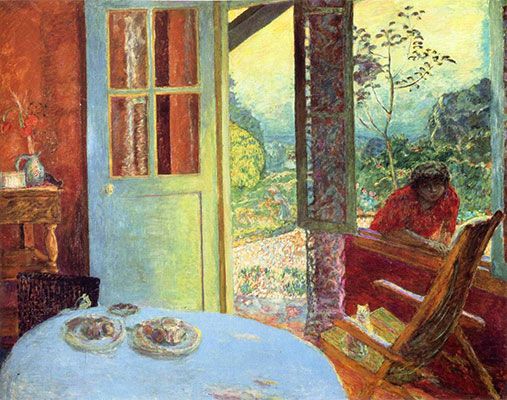
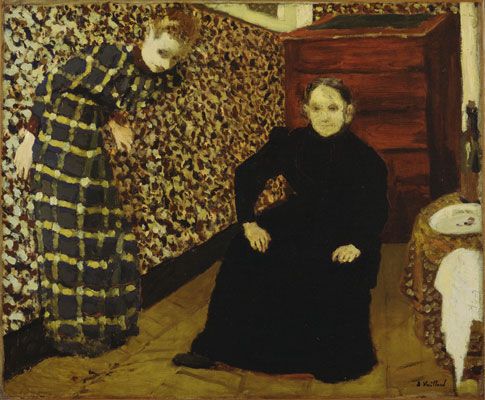
Fairfield Porter was one of the foremost practitioners of representational painting in the American art world of the mid-20th century. For several decades he created portraits, domestic scenes, and landscapes of the places he lived in, all depicting a relaxed and comfortable world that seemed to mirror his own affluent, well-connected existence. However, his art was often more nuanced than it appears at first glance. The influence of French Nabis painters Pierre Bonnard and Édouard Vuillard is obvious, yet Porter was also fully conversant in contemporary movements such as Abstract Expressionism, and his loose, energetic painting style owed much to his understanding of gestural abstraction. Porter was also a prolific critic whose work was published in several influential art journals; in his writing, as in his friendships and mentorships, he often championed other artists who sustained a commitment to realism and figuration.
Accomplishments
- Porter painted in a representational style at the height of Abstract Expressionism's dominance. He insisted on the relevance of authentically lived experience as subject matter, rather than pure ideology as a motivation for making art."The truest order is what you already find there, or that will be given if you don't try for it,"he wrote. "When you arrange, you fail."
- Porter was vitally concerned with the close relationship between realism and abstraction: in successful art, he believed, one could not exist without the other. He once wrote: "The realist thinks he knows ahead of time what reality is, and the abstract artist what art is, but it is in its formality that realist art excels, and the best abstract art communicates an overwhelming sense of reality."
- As an art critic, Porter also championed the next generation of representational painters working in figurative and realist styles. In this way he provided a link between movements like Social Realism of the 1930s and Neo-Expressionism of the 1980s.
Important Art by Fairfield Porter

Untitled (First Avenue)
Due to the financial hardships of World War II, Porter and his family rarely traveled outside New York City between 1941 and 1946, forgoing visits to their home on Maine's Great Spruce Head Island. During these years Porter was obliged to adjust his work patterns to city life. This untitled work from 1945 depicts Manhattan's First Avenue, presumably the corner just a half-block from the family home on East 52nd Street. The drab grays and browns of this painting, which are quite different from his vibrant use of color in later works, indicate Porter's somber mood, brought about by family strife and ongoing confinement to the city.
Oil on canvas - The Parrish Art Museum, Southampton, NY

Katie and Anne
This scene of Porter's daughter Katherine and wife Anne is characteristic of the artist's oeuvre. Its interior setting, its golden light, and its intimate glimpse of family members in a moment of tranquility all show the influence of Édouard Vuillard and Pierre Bonnard on Porter's work. Yet the setting of the Porters' home is distinctly American and mid-20th century, from the rug on the floor to Anne's clothing.
Even while painting a spacious room and the landscape beyond its window, Porter insists on the shallowness of his pictorial space and the flatness of the colors he has placed upon the canvas: certain passages of brushwork, particularly in the curtains and the chair in the background, are nearly abstract. As scholar William Agee has written of this work, "The surface is a single entity, all of it simultaneously present. Porter sought, as did Matisse, to make every corner of the canvas alive."
Oil on canvas - The Hirshhorn Museum and Sculpture Garden, Smithsonian Institution, Washington DC

The Mirror
Porter painted several self-portraits of himself in the studio, and here he combines a self-portrait with a portrait of his ten-year-old daughter Elizabeth in the family's Southampton house. The Mirror's composition is complex: Elizabeth faces the viewer (and, by implication, the artist), and the mirror acts as a picture-within-a-picture, reflecting Porter as well as the room and the landscape beyond the window. In this single work, Porter pays homage to several of his artistic heroes. One is Édouard Vuillard, of course, but he also refers to Henri Matisse, whose Carmelina (1903) used a similar device of a frontally posed girl and a mirror reflecting the artist, and Diego Velázquez, whose Las Meninas (1656) is the forerunner of all such self-portraits within studio portraits of young women. Leonardo da Vinci is even present, in a detail of the Mona Lisa (1503-17) pinned to the studio wall. Despite these art-historical allusions, however, the specificity of Porter's studio (with its wood-burning stove) and the architecture beyond the window grounds the picture in the reality of the 1960s and coastal Long Island. Porter is both inside and outside the picture, unifying its reality and its reflections, history and the present day, in a skillfully arranged configuration of images within images, while putting us in his place to consider what it means to perceive and represent the world around us.
Oil on canvas - The Nelson-Atkins Museum of Art, Kansas City, Missouri

Island Farmhouse
Porter routinely experimented more with color when painting outside, yet his subjects always remained identifiable. As he wrote in 1960 for The Nation, "Reality is stronger than thought, feeling, the means of its achievement, the artist's ego or his subjectivity. "The visual complexity of this landscape painting underscores the richness of Porter's family history. This scene includes the house that Porter's architect father had built on Maine's Great Spruce Head Island decades earlier; as Porter once said in an interview, every painting of this house was, in a way, also a portrait of his father. In this idyllic view, a boat sails on nearby Penobscot Bay and the family dog rests in the shady foreground. The intense yellows, greens, and blues suggest a Fauvist influence, but the cropping of the scene and the use of flattened forms in shallow pictorial space show Porter's interest in abstraction. Every element of this visual arrangement, even ephemeral things like the reflections in the windows to the shadow on the grass, has a weight and presence of its own, yet all the disparate parts fit together on the picture's surface like a perfectly designed jigsaw puzzle.
Oil on canvas - Private Collection

Under the Elms
The ostensible subject of this well-known painting is his daughter Katie, posed in the yard of the family's Long Island home, yet Porter was less interested in capturing his sitter's personality than in visually integrating figure and background. The designs of the girl's vest are echoed in the broad patches of sunlight and shadow on the lawn and in the formations of the tree's foliage. This painting encompasses Porter's painterly style and philosophy: as a realist, he depicted locations and individuals from his own life, but he rendered those subjects with an expressive quality that recalled the turn-of-the-century Parisian masters. Under the Elms demonstrates why some of the great Abstract Expressionist artists admired Porter's art: in works like this one, he skillfully incorporated surface patterning and all-over compositional effects into representational imagery, while still suggesting a reality above and beyond the observed world. The landscape could almost be a fantastic scene within the girl's own imagination, as she stands on the threshold of adolescence.
Oil on canvas - Pennsylvania Academy of the Fine Arts, Philadelphia

Broadway South of Union Square
Broadway South of Union Square, a Manhattan street scene, dates to the final year of Porter's life. This cityscape places the viewer at the corner of Broadway and 12th Street, facing north towards the greenery and open public areas of Union Square. American Impressionists had been painting the area around Union Square since the late-19th century; Porter anchors his scene in his own time, however, with the inclusion of 20th-century traffic lights and automobiles. His abstract handling of paint is evident in the office buildings' grid-like banks of windows, the simplification of the distant trees, and the cursory treatment of the pedestrian's faces and clothing. Even the iconic Empire State Building, visible from its location twenty blocks north, is reduced to flattened planes and dark, angled edges. At the same time, this imagery of an urban street, from its vehicles to its signage, reminds us that Porter's career overlapped with such movements as Pop art and Photorealism, which brought representational imagery back into artistic vogue.
Oil on canvas - Private Collection
Biography of Fairfield Porter
Childhood
Fairfield Porter was born in Winnetka, Illinois, a suburb of Chicago. He was the fourth of five children of James and Ruth (née Furness) Porter. The Porter family fortune, based in Chicago real estate, was several generations old; both sides of his family also had deep roots in New England.
Porter acquired a love for art and literature at an early age. His mother, who belonged to the progressive Unitarian church, had sophisticated views on child-rearing and childhood education. From his mother, Porter learned to adopt a critical eye when viewing pictures and artworks.
Porter's father, James, held a degree in architecture from Columbia University and had designed the family homes in Winnetka, Illinois, as well as the Porter vacation home on Great Spruce Head Island off the coast of Maine. However, James was unable to make his living as an architect, and was instead obliged to assist his mother in managing the family real estate business during difficult economic times.
Education and Training
Porter entered Harvard University in 1924 with the intention of studying philosophy. He attended lectures delivered by the English philosopher and mathematician Alfred North Whitehead, whom he would later credit as a major influence in his own development as an artist and writer. He also developed a strong interest in art history, studying under Arthur Pope, a well-known archeologist and historian of ancient Persian art. Porter wrote poetry during this time and also began to take an interest in leftist politics.
In the summer of 1927, Porter took a walking and bicycle tour of France, which eventually took him to Berlin and finally to Moscow. While in Russia he attended a lecture given by Leon Trotsky, an experience that would inform Porter's developing political views, especially during the years of the Great Depression.
After graduating from Harvard in 1928, Porter moved to New York and studied for two years at the Art Students League, where one of his teachers was Thomas Hart Benton. Benton's commitment to figurative painting had a lasting effect on Porter, as did his studies of the French Post-Impressionist painters Édouard Vuillard and Pierre Bonnard.
In 1931 Porter returned to Europe; on this trip, he concentrated on visiting museums and galleries. This travel, in addition to his studies at Harvard, afforded Porter a close and deep knowledge of nearly every movement and style in Western art, from ancient Greek sculpture to Old Master paintings to Pablo Picasso.
Upon his return to the United States, Porter set out to become more politically active and to create socially relevant art. He made artwork on behalf of the communist John Reed Club, taught drawing classes for the Socialist arts group Rebel Arts, and began work as an editor for a short-lived American Socialist tabloid called Arise!. It was during these years that Porter became interested in art criticism.
Mature Period
In 1932 Porter married Boston poet Anne Channing and the two settled in New York. They briefly lived in Porter's hometown of Winnetka in the late 1930s, then in New York again in the early 1940s. They had five children: John, Laurence, Richard, Katherine, and Elizabeth. The Porters struggled financially during the wartime years in New York, but they led a rich social life, becoming close friends with writer Edwin Denby and artists Rudy Burckhardt and Willem and Elaine de Kooning. Porter was one of the first people to purchase Willem de Kooning's art. In 1940 he wrote a piece on the artist for the Partisan Review; although it was not published, it is now believed to be the first review of his work ever written.
In 1949, the Porters moved to the seaside town of Southampton on New York's Long Island. Their new seasonal home would become the inspiration for many of Porter's landscape paintings over the next twenty-five years. Porter and his family divided their time between winters in Southampton and summers on Great Spruce Head Island in Maine (they also had a home in midtown Manhattan for several years). Porter and his wife experienced frequent personal difficulties, due to Porter's bisexuality, and an extramarital affair that Anne had in the early 1940s, yet the marriage endured.
Meanwhile, Porter was slowly establishing himself in the New York art world. As a bohemian and political leftist, Porter meshed easily with the New York School of intellectuals and Abstract Expressionist artists, but his representational and figurative paintings expressed something utterly different. While Porter continually expressed a deep interest in abstraction and believed that artists like Willem de Kooning and Jasper Johns were true modern masters, he wanted to express a different reality in his own paintings, something closer to what he saw with his eyes, rather than limiting himself to formal experimentation. Porter found himself slowly as an artist, and he was already in his early forties when he had his first exhibition in New York in 1952, at the Tibor de Nagy Gallery. From that point forward, the owner of the gallery, John Bernard Myers, represented Porter and gave him annual gallery exhibitions. His art was also included in six annual group exhibitions at the Whitney Museum of American Art from 1959 through 1968.
Porter's most prolific period as an art critic was the 1950s. From 1951 to 1967 he wrote for Art News, reviewing roughly twelve gallery shows and museum exhibitions every month. In addition, Porter also became a regular contributor to the leftist periodical The Nation. In 1959 he wrote an essay on the American realist and landscape artist Thomas Eakins for a series on American painters published by Thomas Hess.
Late Years and Death
Throughout his career, in spite of his friendships with many members of the American avant-garde, Porter felt a stronger kinship with the European Realists, Naturalists, and Impressionists, from Rembrandt to Edgar Degas and Édouard Vuillard, in his art and his criticism. These artists, much like Porter himself, stressed a theoretical fusion of paint application and composition and believed that the human figure should be the chief concern of art. Porter frequently referred to the abstract artists of the New York School as the "idealists of New York painting," and throughout his career he expressed mixed feelings regarding Abstract Expressionism. "[They] isolate art from the details of actuality," wrote Porter. "They wish to see profoundly and are against illusion. Or perhaps they simply wish to seem to see profoundly."
In 1967 Porter took his wife and two daughters to Europe, his first trip abroad since his studies in the early 1930s. Porter wrote occasionally throughout the 1960s and early 1970s, but he did not produce nearly as much criticism as in the previous decade. He continued to paint through his final years; in fact, many of his most famous landscapes were painted in the last five years of his life. The first retrospective exhibition of his art was held from 1974 to 1975 and traveled to three venues: the Heckscher Museum on Long Island, the Queens Museum in Flushing, New York, and the Montclair Art Museum in New Jersey.
Porter died on September 15, 1975 at age 68. A full-scale retrospective of his art was organized by the Boston Museum of Fine Art in 1983. Due to a donation by his wife Anne, the largest collection of his work and papers now resides at the Parrish Art Museum, not far from the Porters' home in Southampton, New York.
The Legacy of Fairfield Porter
Porter was a lasting influence on many younger American artists who explored figurative painting in the 1970s and beyond, such as Alex Katz, Jane Freilicher, Grace Hartigan, Larry Rivers, and Neil Welliver. He was also a friend to many poets of the New York School, including Frank O'Hara and James Schuyler, all of whom shared his interest in making art from the experiences of everyday life.
In his criticism, he praised and promoted certain artists, thus bringing their work to a wider audience; just a few of his subjects were Jane Freilicher, Larry Rivers, Jasper Johns, Joan Mitchell, Jack Tworkov, and Richard Stankiewicz. Lastly, he had an aesthetic ally in his own brother Eliot Porter, a well-known photographer who specialized in images of the natural world and continued that work until his own death in 1990.
Influences and Connections


-
![Clement Greenberg]() Clement Greenberg
Clement Greenberg ![Virginia Woolf]() Virginia Woolf
Virginia Woolf![Bertrand Russell]() Bertrand Russell
Bertrand Russell![Carl Jung]() Carl Jung
Carl Jung


-
![Frank O'Hara]() Frank O'Hara
Frank O'Hara ![James Schuyler]() James Schuyler
James Schuyler![John Ashbery]() John Ashbery
John Ashbery![Peter Schjeldahl]() Peter Schjeldahl
Peter Schjeldahl


Useful Resources on Fairfield Porter
- Fairfield Porter: A Life in ArtOur PickBy Justin Spring
- Fairfield PorterOur PickBy John T. Spike
- Fairfield Porter: RawBy Klaus Ottmann
- The Undiscovered CountryBy Philip Guston, Fairfield Porter, John Baldessari, and Richard Hamilton
- Art in Its Own Terms: Selected CriticismOur PickBy Fairfield Porter and Rackstraw Downes
- Material Witness: The Selected Letters of Fairfield PorterBy Ted Leigh