Ask The Art Story AI


Summary of Kenneth Noland
Kenneth Noland's Color Field painting, which was categorized by Clement Greenberg as belonging to the "Post-Painterly Abstraction" movement, was some of the most focused and consistent art produced in mid-20th-century America. After studying under such artists as Ilya Bolotowsky and Josef Albers and working alongside fellow second-generation Color Field abstractionists like Helen Frankenthaler and Morris Louis, Noland developed a signature style based on simplified abstract forms, including targets, chevrons, and stripes. Noland's paintings are characterized by strikingly minimalist compositions of shape and color. In this regard, Noland's art has influenced a wide range of contemporary abstractionists who continue to experiment with highly simplified forms and pure saturated color.
Accomplishments
- Noland's concentric circles were not targets, the diagonals of his chevrons did not indicate receding space, and his broad horizontal stripes were decidedly not literal horizons. Each was solely a means of exploring pure color. This reductive approach also foreshadowed the emergence of Minimalism.
- Noland applied Josef Albers's theory of "the interaction of colors" to his own compositions, which explore the relationships between contrasting or complementary colors; painted in thin yet opaque layers, each tone reveals its particular characteristic weight, density, and transparency.
- As a member of the Color Field contingent that practiced hard-edge abstraction, Noland was interested in removing all texture, gesture, and emotional content from his paintings. He even executed some works on shaped canvases that were filled by their compositions from edge to edge, leaving no marginal space for suggestions of depth or background. In these shaped works, the viewer no longer looks "into" the picture; instead, the work of art coexists in the viewer's space as a complete object.
Important Art by Kenneth Noland

Tiger Lilies
This early oil painting dates close to Noland's first visit to Helen Frankenthaler's studio, when the artist was clearly still working under Abstract Expressionism's influence and trying to find his own painterly voice. Noland's early style is exemplified by visible brushwork, monochromatic palette, and calligraphic markings; the painting's title indicates that he had not yet ceased making references to the material world in his art.
Oil and enamel paint on canvas - Hirshhorn Museum and Sculpture Garden, Washington DC

Ex-Nihilo
The late 1950s marked an important turning point in Noland's career. In Ex Nihilo (a Latin phrase meaning "out of nothing"), Noland began painting simplified forms and balancing carefully selected colors in order to create, as the painting's title suggests, something out of nothing. However, Noland had yet to find his signature style. Unlike his later renditions of his circles and targets, where color itself is the subject, here he hinted at the representational or even the figurative. The gray-ringed, amoeba-like form resembles an egg being fertilized from its left side, while the innermost area (painted in gold, pink, and pale blue) could be some kind of zygote. We seem to be witnessing the conception of form, as order is manifested out of chaos.
Magna on canvas - Private Collection

Beginnings
This work, which places concentric circles on a perfectly square canvas, marks one of Noland's very first attempts at painting basic forms and archetypal patterns. Beginnings's circles are slightly irregular, an effect that may or may not have been intentional. Their varying colors complement or contrast with one another, creating a lively perceptual effect for the viewer. The final, jagged penumbra of black paint that frames these inner circles reinforces the improvisational feel of the whole work, pulling the viewer's attention beyond the nested circular forms and imbuing the whole with a burst of energy.
Magna on canvas - Hirshhorn Museum and Sculpture Garden, Washington DC

Birth
In this mature Circle canvas, Noland painted three concentric circles in complementary colors: yellow, magenta, and red. Although the viewer may attempt to see the circles as receding into space, they remain flat on the picture plane. Rather than attempting to create an illusion of depth, the artist focuses on the relational qualities of the three colors (how they make one another appear brighter or darker, softer or more intense) as well as the contrast between the vibrant, hard-edged rings and their neutral background. The title hints at the circle's universal symbolism of life and eternity, yet there is no specific subject matter in this totally abstract work: the only "birth" or creation that has occurred is that of the painting itself.
Oil on canvas - The Solomon R. Guggenheim Museum, New York, New York

Shoot
In the early 1960s Noland began painting chevrons, or sharply defined V-shaped forms. This shift from circles to straight lines gave him the opportunity to start afresh in his exploration of color relationships, arranging contrasts of colors that interacted side-by-side rather than radially from a shared center. Shoot is an arrangement of four nested chevrons painted in alternating cool and warm colors. Rather than read this canvas from left to right, as we might do with a narrative scene or a landscape, we automatically concentrate on the center of this strictly symmetrical abstract arrangement on its square canvas. The point of the outermost chevron makes contact with the lower edge, thus creating a tension between Noland's composition and the boundaries of its picture plane.
Acrylic on canvas - Smithsonian American Art Museum, Washington DC

Bend Sinister
In some Chevron paintings, such Bend Sinister, Noland placed his compositions off-center against neutral grounds. Although Noland's titles are often difficult to decipher, this one makes a clear allusion to the painting's structure: "sinister" is the Latin word for "left," the direction in which the chevron forms point. The asymmetry of this work and this use of fewer colors with more contrast adds to the piece's visual drama, and the placement of the chevrons pointing downwards from the top edge of the canvas reverses the viewer's expectations of where and how to look.
Acrylic on canvas - Hirshhorn Museum and Sculpture Garden, Washington DC

Graded Exposure
In the late 1960s, Noland ventured into new territory with his Striped paintings. With this work, which measures nearly 19 feet wide, Noland painted his stripes progressively thinner towards the top, as if the image were receding into the distance. Additionally, the rainbow-like effect of coloring suggests a horizon that extends beyond the canvas. This visual effect, however, should not be confused with any particular subject matter or context, since Noland repeatedly stated that the content of his art is pure color and form, and nothing more. As he said in an interview of 1977, "I wanted to have color be the origin of the painting, I was trying to neutralize the layout, the shape, the composition. I wanted to make color the generating force." By working on a monumental scale, he has also granted pure abstraction the same status as traditional history painting or landscape painting.
Acrylic on canvas - Private Collection

Vault
Noland said in a 1977 interview, "Paintings have their own boundaries, their own zones, their own limits." His innovation of shaped canvases allowed him to vary the boundaries of his works, creating new effects of weight and movement without resorting to traditional illusionism or perspective. Whereas Noland's Chevrons and Circles series created visual tension between color and blank background, Vault is animated from edge to edge with color. And, unlike the square canvases of other paintings, this shaped canvas allows its support to echo and reinforce the wedges of color that are the work's sole content. By unifying composition and support while eliminating representational imagery, pictorial space, and any evidence of his own brushwork, Noland succeeds in making the interplay of color and form his only subject.
Acrylic on canvas
Biography of Kenneth Noland
Childhood
Kenneth Noland was born on April 10, 1924 in Asheville, North Carolina, one of five sons of Harry Caswell Noland and Bessie Noland. Noland's father was a physician; Noland later described him as a "Sunday painter," an amateur artist who painted in his spare time. Having access to his father's brushes, paints, and canvases, the young Noland played and experimented with these materials, which instilled in him a love of painting and the visual arts. Another early influence was an exhibition of Monet's paintings that he viewed at the National Gallery in Washington, D.C.
After graduating from high school in 1942, Noland enlisted in the U.S. Air Force following the United States' entry into World War II. He returned from his military service nearly four years later. In 1946 he took advantage of the G.I. Bill by enrolling at Black Mountain College, which was conveniently located approximately 20 miles from Noland's childhood home in Asheville. The highly experimental school was important to many young artists at this time because of its interdisciplinary approach to art education. Its faculty (which included notables like Willem de Kooning and John Cage) insisted that every student receive a comprehensive education in everything from dance and musical composition to sculpture and easel painting.
Early Training
At Black Mountain College, Ilya Bolotowsky introduced Noland to the Neo-Plasticism and geometric abstraction of Piet Mondrian, while Bauhaus artist Josef Albers acquainted him with the work of Paul Klee. Noland paid close attention to Klee's subtle nuances of color combined with bold contrasts of positive and negative space, which eventually informed Noland's own art. In later years Noland credited Albers as the most influential of all his former instructors, particularly in his teachings on the interaction of color.
In 1948, after two years at Black Mountain, Noland traveled to Paris and studied under the Russian sculptor Ossip Zadkine. Noland would eventually rebel against Zadkine's Cubist teachings, opting for radically simplified color and form. In 1949 he had his first one-man show at the Galerie Raymond Creuze in Paris.
After a year abroad, Noland returned to the United States and began his teaching career. He taught at the Institute of Contemporary Art in Washington, D.C. from 1949 to 1951, then at Catholic University (also in D.C.) from 1951 to 1960. He also taught at the Washington Workshop Center for the Arts from 1952 to 1956.
While living in D.C., Noland met and befriended fellow painter Morris Louis. At this time both men were painting in an Abstract Expressionist style, although neither artist was considered a member of the so-called first generation of Abstract Expressionist artists that centered in New York City. In 1951, he married Cornelia Langer, the daughter of a United States senator. The marriage would end in divorce, as did his second and third marriages: he was wed to Stephanie Gordon in 1967 and to Peggy Schiffer in 1970.
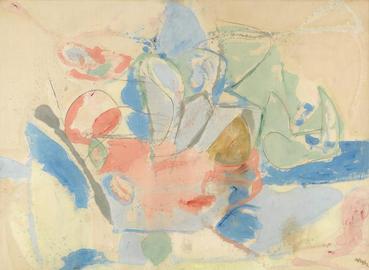
In 1952 or 1953, the critic Clement Greenberg escorted Noland and Louis to the New York studio of Helen Frankenthaler to view her recently completed Mountains and Sea (1952). At the time, Frankenthaler was using a unique technique of pouring oil paints onto unprimed canvas, allowing the medium to soak into its support rather than just dry on the surface. Viewing this technique marked a major turning point in Noland's career as an artist. Following this studio visit, Noland decided to abandon any tendencies to paint in the Abstract Expressionist style and began work on a new set of paintings: the so-called Targets (c. late 1950s-60s). These paintings, also called Circles, were his breakthrough works. In 1958 he began applying a variety of colors to a basic circle template centered on a square canvas, creating a burst of concentric circles rendered in complementary colors that contrasted sharply against the neutral background of the square support.
Mature Period
In the early 1960s, Noland's exploration of color relationships grew increasingly bold and ambitious. In his earlier, less refined Target paintings, heavier color forms had been placed against a white or off-white backdrop. By 1962 Noland began to experiment with colored backdrops and cleaner edges. He also began making the innermost circles, rather than the outer layers, the visual focal point of the composition.
By 1963 Noland had concluded that he had exhausted the possibilities of his "circles in a square" format. He wanted to continue to experiment with colors and their interactions, but he needed a different theme with which to work. For the next phase of his career he began his Chevron paintings (1960s), an even more simple and minimalist series of abstract imagery.
In 1964 Clement Greenberg curated an exhibition of new art at the Los Angeles Country Museum of Art, including works by Noland as well as by Jules Olitski, Helen Frankenthaler, Ellsworth Kelly, Jack Bush, Frank Stella, Morris Louis, and various others. Attempting to formally categorize this emerging post-Abstract Expressionist art, Greenberg dubbed this group's work "Post-Painterly Abstraction."
Later that year, Noland was selected to participate in a show entitled "Four Germinal Painters" at the United States Pavilion of the 32nd Venice Biennale. In that installation, a number of Noland's works from his Targets and Chevrons series hung alongside paintings by Morris Louis, Jasper Johns, and Robert Rauschenberg.
In the early 1960s, Noland began dividing his time between New York and a farm in Vermont. In Vermont he met and became lifelong friends with the artists Jules Olitski and Anthony Caro, with whom he shared certain abstractionist values.
In the late 1960s, Noland's approach to Color Field Painting grew even more reductive, but no less bold. Having run through multiple permutations of both the target and chevron format for the time being, Noland switched to using rectangular canvases and horizontal lines in a new series he called Stripes (1967-70). In his Targets and Chevrons, the artist tended to juxtapose color bands of equal width and to impose some form of axial symmetry on the canvas, leaving portions of unprimed canvas blank in contrast to the color. None of these features occur in Noland's Stripes. Instead, Noland began playing with scale, color, and form on new levels. He reduced his compositions to a basic formula: parallel horizontal lines of varying widths and colors, running along the entire width of the canvas.
Late Period
In the 1970s and 1980s, Noland made a brief return to chevrons, experimented with color compositions in plaid-like patterns, and, perhaps most importantly, produced several differently shaped canvases. He also made a brief return to teaching, and in 1985 he took an appointment as the Milton Avery Professor of the Arts at Bard College.
In 1999, Noland began work on his Mysteries series of paintings (c. 1999-2002), which was in many respects a return to his beginnings as a formalist abstractionist of the late 1950s. Using acrylics on paper and unprimed canvas, he once again painted symmetrical circular targets on square supports. His new Targets, much like the older ones, were as visually bold as they were deliberately void of subject; however, he wanted to reaffirm their relevancy as the new millennium approached.
Noland died in 2010, at the age of 85. He had lived much of his late life in a quiet community in Maine, where he worked in his studio until his final days. He was survived by his fourth wife, Paige Rense, as well as three children from his first marriage and a son from his third marriage. He was honored shortly after his death by a memorial presentation at the Guggenheim Museum.
The Legacy of Kenneth Noland
Combining the geometric abstraction of Mondrian and the color interactions of Albers with the spiritual ambiguity of Mark Rothko and Barnett Newman, Noland created abstractions comprised of pure colors, shapes, and lines to create contrast and energy on the canvas, while eventually removing all gestural traces or references to the external world. In this artistic enterprise he shared a mutual influence with his contemporaries Al Held, Ellsworth Kelly, and David Smith, as well as other Washington Color School artists like Anne Truitt and Gene Davis. His flat, starkly simple compositions helped to pave the way for Minimalism and for artists like Frank Stella, Donald Judd, and Robert Irwin, as well as for the Neo Geo movement's ironic revival of flat, geometrical compositions in the 1980s. Noland's art also exercised a continuing influence on a later generation of Washington, D.C. painters working in various modes of abstraction.
Influences and Connections
-
![Paul Klee]() Paul Klee
Paul Klee -
![Piet Mondrian]() Piet Mondrian
Piet Mondrian -
![Josef Albers]() Josef Albers
Josef Albers ![Ossip Zadkine]() Ossip Zadkine
Ossip Zadkine![Ilya Bolotowsky]() Ilya Bolotowsky
Ilya Bolotowsky


-
![Frank Stella]() Frank Stella
Frank Stella -
![Ellsworth Kelly]() Ellsworth Kelly
Ellsworth Kelly -
![Jules Olitski]() Jules Olitski
Jules Olitski ![Robert Irwin]() Robert Irwin
Robert Irwin


Useful Resources on Kenneth Noland
- Kenneth Noland: The Nature Of ColorBy Alison de Lima Greene, Karen Wilkin, and Peter Marzio
- Kenneth NolandBy Kenworth Moffett
- Kenneth Noland (20th Century Artists)By Karen Wilkin
- Kenneth Noland: Paintings 1958-1989By Terry Fenton
- Kenneth Noland: A RetrospectiveOur PickBy Diane Waldman
- Kenneth Noland: Themes and variations, 1958-2000By Kenneth Noland
- Kenneth Noland: The Circle Paintings 1956-1963By William C. Agee and Alison de Lima Greene
- Kenneth Noland: Monotypes, Barcelona 1984By Kenneth Noland