Ask The Art Story AI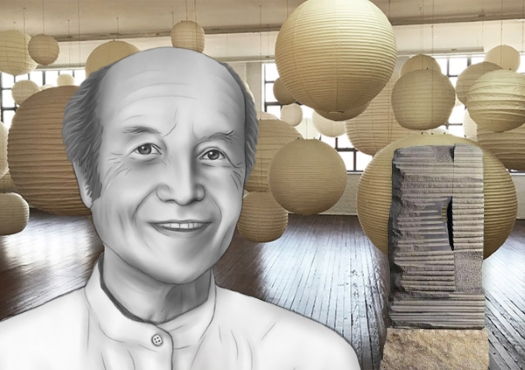


Summary of Isamu Noguchi
Isamu Noguchi, a major American and Japanese sculptor and designer, spent over six decades creating abstract works - largely in stone - based on both organic and geometric forms. Greatly inspired by traditional Japanese art, as well as by the biomorphic style of some Surrealist art, Noguchi became internationally known both for his artwork and his publicly accessible furniture and architecture. His ultimate objective, to create and enhance public spaces through sculpture, provided his career with a distinct direction and established him as a critical figure in the worlds of post-war art, architecture and design.
Accomplishments
- The overarching concept informing Noguchi's work was his passionate, career-long desire to create art the public could use in a social space. He realized this goal in myriad ways: mass produced furniture and lamps; theatrical set designs; public projects such as gardens, playgrounds and fountains; and sculptural manipulations of the natural landscape.
- Noguchi wanted to call attention to the dichotomies inherent in much of his work: he merged geometric and organic forms, found value in both positive and negative space, and created works that challenged the boundaries of design and art. He also integrated the materials and art forms of both his Japanese and American heritages into his innovative creations.
- Noguchi was socially and artistically connected to Abstract Expressionism, as evident not only in his large-scale works evoking abstracted forms but also in his friendships with Arshile Gorky and Willem de Kooning. Yet, his sculpture retained a distinct sensibility in its use of natural materials and its distinct blend of Surrealist and Japanese influence.
Important Art by Isamu Noguchi

Portrait of R. Buckminster Fuller
During the 1920s and 1930s, Noguchi's primary means of financial support came from sculpting portrait busts. At this point he had already studied with Brancusi and had begun to make his own abstract sculptures, many of which merged geometric and organic forms. Although his commissioned portraits were more representational than the majority of his artistic output, these powerful sculptures suggest Noguchi's interest in the abstract, as well as a keen understanding of his material and its properties. The portrait of R. Buckminster Fuller, a likeness of the inventor, theorist and architect who became a life-long friend, is covered in extremely reflective industrial chrome. These high-tech materials created "form without shadow," Noguchi stated, meaning that the reflection itself became a sculptural element. The choice of a modern material for this sculpture was also a reference to Fuller's work with technology. Noguchi was truly an international figure and is also notable for having engaged with leading figures of twentieth-century art, dance, literature and science. It was commented upon during his lifetime that he literally knew everybody of note.
Chrome-plated bronze

Death (Lynched Figure)
Considered a major early piece by Noguchi, Death (Lynched figure) testifies to the artist's progressive racial views and strong social commitment. Noguchi modeled the painfully contorted figure, which hangs on rope upon a photograph of African-American George Hughes being lynched above a bonfire, writhing in agony; Hughes was hung in Texas in 1930. The horrifying photograph of Hughes was later reproduced in the Communist magazine, Labor Defender, which is where Noguchi saw it. In terms of form, the sculpture is unusual since Noguchi suspended the figure above the ground on a metal armature. Noguchi created this sculpture for a 1935 exhibition organized by the NAACP to protest the national rise in lynching, and also to pressure President Roosevelt to enact legislation prohibiting such vigilante violence; the President did not. While the sculpture was well received, some critics reacted harshly, revealing their own racism by claiming the artist was not native-born, and in one instance referring to the provocative sculpture as "a little Japanese mistake." The raw emotion and vital energy of Death (Lynched Figure) still remains potent today.
Monel, steel, wood, and rope - The Isamu Noguchi Foundation

History as Seen from Mexico in 1936
Considered one of the most innovative and important public works of art from the 1930s, this bold high-relief mural emerged from Noguchi's involvement with the revolutionary world of the Mexican intelligentsia. The sculptural mural was Noguchi's first fully realized public project, and speaks to the interwoven histories and modernisms of Mexico and the U.S. The three-dimensional mural displays the aesthetic and political influence of such Mexican Muralists Diego Rivera and José Clemente Orozco in the choice of the mural format and also, its overt Leftist symbolism - the clenched worker's fist, the tilled field, for examples. It was David Alfaro Siqueiros, the third great Mexican muralist, who inspired Noguchi's use of such innovative art-making materials, such as the unorthodox use of cement, believing modern art must be made using modern means. Noguchi chose to situate his work in an ordinary marketplace so that the common people of Mexico, or the masses, could encounter it during their daily routine. The work's intention was to inspire the dispossessed of Mexico to join in the revolutionary cause. The work's adaption of abstraction is without precedent in Mexican modern art, and was derived more from Noguchi's intimate familiarity with European modernism.
Tinted cement, concrete, and brick - Abelardo L. Rodriquez Market, Mexico City

Kouros
In the 1940s, Noguchi made a series of interlocking slab sculptures, drawing on Surrealist-inspired biomorphic forms, organic abstractions, traditional Japanese art, and Brancusi's simplified figuration. Biomorphism appeared in much of Noguchi's work - both in free-standing sculptures and furniture designs. Kouros, the largest work of the series and titled after the Greek word for "man," depicts a three-dimensional, fragmented human shape rendered in smooth, interlocking flat surfaces slotted and notched together in a tense balance. The aesthetic roots of Noguchi's sculpture reside in the beginnings of western culture, within ancient Greece and its veneration of the young male both in society and in statuary. The idealized Greek male represented the highest pinnacle of human beauty and perfection within western society up through the 19th and early-20th-century artistic ideals and racial politics. Due to his hybrid identity, Noguchi and other Japanese-Americans suffered overt racism before, during, and after WWII, finding their identities split in half, rather than seen as a united whole. What Noguchi has accomplished with Korous is to challenge the basis of Western art and society, remaking the ideal human form into solids and voids, a whole that can be disassembled and rearranged, just as Noguchi experienced his identity differently in various social and political situations.
Marble - The Metropolitan Museum of Art, New York

Noguchi Table
Good design can allow art, including that of the avant-garde, to enter and enhance the lives of everyday people. Noguchi accomplishes this ideal by reducing a table to just three basic elements: two smoothly shaped pieces of wood - unpainted to exploit the natural grain, interlock to create a tripod that supports the glass top. Noguchi eschews all excess ornamentation, letting the true nature of the materials speak while accentuating the elegance of the simple forms. The Noguchi Table conceals nothing, revealing everything about the simplicity of his materials, and harmoniously unites design with functionality. Noguchi originally created this iconic table in 1944, and today it is widely sold by Herman Miller, Inc. It is considered one of the most important works of modern furniture ever designed, and, even more noteworthy, can be found in living rooms, as well as museums, across the world today.
Wood, glass - Museum of Modern Art, NYC

Jardin Japonais - Gardens for UNESCO
Noguchi first encountered Japanese gardens during his visits to his father's birth land in the 1930s. By the 1950s he began to design his own unique gardens. The designed garden became a crucial concept for his sculptural landscapes, which he saw as a means to integrate art into social environments. He viewed his work as a "sculpture of spaces," rather than a collection of discrete pieces. Jardin Japonais, for UNESCO headquarters in Paris, was his first major landscape commission. Noguchi felt that gardens should be experienced as nature untouched, so he included elements such as overall organic shapes and lanterns made of natural stone. He arranged the carefully selected Japanese stones by drawing on both Japanese tradition and his own unique design, fusing his skill as a designer with his high regard for the natural world. The fact that Noguchi's patron was the United Nations for a French location speaks to the international reputation, and high regard for the artist and his ability to represent the highest ideals of this international entity.
n/a - UNESCO Headquarters, Paris

Akari E lamp
In the 1940s, Noguchi produced his first illuminated sculptures, Lunars, having previously explored the idea of sculpting with light. His Lunars demonstrate how the artist continued to draw upon Surrealist-inspired biomorphic shapes, and were comprised of magnesite and light bulbs. In 1951 Noguchi expanded his basic formula to create his Akari works at the request of the mayor of Gifu, Japan, to modernize the local lantern designs; again, Noguchi united the traditional and the modern. The results have been both exhibited and mass produced since 1955. Noguchi envisioned his Akari (which means "light as illumination") as two sculptures - both the outward form of the sculpture itself and the resulting shapes created by the emitted light. For Noguchi, light was another type of medium in which to work, one that challenged the idea of materiality through its fundamental ethereality, and which radiated both the natural and industrial worlds.
Mulberry bark paper, bamboo, and wire - The Metropolitan Museum of Art, New York

Energy Void
Noguchi started his Void series in Italy, but he carved the largest, Energy Void of 1971, at his studio on the island of Shikoku, Japan. There he worked primarily in basalt - a local stone -- and granite for the remainder of his career, splitting his time between his studios in the U.S. and Japan. Here, in Energy Void, Noguchi worked with black Swedish granite on a large scale (approximately 6 feet high), having built his studio around the work. In these abstract Void sculptures, Noguchi emphasized the importance of negative space in sculpture by drawing on Zen Buddhist concepts of emptiness. He also found inspiration in laws of physics referring to the cyclical energy flow through all matter, seen here in the piece's continual loop. The piece neither begins nor ends, but rather suggests the timeless flow of energy and of life itself.
Granite - The Isamu Noguchi Foundation

The Well (Variation on a Tskubal)
Located within the garden at the Noguchi Museum in New York, The Well demonstrates Noguchi's mastery of natural elements, and the strong presence of a Japanese aesthetic. Noguchi worked with stone his entire life, first learning how to carve while an assistant to Constantin Brancusi. Noguchi produced his final stone sculptures at his studio on Shikoku Island, Japan, where he worked with the local basalt stone. The Well perfectly balances modernism with traditional Japanese stonework, the man made with the natural. The piece unites natural contrasts: the fluidity and transparency of water against the still, solid black stone. Filtered up from below, the water gently skims the surface of The Well; there is a slight indentation on top that pools with water before cascading downwards. Noguchi sensually combines natural elements, creating a work that is both contemplative, but joyous.
Water, Basalt - The Isamu Noguchi Foundation
Biography of Isamu Noguchi
Childhood
Isamu Noguchi's parents met when his mother, an American writer, was hired to assist his father, a young Japanese poet, with his English. By the time Noguchi was born in 1904, his father had returned to Japan. At two years old, Noguchi and his mother moved to Tokyo to live with his father, but left in 1910 for Omori and in 1912 for Chigasaki, where nine-year-old Noguchi helped with the construction of his home. In 1913, Noguchi's father married a Japanese woman and began his own family, further distancing himself from his son. At 13, Noguchi's mother sent him to the Interlaken School in Rolling Prairie, Indiana.
Early Training
After graduating high school in Indiana, Noguchi spent a summer tutoring the son of sculptor Gutzon Borglum in Connecticut; in exchange he received training from the future Mount Rushmore sculptor, who asserted that Noguchi was talentless. Although Noguchi had wanted to be an artist since he was young, he entered Columbia University as a pre-med student in 1922. His mother moved to New York in 1924 and encouraged her son to study sculpture at the Leonardo da Vinci School of Art. Later that year, Noguchi left Columbia to focus on his art full-time; he also began using his father's name "Noguchi," rather than his mother's, "Gilmour," which he had previously used. His academic, figurative sculptures were soon shown in several exhibitions at the da Vinci School, the National Academy of Design and the Pennsylvania Academy of the Fine Arts.
In 1927, Noguchi traveled to Paris on a Guggenheim Fellowship and began working as an assistant to Constantin Brancusi, whose New York gallery exhibition the previous year had been extremely influential for the young artist. While teaching Noguchi methods of Direct Carving in wood and stone, Brancusi strongly communicated to Noguchi his aesthetic and relationship to his materials. From Brancusi, Noguchi became interested in the idea of leaving the marks of his tools on his sculpture to signify an ongoing connection between sculptor and material. However, it was only after leaving Brancusi's studio that Noguchi began creating his own sculptures, many of which initially echoed the form, themes and materials of his mentor. Noguchi's sculptures began as simple geometric shapes, but he soon moved toward more organic forms, sometimes merging the two. While in Paris, Noguchi also became part of the Bohemian community, meeting artists such as Alexander Calder, Stuart Davis and Jules Pascin.
Upon returning to New York in 1929, when his Fellowship expired, Noguchi had his first solo exhibition at the Eugene Schoen Gallery, which was met with a positive response despite a lack of sales. To make money, he returned to the representational portrait sculptures he had begun in his academic years, creating busts of well-known artists such as George Gershwin, Martha Graham and Buckminster Fuller. For the next two years he traveled to Paris, Beijing and finally Japan. In Kyoto he first saw the Japanese pottery and Zen gardens that would greatly influence much of his work.
Mature Period
Noguchi returned to New York in 1931 and became involved in the social and labor activism of the 1930s, when he executed designs for workers' memorials, public art projects and political works. During this period, Noguchi also designed sets for dance and theater performances, particularly for modern dance choreographer Martha Graham, with whom he collaborated for several decades. He also became very interested in the application of art to lived environments and created proposals for several outdoor spaces, playgrounds, and other public projects.
After the Japanese Pearl Harbor attack on the United States, Noguchi furthered his political actions by protesting against the 100,000 Japanese Americans interned. He formed the Nisei Writers and Artists Mobilization for Democracy in 1942 and registered complaints in Washington. That year he also voluntarily spent several months in an Arizona internment camp, even though he was living in New York and was not required to be detained. He went there for a couple of months, with the goal of improving the lives of the people encarcerated. Instead, the budget for his projects was cut, and his paperwork to be released got lost. Noguchi pleaded for release and ultimately spent a total of 7 miserable, unproductive months in the camp.
At around this time Noguchi also began to develop his freestanding sculptures, many of which were based on the biomorphic forms of Surrealist art. Biomorphism also infused his furniture designs, such as his iconic table that was mass-produced in 1947 and is still popular today. Also in the 1940s, Noguchi started creating sculptures with light, entitled Lunars, which similarly employed biomorphic shapes. His Akari lamps of 1951 furthered his experiments in using electric light as a key sculptural element. He continued producing such sculptures for the rest of his career and included illumination in some of his public and environmental sculptures. Post-war construction growth in the 1950s and 1960s provided Noguchi with the opportunity to design numerous international public projects, many of which were focused around gardens.
Late Years and Death

In 1962, Noguchi spent time in Italy as an artist-in-residence at the American Academy in Rome. Later that decade, while still in Italy, he began his banded marble works, for which he used a post-tension technique involving a tightened, internal metal rod holding the multicolored pieces together. Noguchi also started his Void series in Italy in 1970. During the later period of his career, Noguchi continued creating public sculptures, gardens, fountains and playgrounds for international sites. His late sculptural work was made primarily using stone, some of which he left unpolished and in its natural state. In 1981 he began designing the Noguchi Museum in Long Island City, New York; it opened in 1985, three years before his death in New York in 1988.
The Legacy of Isamu Noguchi
Although considered by some to be part of the Abstract Expressionist movement, Noguchi's dual heritage and time abroad diverted his individual aesthetic toward a unique blend of Eastern and Western art. As a result, he had a distinct influence upon subsequent generations of modern artists, designers and architects. Noguchi's determined efforts to create sculptural spaces and objects to be used by the general public were highly successful; innumerable examples of his inventive designs, sculptures and architecture can be found worldwide in museum collections and public spaces, as well as inside everyday homes.
Influences and Connections


-
![R. Buckminster Fuller]() R. Buckminster Fuller
R. Buckminster Fuller -
![Alexander Calder]() Alexander Calder
Alexander Calder -
![Arshile Gorky]() Arshile Gorky
Arshile Gorky ![Martha Graham]() Martha Graham
Martha Graham


-
![Maya Lin]() Maya Lin
Maya Lin -
![Robert Smithson]() Robert Smithson
Robert Smithson ![Lawrence Halprin]() Lawrence Halprin
Lawrence Halprin


-
![R. Buckminster Fuller]() R. Buckminster Fuller
R. Buckminster Fuller ![Isamu Kenmochi]() Isamu Kenmochi
Isamu Kenmochi

-
![Abstract Expressionism]() Abstract Expressionism
Abstract Expressionism ![Modern Furniture Design]() Modern Furniture Design
Modern Furniture Design![Landscape Architecture]() Landscape Architecture
Landscape Architecture


Useful Resources on Isamu Noguchi
- Isamu Noguchi's Modernism: Negotiating Race, Labor, and Nation, 1930-1950By Amy Lyford
- The Life of Isamu Noguchi: Journey Without BordersBy Masayo Duus
- Isamu Noguchi: A Study of SpaceBy Ana Maria Torres