Ask The Art Story AI


Summary of Barnett Newman
Newman shared the Abstract Expressionists' interests in myth and the primitive unconscious, but the huge fields of color and trademark "zips" in his pictures set him apart from the gestural abstraction of many of his peers. The response to his mature work, even from friends, was muted when he first exhibited it. It was not until later in his career that he began to receive acclaim, and he would subsequently become a touchstone for both Minimalists and a second generation of Color Field painters. Commenting on one of Newman's exhibitions in 1959, critic Thomas B. Hess wrote, "he changed in about a year's time from an outcast or a crank into the father figure of two generations."
Accomplishments
- Newman believed that the modern world had rendered traditional art subjects and styles invalid, especially in the post-World War II years shadowed by conflict, fear, and tragedy. Newman wrote: "old standards of beauty were irrelevant: the sublime was all that was appropriate - an experience of enormity which might lift modern humanity out of its torpor."
- Newman's pictures were a decisive break with the gestural abstraction of his peers. Instead, he devised an approach that avoided painting's conventional oppositions of figure and ground. He created a symbol, the "zip," which might reach out and invoke the viewer standing before it - the viewer fired with the spark of life.
- He thought that humans had a primal drive to create, and one could find expressions of the same instincts and yearnings locked in ancient art as one would find in modern art. He saw artists, and himself, as the creators of the world.
The Life of Barnett Newman

Saying "A painter is a choreographer of space," Barnett Newman invented what he called the "zip," a band of vertical color. Thus he led Abstract Expressionism and Color Field Painting, impacted related movements, while also being an inspiring art theorist.
Important Art by Barnett Newman

Onement I
Newman saw Onement I as a breakthrough in his work. It features the first full incarnation of what he later called a "zip," a vertical band of color. This motif would play a central role in many of his subsequent paintings. The painting's title is an archaic derivation of the word "atonement," meaning, "the state of being made into one." For Newman, this unevenly painted zip on a flat field of color does not divide the canvas; rather, it merges both sides, drawing in the audience to intensely experience the work both physically and emotionally. Some have compared the zips to Alberto Giacometti's slender figures, reinforcing Newman's own connections between his paintings and the viewer's body.
Oil on canvas and oil on masking tape on canvas - The Museum of Modern Art, New York
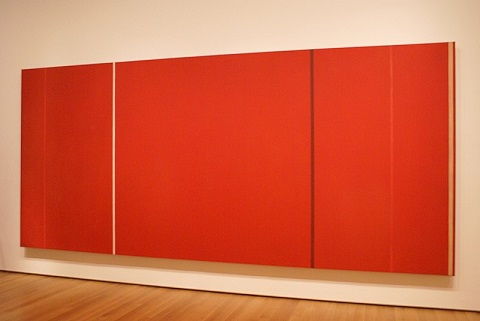
Vir heroicus sublimis
Translated as "Man, heroic and sublime," Vir heroicus sublimis was, at 95 by 213 inches, Newman's largest painting at the time it was completed, although he would go on to create even more expansive works. He intended his audiences to view this and other large paintings from a close vantage point, allowing the colors and zips to fully surround them. In this piece, which is more complex than it initially appears, Newman's zips are variously solid or wavering, creating a perfect square in the center and asymmetrical spaces on the perimeter. Mel Bochner, an artist associated with Conceptualism, remembered encountering it at the Museum of Modern Art in the late 1960s and realizing that its scale and color created a new kind of contact between the artwork and the viewer. "A woman standing there [looking at it]...was covered with red," he recalled. "I realized it was the light shining on the painting reflecting back, filling the space between the viewer and the artwork that created the space, the place. And that that reflection of the self of the painting, the painting as the subject reflected on the viewer, was a wholly new category of experience."
Oil on canvas - The Museum of Modern Art, New York

The Wild
The Wild is unique in Newman's oeuvre by virtue of its unusual size; at eight feet tall by one and a half inches wide, it focuses on the zip alone. When first exhibited it was placed directly across from the vast Vir heroicus sublimis (1950-51) and was said to be a response to the latter's sprawling size. It demonstrated Newman's belief that a painting need not be physically large to inspire an intense response from the viewer. The Wild could also be regarded as one of the first of the shaped canvases that became popular over a decade later with the arrival of artists such as Frank Stella and Kenneth Noland.
Oil on canvas - The Museum of Modern Art, New York

Third Station
Third Station is part of Newman's major fourteen-piece series, The Stations of the Cross: Lema Sabachthani (1958-66). The title refers to Christ's cry on the cross, yet he also intended to evoke the cries of humanity throughout history. The series is characterized by a stark palette of black, white, and raw canvas - Newman wanted the unpainted canvas to become its own color - and the picture expands the artist's use of the zip, with some appearing starkly straight and others seeming feathered and about to explode. The series took eight years to complete because, as Newman said, he could never plan a picture; "I could not do them all at once, automatically, one after the other...When there was a spontaneous urge to do [each of the paintings] is when I did them."
Oil on canvas - The National Gallery of Art, Washington DC

Canto VII
In addition to paintings, Newman also created etchings and lithographs, such as the series 18 Cantos (1963-64). The Cantos are his only print series executed in color, and Newman spoke of them using musical analogies; "their symphonic mass lends additional clarity to each individual canto," he wrote in an introduction to the series, "and at the same time, each canto adds its song to the full chorus." In 18 Cantos, Newman employs a wide, offset band, a variation on the thinner zips, and allows the colors to bleed out into the margins, testing the idea of spatial boundaries. He has written that each canto has its own "personal margins."
Lithograph - The Museum of Modern Art, New York

Broken Obelisk
Newman made several sculptures, but Broken Obelisk is his most monumental. Its use of heavy, rough-surfaced steel contrasts with the impression of lightness created by the inverted obelisk that almost floats above the stable pyramid. The two parts connect at a space of only two and a quarter inches, with an internal steel rod stabilizing the massive sculpture. Although ancient imagery of pyramids and obelisks are often associated with death, Newman reinvents them here to evoke life and transcendence. Several versions of Broken Obelisk exist, with one in Houston, dedicated to the memory of Dr. Martin Luther King, Jr.
Cor-Ten steel - The Museum of Modern Art, New York
Biography of Barnett Newman
Childhood
Barnett Newman was born in 1905 to Jewish parents who had immigrated to New York from Russian Poland five years earlier. Barney, as his family and friends called him, grew up in Manhattan and the Bronx with three younger siblings. He started drawing at the Art Students League during high school, continuing to take classes there while earning a philosophy degree from City College of New York. It was at the Art Students League that he would meet and befriend Adolph Gottlieb, who would introduce him to important New York artists and gallery owners.
Early Training
Following his college graduation, Newman worked for his father's clothing manufacturing business until it failed a few years after the 1929 stock market crash. During the next few years, his disparate pursuits included substitute art teaching (despite failing the art teacher qualification exam many times), running as a write-in candidate for mayor in 1933, and creating a short-lived magazine advocating civil service workers' rights. In 1936, he married Annalee Greenhouse, a teacher. During the early 1940s, he gave up painting entirely. Instead, he studied natural history, ornithology, and Pre-Columbian art, wrote museum catalogue essays and art reviews, and organized exhibitions. His interest in ornithology would later inform his famous quote, "Aesthetics is for the artist as ornithology is for the birds." During this time, he began a friendship with gallery owner Betty Parsons, for whom he organized several exhibitions. She soon began representing Mark Rothko, Clyfford Still, and Jackson Pollock, all close friends of Newman.
By 1944, Newman had returned to art practice, inspired in part by Surrealism. Dissatisfied with his earlier figurative work, he destroyed everything he had previously made, and he would continue to destroy work that failed to please him throughout his career. In 1946, the Betty Parsons Gallery began representing him.
Mature Period
The year 1948 was a major turning point in Newman's career. He began developing a pictorial device he called a "zip," a vertical stripe of color running the length of the canvas, and this led to the painting Onement I(1948). The device would become the trademark of all his work to come. With it, he suspended a painting's traditional opposition of figure and ground and created an enveloping experience of color in which the viewer herself, physically and emotionally, is invoked by the zip - gestured to as a being filled with the original spark of life, just like Newman's mythical "first man" (see "Writings and Ideas" below). He touched on some of these ideas in explaining how viewers should read his much larger 1950 canvas Vir heroicus sublimis: "It's no different, really, from meeting another person. One has a reaction to the person physically. Also, there's a metaphysical thing, and if a meeting of people is meaningful, it affects both their lives."
The new work, including Onement I (1948), was first shown at Betty Parsons Gallery in 1950. The response, however, was chiefly negative; one painting was even defaced, and Newman's works would continue to excite violent reactions from audiences, being slashed on several occasions in subsequent years. The following year, Parsons showed him again, yet the response was little better and it drove Newman to withdraw from the gallery scene. Throughout this time he continued writing, producing several philosophical essays about art. Most notably, he wrote "The Sublime Is Now," in which he stated, "I believe that here in America, some of us, free from the weight of European culture, are finding the answer, by completely denying that art has any concern with the problem of beauty and where to find it."
His work was not shown anywhere between 1951 and 1955; he even bought back a painting he no longer wanted on view. And throughout these early years, he sold very few paintings. It was not until the early 1960s - and following a heart attack in 1957 - that some of his most ardently negative critics began to shift their viewpoints.
Late Period
With the critical tide gradually changing, many began to consider Newman an important artist within Abstract Expressionism, particularly after Clement Greenberg organized his 1959 solo show at French & Company. In the 1960s, Newman expanded his work into lithographs and sculpture, which he had only delved into earlier in his career. His work appeared in several important museum exhibitions on Abstract Expressionism, securing his significant place within the movement. Despite this broader recognition, however, many still misinterpreted his work; Newman would repeatedly dispute such misunderstandings throughout his career. He would even do this at considerable cost to himself; at a time when few museums were interested in his work, he refused an offer to be in the 1962 Whitney exhibit on Geometric Abstraction.
In 1966, the Guggenheim gave Newman his first solo museum exhibition, displaying his Stations of the Cross, a series of fourteen pictures executed between 1958 and 1966. Although this show also received many negative reviews, it expanded his recognition within the art world. Over the next few years, he continued creating some of his most important work. Among these included his largest painting, Anna's Light (1968), the series Who's Afraid of Red, Yellow and Blue (1966-68) and the monumental sculpture Broken Obelisk (1963-69). On July 4, 1970, Newman died of a heart attack in New York.
The Legacy of Barnett Newman
Although largely unappreciated during his life, Barnett Newman is now viewed as crucial to the Abstract Expressionist movement and as a precursor to Minimalism. Yet he never considered himself a part of any particular movement, nor a contrast to one. He rejected comparisons to geometric painters as well as comments that named him a progenitor of the Minimalist movement. Unlike those more stark canvases that focused on non-representational meaning of shapes and colors, Newman brought a more philosophical edge to his paintings, infusing them with his own self, and inviting the audience to experience them with both their bodies and their psyches.
Writings and Ideas
Introduction
Newman stands out among artists of the New York School for the quantity of writing he produced, particularly in the early to mid 1940s. Discussion and ideas remained important to him, and he likened abstract thought to the non-objective forms of "primitive" art - both, he believed, were aimed at generalization and classification. However, as an artist, Newman claimed to have never approached any painting with a plan. "I am an intuitive painter," he wrote, one who is concerned with the "immediate and particular." In this respect, Newman's ideas about art were romantic. He believed that a maker of abstract art was harnessing the most basic human emotions, but wasn't bound by any mythology or ancient standard for making art, or even for viewing it.
In a 1962 interview Newman gave to Art in America magazine, he remarked, "The central issue of painting is the subject matter... My subject is antianecdotal." An anecdotal painting, he believed, was like an episode or a piece in a longer sequence. Newman believed that if a painting is antianecdotal, then it somehow becomes more whole, self-sufficient and independent. He also believed that whatever a painting's meaning, it would come out in the viewing of the work, not through discussion.
MOST IMPORTANT WRITINGS
'The First Man Was an Artist'
Tiger's Eye
October 1947
Newman worked as an associate editor for Tiger's Eye, and 'The First Man Was an Artist' was published in the magazine's first year. In the essay, Newman asserted the priority of the aesthetic over the social: "The human in language is literature," he wrote, "not communication." Humans were artists before they were hunters, he claimed, and were storytellers before they were scientists. "Just as man's first speech was poetic before it became utilitarian, so man first built an idol of mud before he fashioned an axe."
Newman also questioned the benefits of scientific advancements on the mind of modern man. His position was not that science was particularly malevolent, but rather that it had become a strict form of theology that restricted the creative spirit. "The domination of science over the mind of modern man," he wrote, "has been accomplished by the simple tactic of ignoring the prime scientific quest; the concern with its original question What?"
According to Newman, once this question of "what?" ceases to be at the forefront, advancements in the arts and sciences are no longer possible; they became merely the practice of reaffirming old and tried ideas.
'The Sublime is Now'
Tiger's Eye
December 1948
In this, perhaps Newman's most famous essay, he examined the work of several 20th-century European artists who, he believed, destroyed old standards of beauty. He also briefly touched on the standards of beauty in art established by the ancient Greeks and examined the ways in which influential philosophers - particularly 19th-century Germans - reconciled these ideas with the advent of new modern styles. The key struggle, according to Newman, was that which occurs between ideas of beauty and ideas of the sublime. Newman concluded that artists had finally succeeded in creating a new standard of beauty and the sublime. Not since the Renaissance, he claimed, had a melding of those two concepts occurred with such force. Before Abstract Expressionism, some of the greatest modern artists had only succeeded in challenging old ideas about beauty in the visual arts: "Picasso's effort may be sublime," he wrote, "but there is no doubt that his work is a preoccupation with the question of what is the nature of beauty." He believed his own generation was a new breed - artists who didn't simply question or even challenge old standards, but rather created entirely new and consequently sublime ideas about beauty.
On Abstract Art
Newman considered himself a pure artist, working with pure forms. For a 1947 exhibition at Betty Parsons Gallery, entitled The Ideographic Picture, he wrote, "The basis of an aesthetic act is the pure idea. But the pure idea is, of necessity, an aesthetic act." Newman affirmed his belief that authentic, expressive abstract art was void of symbolism or illusion and that the purest living form in an abstract painting was its shape. "[A] shape [is] a living thing," he wrote, "a vehicle for an abstract thought-complex, a carrier of the awesome feelings [the artist] felt before the terror of the unknowable."
On Art and Inquiry
For the first issue of Tiger's Eye, in October 1947, Newman wrote one of his most famous essays, 'The First Man Was an Artist'. In it he sought to establish a rather unorthodox link between art and science; "For there is a difference between method and inquiry," he wrote. "Scientific inquiry, from its beginnings, has perpetually asked a single and specific question, What? What is the rainbow, what is an atom, what is a star [sic]?" This basic and instinctive question of "what?" was what made all art into a science - not a science that set out to prove something, but rather a science that simply sought new knowledge and experience.
On Beauty
According to Newman, all of modern art had been a quest to negate the classical standards of beauty established during the Renaissance. The early Modernists - artists such as Édouard Manet and the Impressionists - had failed to fully achieve this, and the task of completion was left to his own generation. "I believe that here in America," he wrote in 1948, "some of us, free from the weight of European culture, are finding the answer, by completely denying that art has any concern with the problem of beauty and where to find it... We are reasserting man's natural desire for the exalted, for a concern with our relationship to the absolute emotions."
Barnett Newman vs. Ad Reinhardt
In 1956, Ad Reinhardt wrote an article in College Art Journal entitled 'The Artist in Search of an Academy', in which he derided Barnett Newman as "the artist-professor and traveling-design-salesman, the Art-Digest-philosopher-poet and Bauhaus-exerciser, the avant-garde-huckster-handicraftsman and educational-shop-keeper, the holy-roller-explainer-entertainer-in-residence."
Newman was enraged and sued Reinhardt for libel. When the case reached the New York Supreme Court, it was dismissed and subsequently rejected again upon appeal. But Newman was often similarly criticized by fellow artists for being overly romantic - Pollock reportedly called him a "horse's ass" at one gallery opening.
In Discussion with Hess on Stations of the Cross
In a public conversation between Thomas B. Hess and Newman, staged at the Guggenheim Museum on May 1, 1966, Newman was asked a series of questions regarding his Stations of the Cross series (1958-66), which were exhibited at the museum in Newman's very first solo exhibition at a public gallery.
"When I call them Stations of the Cross," he said, "I am saying that these paintings mean something beyond their formal extremes...What I'm saying is that my painting is physical and what I'm saying also is that my painting is metaphysical...that my life is physical and my life is also metaphysical." Hess later asked Newman about the absence of color in the pictures - something that was unusual in his work. Newman responded, "Tragedy demands black, white, and gray. I couldn't paint a green passion, but I did try to make raw canvas come into color. That was my color problem - to get the quality of color without the use of color. A painter should try to paint the impossible."
Influences and Connections


-
![Clement Greenberg]() Clement Greenberg
Clement Greenberg ![Immanuel Kant]() Immanuel Kant
Immanuel Kant![Johann Wolfgang von Goethe]() Johann Wolfgang von Goethe
Johann Wolfgang von Goethe![Georg Hegel]() Georg Hegel
Georg Hegel![Karl Marx]() Karl Marx
Karl Marx


-
![Abstract Expressionism]() Abstract Expressionism
Abstract Expressionism -
![Color Field Painting]() Color Field Painting
Color Field Painting -
![Surrealism]() Surrealism
Surrealism ![Pre-Columbian Art]() Pre-Columbian Art
Pre-Columbian Art


Useful Resources on Barnett Newman
- Reconsidering Barnett NewmanBy Melissa Ho, Mel Bochner, Yve-Alain Bois, B.H. Friedman, Mark Godfrey, Ben Heller, Carol Mancusi-Ungaro, Robert Murray, Suzanne Penn, Sarah K. Rich, Nan Rosenthal, Pierre Schneider, Gabriele Schor, Richard Shiff, Allan Stone
- Barnett NewmanOur PickBy Thomas B. Hess
- Barnett Newman: Selected Writings and InterviewsOur PickBy Barnett Newman, John P. O'Neill, Richard Shiff
- The Sublime Is Now: The Early Work of Barnett NewmanBy Jeremy Strick, Barnett Newman, Walker Art Center, St. Louis Art Museum, Pace Gallery