Ask The Art Story AI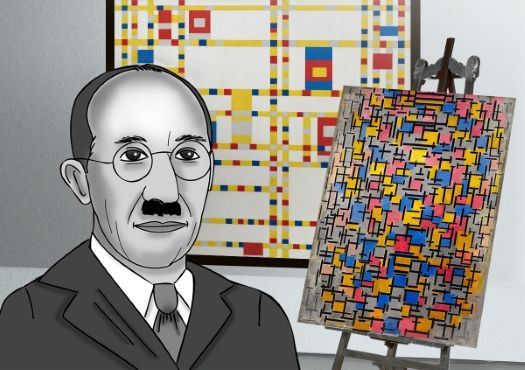


Summary of Piet Mondrian
Piet Mondrian, one of the founders of the Dutch modern movement De Stijl, is recognized for the purity of his abstractions and methodical practice by which he arrived at them. He radically simplified the elements of his paintings to reflect what he saw as the spiritual order underlying the visible world, creating a clear, universal aesthetic language within his canvases. In his best known paintings from the 1920s, Mondrian reduced his shapes to lines and rectangles and his palette to fundamental basics pushing past references to the outside world toward pure abstraction. His use of asymmetrical balance and a simplified pictorial vocabulary were crucial in the development of modern art, and his iconic abstract works remain influential in design and familiar in popular culture to this day.
Accomplishments
- A theorist and writer, Mondrian believed that art reflected the underlying spirituality of nature. He simplified the subjects of his paintings down to the most basic elements, to reveal the mystical balance of forces that governed nature and the universe. In so doing, he became one of the most sophisticated practitioners of Theosophical ideas through his art.
- Mondrian chose to distill his representations of the world to their basic vertical and horizontal elements, which represented the two essential opposing forces: the positive and the negative, the dynamic and the static, the masculine and the feminine. The dynamic balance of his compositions reflect what he saw as the universal balance of these forces.
- Mondrian's singular vision for modern art is clearly demonstrated in the methodical progression of his artistic style from traditional representation to complete abstraction. His paintings evolve in a logical manner, and clearly convey the influence of various modern art movements such as Luminism, Impressionism, and most importantly, Cubism.
- Mondrian, and the artists of De Stijl, advocated pure abstraction and a pared down palette in order to express a utopian ideal of universal harmony in all of the arts. By using basic forms and colors, Mondrian believed that his vision of modern art would transcend divisions in culture and become a new common language based in the pure primary colors, flatness of forms, and dynamic tension in his canvases.
- Mondrian's development of Neo-Plasticism became one of the key documents of abstract art. In the movement he detailed his vision of artistic expression in which "plasticism" referred to the action of forms and colors on the surface of the canvas as a new method for representing modern reality.
The Life of Piet Mondrian
Mondrian said: "The position of the artist is humble. He is essentially a channel." An advocate of esoteric philosophy and a true mystic, he led a live of ascetic commitment to experiment, creating a whole new abstract visual language in the process.
Important Art by Piet Mondrian
Evolution
Mondrian was a lifelong Theosophist, joining the Dutch Theosophical Society in 1909 and living briefly at the movement’s headquarters in Paris in 1911. When he moved to England in 1938 Mondrian transferred membership to the English Theosophical Society. When he died in 1944 in New York his few remaining possessions included books on Theosophy and a Theosophical Society membership card. He was in regular contact with the Anthroposophist Rudolf Steiner and drew on his ideas.
Mondrian’s later, minimalist De Stijl works can be seen as theosophically influenced in their use of elemental horizontals and verticals and a simple palette of colors which represented underlying energies and harmonies in nature. But his earlier, more figurative work expresses Theosophical ideas more explicitly. The monumental triptych Evolution (1910-11) was created when Mondrian still identified with Symbolism.
Art historians Charles Cramer and Kim Grant note that the work “shows the ‘three spirits’ that Madame Blavatsky [the founder of Theosophy] described as living within humankind: terrestrial (on the left), sidereal or astral (on the right), and divine (in the center).” Robert P. Welsh takes the yellow in the center and right-hand panels to represent astral "shells or radiations" emanating from those two figures, suggesting that, scanning left to right, the figures represent a development "from matter through soul to spirit."
Oil on canvas - Kunstmuseum
The Gray Tree
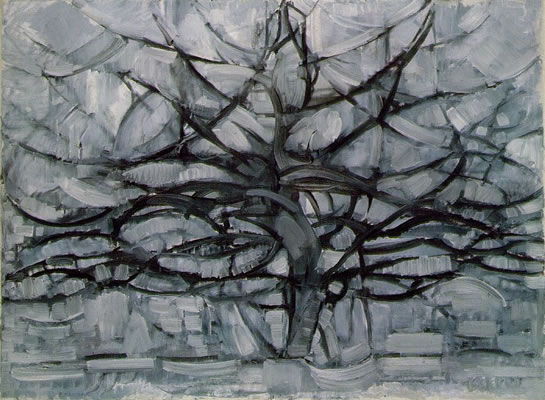
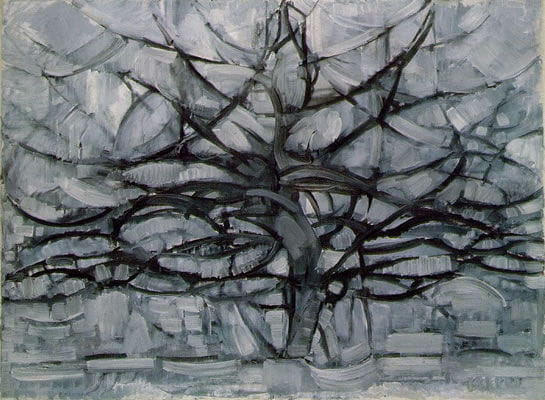
The Gray Tree exemplifies Mondrian's early transition toward abstraction, and his application of Cubist principles to represent the landscape. The three-dimensional tree has been reduced to lines and planes using a limited palette of grays and black. This painting is one in a series of works Mondrian created, in which the early trees are naturalistically represented, while the later works have become progressively more abstract. In the later paintings, the lines of the tree are reduced until the form of the tree is barely discernable and becomes secondary to the overall composition of vertical and horizontal lines. Here, there is still an allusion to the tree as it appears in nature, but one can already see Mondrian's interest in reducing the form to a structured organization of lines. This step was invaluable to Mondrian's development of his mature style of pure abstraction.
Oil on canvas - Gemeentemuseum, The Hague
Pier and Ocean (Composition No. 10)
Pier and Ocean marks a definitive step in Mondrian's path toward pure abstraction. Here he has eliminated diagonal and curved lines as well as color; the only true reference to nature is found within the title and the horizontal lines that allude to the horizon and the verticals that evoke the pilings of the pier. The rhythms created by the alternating lines and their varying lengths presages Mondrian's mature dynamic, depicting an asymmetrical balance as well as the pulse of the ocean waves. Reviewing this work, Theo van Doesburg wrote: "Spiritually, this work is more important than the others. It conveys the impression of peace; the stillness of the soul." Mondrian had begun to translate what he saw as the underlying ordered patterns of nature into a pure abstract language.
Oil on canvas - State Museum Kroller-Muller, Otterlo
Composition with Color Planes
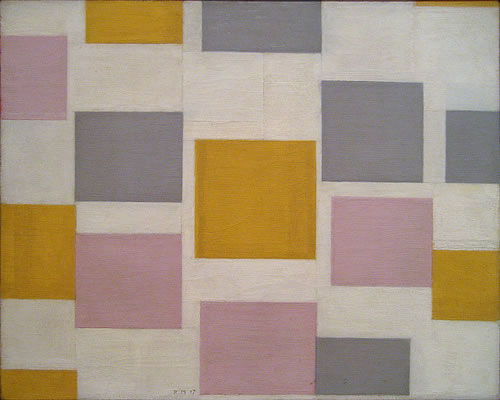
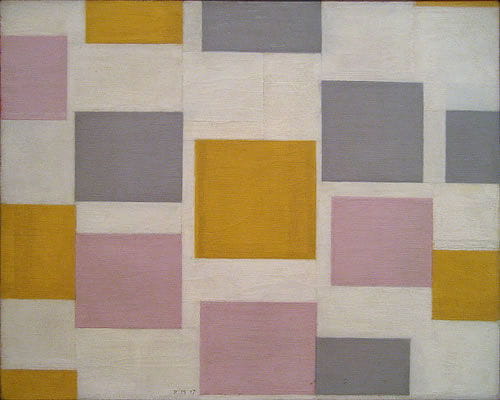
While still in Holland during World War I, Mondrian helped found the group of artists and architects called De Stijl, and it was during this period he refined his style of abstraction even further. Composition with Color Planes shows his break with Analytic Cubism and exemplifies the principles he expressed in his essay "The New Plastic in Painting." Here, Mondrian has moved away from the Cubist palette of ochres, grays, and browns, opting instead for muted reds, yellows and blues - a clear precursor to his mature palette that focused on primary colors. The blocks of color float on a white ground and no longer reference a physical object in nature such as a tree or building, while all reference to illusionistic depth has been eliminated. The composition is based on color and balance and gives even weight to all areas of the picture surface, moving toward the precise balance of his mature canvases.
Oil on canvas - The Museum of Modern Art, New York
Yellow, Black, Grey and Blue
In the 1920s, Mondrian began to create the abstract paintings for which he is best known. He limited his palette to white, black, gray, and the three primary colors, with the composition constructed from thick, black horizontal and vertical lines that delineated the outlines of the various rectangles of color or reserve. The simplification of the pictorial elements was essential for Mondrian's creation of a new abstract art, distinct from Cubism and Futurism. The assorted blocks of color and lines of differing width create rhythms that ebb and flow across the surface of the canvas, echoing the varied rhythm of modern life. The composition is asymmetrical, as in all of his mature paintings, with one large dominant block of color, here red, balanced by distribution of the smaller blocks of yellow, blue, grey, and white around it. This style has been quoted by many artists and designers in all aspects of culture since the 1920s.
Works such as these also can be seen to express Mondrian’s engagement with ideas from Theosophy. For example, his decision to only use horizontal and vertical lines, and to work in a drastically reduced color palette, indicated his belief in a series of key relationships and harmonies underpinning the nature universe, which he attempted to translate into an iconic, abstract visual language.
Oil on canvas - Gemeentemuseum, The Hague
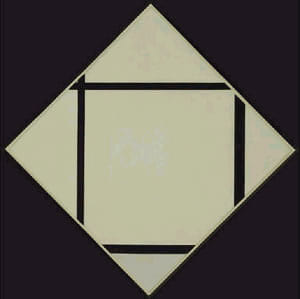
Tableau I: Lozenge with Four Lines and Gray
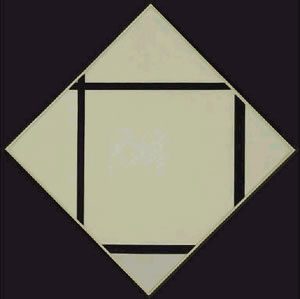
Following the development of his mature Neoplastic style, Mondrian sought to express a more dynamic rhythm in his abstractions. He began producing "lozenge" paintings (as early as 1919) in order to create a more vibrant tension on the picture plane. The "lozenge" paintings are known as such because of their diamond-shape that results from Mondrian using an unconventional orientation for his square canvases, turning them on a forty-five degree angle with a corner at the top. His innovation introduced the diagonal line of the canvas edge into his grid of horizontal and vertical lines. In this particular composition, the lines appear to extend beyond the edges of the canvas as they intersect with the diagonals at varied intervals. This particular example relies upon only four lines of varied thickness, bisecting the gray picture plane in order to express Mondrian's ideal of active balance. By shifting the orientation of the canvas, Mondrian provided an important precedent for the shaped canvases of the Minimalists in the 1960s. With the complete absence of color in this painting, Mondrian has also prefigured the Minimalists' interest in pure form and favoring of gray, white, and other muted colors.
Oil on canvas - The Museum of Modern Art, New York

Broadway Boogie-Woogie
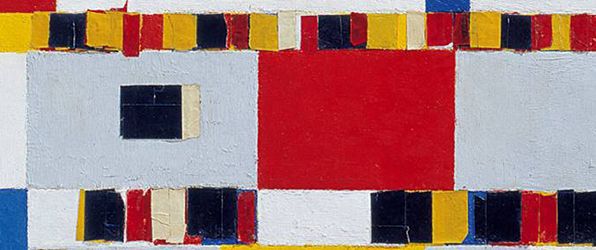
This canvas presents the viewer with the culmination in Mondrian's life-long pursuit of conveying the order that underlies the natural world through purely abstract forms on a flat picture plane. Broadening the use of his basic pictorial vocabulary of lines, squares and primary colors, the black grid has been replaced by lines of color interspersed with blocks of solid color. This, and his other late abstract paintings, show a new, revitalized energy that was directly inspired by the vitality of New York City and the tempo of jazz music. The asymmetrical distribution of the brightly colored squares within the yellow lines echoes the varied pace of life in the bustling metropolis, one can almost see the people hurrying down the sidewalk as taxi cabs hustle from stop-light to stop-light. Broadway Boogie-Woogie not only alludes to life within the city, but also heralds New York's developing role as the new center of modern art after World War II. Mondrian's last complete painting demonstrates his continued stylistic innovation while remaining true to his theories and format.
Oil on canvas - The Museum of Modern Art, New York
Biography of Piet Mondrian
Childhood
Piet Mondrian, born Pieter Cornelis Mondriaan, Jr. grew up as the second of five children in a devoutly Calvinist home in central Holland. Art and music were encouraged in his household. His father, the headmaster of the local primary school, was an enthusiastic amateur artist who gave drawing lessons to his son, while Mondrian's uncle, Fritz Mondriaan, was an accomplished artist who taught his nephew to paint.
Early Training
In 1892, Mondrian enrolled in the Rijksakademie van Beeldende Kunsten, or the Royal Academy of Visual Arts in Amsterdam. His three years of academic training focused on drawing from the model, copying Old Masters and genre painting. In the following years, he would rely on these skills to support himself by producing scientific drawings and copies of museum paintings, as well as giving private drawing lessons in his studio.

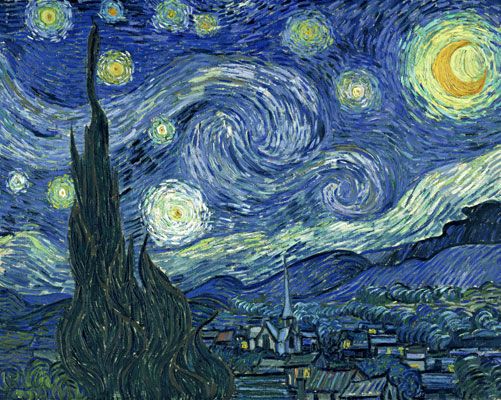
"Always further," is how Mondrian termed his drive to transform his artwork. Starting in 1905, his traditional landscape compositions began to reveal a new sense of drama and light. Jan Toorop, a leading artist of Dutch Luminism, introduced Mondrian to the French Post-Impressionists. Mondrian's paintings changed dramatically as a result, integrating, for example, the bold color and brushwork of Vincent van Gogh and the pointillist technique of Georges Seurat. Even in these early works, it is apparent that Mondrian had a tendency to work in series, focusing on a singular subject. Both of these facets would be invaluable to the development of his mature, abstract style.
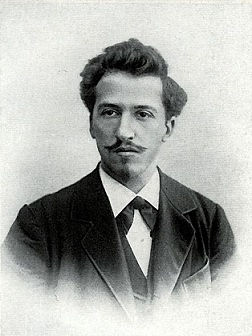
For Mondrian, art and philosophy were deeply intertwined. He was a prolific writer and theorist, and was drawn to spiritual and philosophical studies. In 1909, he joined the Theosophical Society, a spiritual organization with widespread influence in Europe in the early decades of the 20th century, based on the teachings of Buddhism. Theosophy directly influenced his representational style, expressed in paintings of flowers, and more specifically, the work Evolution (1910-1911) that echo the Buddhist and Theosophist cycle of death and rebirth. Mondrian explains the role of spirituality in his artwork, "All the time I'm driven to the spiritual. Through Theosophy I became aware that art could provide a transition to the finer regions, which I will call the spiritual realm." Though he later disagreed with some members of the group, Theosophy influenced Mondrian's goal of representing complete, pure harmony, which he expressed by the balance and tension of form and color in his paintings.
Mature Period
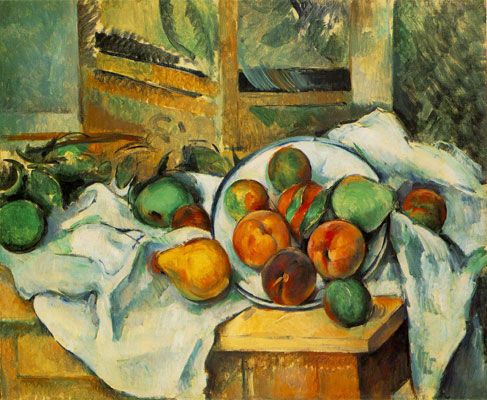
The influence of Cubism marks a turning point in Mondrian's career. In 1912, he moved to Paris, which was the thriving center of the avant-garde art world, and became fully conversant in the works of Picasso, Braque, and others, shifting from a representational, Neo-Impressionistic style to modern abstractions. Analytic Cubism gave Mondrian the structure necessary to distill his landscapes to their sparest elements of line and shape: he made use of the Cubist grid, reducing his images of trees and buildings to a schematized framework. During his first years in Paris, Mondrian temporarily adopted the Cubist muted grey and yellow/brown palette, as in The Gray Tree (1912). However, unlike the Cubists, Mondrian wished to stress the flatness of the painting surface, rather than allude to three-dimensional illusionistic depth, as the Cubists depicted.
In 1914, Mondrian was visiting his sick father in Holland when World War I broke out. He was unable to return to Paris until 1919. Despite being separated from the avant-garde in Paris, Mondrian continued to develop his style toward pure abstraction. Curved lines gradually disappeared from his paintings along with all references to objects or nature. During this key period, Mondrian and artist and architect Theo van Doesburg founded the journal De Stijl in 1917. De Stijl, or "the style," was a movement among Dutch artists, architects, and designers that presented an ideal of total abstraction as a model for harmony and order across the arts. Mondrian and these artists developed a vision of modernism independently from that found in Paris.
Mondrian termed the resulting artistic style Neo-Plasticism, or the new plastic art. For Mondrian, "plastic" merely referred to a novel way of representing reality, found upon the surface of the painting itself. Dedicated to the "absolute devaluation of tradition" the artists of De Stijl emphasized "the need for abstraction and simplification" and limited the elements in their paintings to straight horizontal and vertical lines, right angles, the three primary colors (red, yellow, blue) and the three achromatic colors (grey, white, and black). The De Stijl movement proved to have a major international influence on architecture, art, typography, and interior design throughout the 20th century.
Late Years and Death
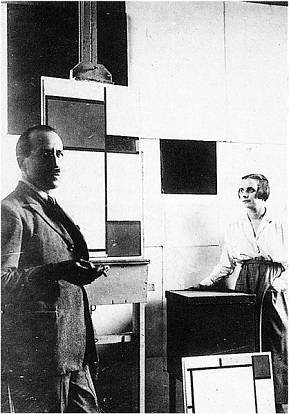
After the end of World War I, Mondrian moved back to Paris and at the age of forty-seven began creating the iconic abstract paintings for which he is best known. Within the milieu of 1920s Paris, he created a unique mode of abstraction compared to the contemporary movements of Surrealism and Paris Dada. Mondrian's paintings of the 1920s are the clearest expression of his ideal of purity and universal harmony in Neoplastic expression. It was only around 1925 that Mondrian began to receive recognition for his contribution to modernism, with his paintings entering the collections of wealthy Europeans and Americans.
Prior to the start of World War II, Mondrian moved to London for two years before settling in New York City in 1940. While in London in 1938, Mondrian met and became friends with Peggy Guggenheim, an amity that led to Guggenheim's staunch support of the Dutch expatriate, both within London and later in New York where she exhibited Mondrian's works at her Art of This Century Gallery. Mondrian was introduced to the burgeoning New York avant-garde art scene and joined the American Abstract Artists - additionally legitimizing the new group's role in modern art through his mentorship in European abstraction.
At the time, he expanded his pictorial vocabulary - introducing double lines, then color lines, and finally his black grid was replaced with pulsating lines of color squares. Inspired by his new surroundings within the American metropolis, his late paintings show a new energy and complexity of composition as evidenced in Broadway Boogie-Woogie (1943). Devoted to his work, Mondrian's life reflected the purity and discipline of his art. He remained unmarried and lived simply with few possessions. He died of pneumonia in 1944 at the age of 71.
The Legacy of Piet Mondrian

The refinement of Mondrian's abstractions as well as the utopian ideals behind his work had an immense impact on the development of modern art, both while he was still alive as well as after his death. His work was immediately referenced by the Bauhaus, particularly in the simplified lines and colors of the school's aesthetic, as well as its ideal in which the arts could bring concord to all aspects of life. Later on, Mondrian's style can be seen in the developments of the Minimalists of the late 1960s, who also opted for reduced forms and a pared down palette. Not only influential within modern art, Mondrian's far-reaching impact can be seen across all aspects of modern and postmodern culture, from Yves Saint Laurent's color-blocking in his "Mondrian" day-dress, to the use of Mondrian's Neoplastic style and palette by the rock band the White Stripes for the cover of their 2000 album, De Stijl, as well as his name as the moniker for three hotels, the "Mondrian" hotel in New York, Los Angeles, and Miami.
Influences and Connections

-
![Vincent van Gogh]() Vincent van Gogh
Vincent van Gogh -
![Paul Cézanne]() Paul Cézanne
Paul Cézanne -
![Pablo Picasso]() Pablo Picasso
Pablo Picasso ![Jan Toorop]() Jan Toorop
Jan Toorop


-
![Theo van Doesburg]() Theo van Doesburg
Theo van Doesburg ![Bart van der Leck]() Bart van der Leck
Bart van der Leck


-
![Ad Reinhardt]() Ad Reinhardt
Ad Reinhardt ![Ilya Bolotowsky]() Ilya Bolotowsky
Ilya Bolotowsky![Leon Polk Smith]() Leon Polk Smith
Leon Polk Smith


-
![Theo van Doesburg]() Theo van Doesburg
Theo van Doesburg -
![Peggy Guggenheim]() Peggy Guggenheim
Peggy Guggenheim ![Bart van der Leck]() Bart van der Leck
Bart van der Leck


Useful Resources on Piet Mondrian
-
![Piet Mondrian: Mister Boogie Woogie Man]() Piet Mondrian: Mister Boogie Woogie ManOur PickMondrian moves to Paris and creates new art. Includes commentary by Robert Hughes
Piet Mondrian: Mister Boogie Woogie ManOur PickMondrian moves to Paris and creates new art. Includes commentary by Robert Hughes -
![Artists of the 20<sup>th</sup> Century: Piet Mondrian]() 70k viewsArtists of the 20th Century: Piet MondrianLonger video exploring pregression of Mondrian's art
70k viewsArtists of the 20th Century: Piet MondrianLonger video exploring pregression of Mondrian's art


-
![Mondrian at Tate Liverpool and Turner Contemporary]() 138k viewsMondrian at Tate Liverpool and Turner ContemporaryArt Historian Rosie Rockel describes Mondrian's artistic development
138k viewsMondrian at Tate Liverpool and Turner ContemporaryArt Historian Rosie Rockel describes Mondrian's artistic development -
!["Victory Boogie Woogie" at The Getty Conservation Institute]() 15k views"Victory Boogie Woogie" at The Getty Conservation InstituteDetailed and technical video. Discussion by expert historians
15k views"Victory Boogie Woogie" at The Getty Conservation InstituteDetailed and technical video. Discussion by expert historians