Ask The Art Story AI


Summary of Fernand Léger
Though Fernand Léger built his reputation as a Cubist, his style varied considerably from decade to decade, fluctuating between figuration and abstraction and showing influence from a wide range of sources. Léger worked in a variety of media including paint, ceramic, film, theater and dance sets, glass, print, and book arts. While his style varied, his work was consistently graphic, favoring primary colors, pattern, and bold form.
Accomplishments
- Léger embraced the Cubist notion of fracturing objects into geometric shapes, but retained an interest in depicting the illusion of three-dimensionality. Léger's unique brand of Cubism was also distinguished by his focus on cylindrical form and his use of robot-like human figures that expressed harmony between humans and machines.
- Influenced by the chaos of urban spaces and his interest in brilliant, primary color, Léger sought to express the noise, dynamism, and speed of new technology and machinery often creating a sense of movement in his paintings that captured the optimism of the pre-World War I period.
- In its embrace of recognizable subject matter and the illusion of three dimensionality interspersed with or often simultaneous with experiments in abstraction and non-representation, Léger's work synchronizes the often competing dualities in much of 20th-century art.
The Life of Fernand Léger

“I was stunned by the sight of the breech of a 75 millimeter in the sunlight. It was the magic of light on the white metal. That's all it took for me to forget the abstract art of 1912–13” Léger famously said of his experience serving in World War I. He went on to pioneer his distinctive visual idiom, painting “in slang with all its color and mobility” to take on a modern vibe.
Important Art by Fernand Léger

Nudes in the Forest
This painting was exhibited at the Salon des Indépendants in 1911 and is considered Léger's first major work showcasing his break from Impressionism and his alliance with Cubism, particularly in his monochromatic palette and his breaking of form into geometric shapes. Léger's focus on drawing and form rather than color also indicates his influence from Paul Cézanne. Léger's Cubism, however, was distinct from mainstream Cubism. Léger does not abandon three-dimensionality and volumetric form to the same degree as Pablo Picasso and Georges Braque whose canvases from this period lack all but the merest illusion of space. Léger's interest in nature, his use of cylindrical form, and his focus on machine-like forms further distinguishes his work from that of other Cubists, while the latter aligns him with Italian Futurism, reflecting the period's optimism about the benefits of urbanization and an industrialized society. These unique qualities led the critic Louis Vauxcelles to dub Léger's style as "Tubism."
Oil on canvas - Kröller-Muller State Museum, Otterlo
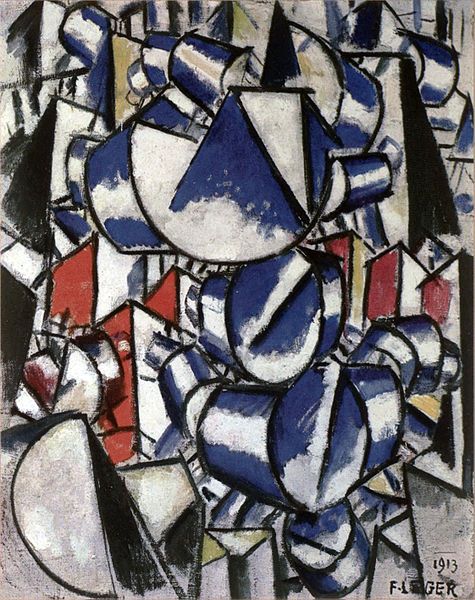
Contrast of Forms
Contrast of Forms was a title given by Léger to a series of paintings completed between 1912 and 1914 in which the artist experimented with the boundaries between abstraction and representation, flatness and three-dimensionality, problems that would occupy him throughout his career. Léger shows his ability to represent volumetric form without the illusion of three dimensions, abstracting both human and mechanical forms. The works exemplify what Léger referred to as the "law of contrasts" in which the greatest opposition or dissonance in line, form, and color are sought. Like Picasso and Braque in their Synthetic Cubist phase, Léger also brings color into these works, particularly blue, red, and yellow; these were typically added very sparsely only after the line and without a smooth finish. These paintings were the first non-representational works to emerge from Cubism and seem to burst with volume and pattern, while giving an overall impression of floating shapes on a flat surface. The painting again exemplifies Léger's unique contribution to Cubism in its use of shading to depict spatial recession and his reliance on mechanical forms.
Oil on canvas - The Museum of Modern Art, New York

The Card Players
Léger worked on this painting as he was recovering from a gas attack during World War I. The work shows the continuing influence of Cézanne, who painted several canvases devoted to this subject matter in the 1890s, as well as Léger's burgeoning interest in the human figure after the trauma of his war experience that gave him an appreciation for ordinary men and crude reality. In referring to the work in 1954, Léger says it was an attempt "deliberately to extract subject from the times" and indeed the helmets and medals of the men mark them as soldiers. His interest in subject matter and three-dimensionality again sets him apart from other Cubists. His color palette remains largely primary and he continues to show his skill in depicting movement, which is highly advanced in The Card Players as the work almost appears as a film sequence.
Oil on canvas - Kröller-Muller State Museum, Otterlo

The City
The City demonstrates Léger's interest in depicting the dynamism and dissonance of urban space rather than pictorial unity or a static image. His fascination with all things modern beyond conventional high art subject matter is evident in the references to traffic lights, billboards, graphic design; he stated that he was especially influenced by the place Clichy in Paris with its large posters. Also obvious is a focus on other colors beyond the primary. He remarked on his use of color in this period: "Color rushes in like a torrent. It swallows up the walls, the streets ... When one opens a window, a piece of shrill publicity blows in the wind ... Exuberance of color and noise." In The City colors play an equal role with form in depicting the chaos of the city; they collide as volumes and flat shapes both recede and move forward in space, seeming to overlap like pieces of a collage, giving the viewer the impression of standing on a busy, noisy street corner.
Oil on canvas - The Philadelphia Museum of Art - this image is only a detail of the painting

Three Women (Le Grand Déjeuner)
This is one of Léger's best-known paintings. In it he retreats from the experimentation with dissonance and collage-like space that he utilized in The City. The work is a culmination of several interests in the previous decade with its depiction of three-dimensionality, its mechanical human figures, and its primary colors. The subject matter of three nude women, however, is one of the most traditional in the history of art. In part for this reason, the painting is often seen as a classic example of what is known as a "return to order" that was typical of many artists in the early 1920s as they retreated from some of their bolder pre-World War I experiments with form, space, and subject matter. Though the subject matter is not contemporary as in The Card Players, Léger is not abandoning his interest in everyday people, but is instead responding to a culture-wide interest in past art with the re-opening of the Musée de Cluny and the expansion of the Louvre to include Egyptian and Assyrian rooms.
Oil on canvas - The Museum of Modern Art, New York

La Joconde aux Cles (Mona Lisa with Keys)
This is one of Léger's most experimental canvases, one of the few in which he shows influence from Surrealism. The objects depicted have no support, but rather simply float in space as in works by Joan Miro. The influence of Surrealism is further evident in the bizarre juxtaposition of objects, chosen specifically because of their lack of relation to one another and in that sense the work harkens back to his interest in dissonance and contrast. Léger had made numerous paintings that included keys in the late 1920s and said of this painting: "One day, after drawing a bunch of keys, I asked myself what element was furthest removed from the bunch of keys, and I said to myself: 'It's the human face.' I went out into the street and saw in a shop window the portrait of Mona Lisa. . . . No contrast has ever been sharper than between this bunch of keys and Mona Lisa." He considered this "risky picture" a success and kept it for himself.
Oil on canvas - Musée National Fernand Léger, Biot, France

Les Grand Plongeurs Noirs (The Big Black Divers)
This painting is part of a series about divers influenced by watching dock workers in Marseilles. Léger shows his ability to depict the human body without sacrificing freedom from representation, a theme that runs through his oeuvre. The bodies here are woven together like a textile, symbolizing a social network, with the arms, legs and torsos also serving as independent forms. As in Mona Lisa with Keys, the bodies float and intertwine in space with no visible support. Further underscoring his dual interest in the human figure and non-representation, the painting includes lines separate from color and blocks of color that are not outlined--a technique that marks Léger's later works. The work was done when Léger was living in New York City during the early period of Abstract Expressionism and the all-over composition no doubt reflects a cross influence with the artists in that circle.
Oil on canvas - Centre Georges Pompidou

The Constructors (Builders with Rope)
Léger became interested in the theme of construction workers in 1940 in line with his socialism and sympathy for the working classes, lecturing at the time that art should be accessible to everyone. The human figure is depicted here as more naturalistic than in his previous works, making him one of the few artists interested in the human figure during this period. In fact, Léger, abandoning his mechanical figures of his earlier period, wanted the human figures to contrast with the steel. He got the idea when he drove past a construction site: "I saw the men swaying high up on the steel girders! I saw man like a flea; he seemed still lost in his inventions ... I wanted to render that; the contrast between man and his inventions, between the worker and all that metal architecture, that hardness, that ironwork, those bolts and rivets." After its completion, Léger wanted the workers to have access to the painting, so he exhibited the work in the cafeteria of the Renault automobile factory and was disappointed that the workers did not seem to understand it.
Oil on canvas - Musée National Fernand Léger, Biot, France
Biography of Fernand Léger
Childhood
Fernand Léger was born in rural Normandy on February 4, 1881 and raised by his family to take up a valuable trade, like his father who was a cattle dealer. While Léger was not encouraged to become an artist, when he showed talent for drawing, he was sent to apprentice with an architect in Caen. After finishing his military training in 1903, he studied in Paris at the École des Arts Décoratifs and Académie Julian. During his studies, he made a living doing architectural drawings and retouching photographs. His paintings during this early period show influence from Impressionism, but the 1907 retrospective of Paul Cézanne at the Salon d'Automne changed the direction of his art.
Early Training
In 1909, Léger moved to Montparnasse and painted early Cubist works such as Le Compotier sur la Table (1909). Though he had met Georges Braque, Pablo Picasso, and Henri Rousseau, his closest friends were the writers Guillaume Apollinaire and Blaise Cendrars. At the 1911 Salon des Indépendants, Léger exhibited paintings that led to his recognition as a major Cubist artist, particularly Nudes in the Forest (1909-1910). He continued to exhibit at the Indépendants and at the Salon d'Automne until he was drafted in 1914, returning with a head injury after being gassed at Verdun in 1916. His war experience fueled Léger's interest in the human figure. He claimed that he forgot the abstraction of 1912-13 because of the "crudeness, variety, humor, and downright perfection of certain men around me, their precise sense of utilitarian reality and its application in the midst of the life-and-death drama we were in ... made me want to paint in slang with all its color and mobility."
Mature Period

In 1920, Léger married Jeanne-Augustine Lohy and also met Le Corbusier with whom he would remain close friends. He aligned himself closely with the circle around Le Corbusier who were interested in machinery and depicting speed and motion. His clean, figurative style and retreat from abstraction in this period are evident in Three Women (Le Grand Déjeuner) of 1921. There are also obvious nods to Futurism in some of his works from this period.
During the 1920s he branched out into other methods of creative expression. He illustrated books, made sets and costumes for ballet and theater performances, and even made the film, Ballet Mechanique, in 1924. It was also in 1924 that he founded a free school for modern art in Paris with Amédée Ozenfant where he taught alongside Marie Laurencin and Aleksandra Ekster.
His subject matter during the 1920s and 1930s reflected his interest in social equality. He was part of the loose Interwar Classicism movemetn, and during this period, Léger began several series of paintings that have been called "cycles," which show different groups of men in action such as construction workers, cyclists, and divers. These works often combined his interest in depicting technology and machinery with a growing focus on the human form, as in Constructor series.
Late Years and Death

Léger first visited the USA in 1931 and relocated to New York City to escape World War II. Between 1940-45 Léger influenced many New York School painters and also administered a lecture series at Yale University called, "Color in Architecture." On his return to France in 1945, he joined the Communist Party. His wife died in 1950 and he was re-married to Nadia Khodossevitch in 1952. Léger became increasingly interested in large-scale public art and in the years before his death produced mosaics, stained glass windows, and murals in Europe and South America. Fernand Léger died at his home in Gif-sur-Yvette, France on August 17, 1955.
The Legacy of Fernand Léger
Léger's unique form of Cubism that relied on cylindrical forms was influential to many abstract painters and sculptors, including Henry Moore, while his bold use of color in combination with his idea of art as something that "everyone can understand" inspired many Pop artists. Léger's belief that art can unify people may even have influenced community-based art as activism movements, such as Fluxus.
Influences and Connections


-
![Paul Eluard]() Paul Eluard
Paul Eluard -
![Hans Richter]() Hans Richter
Hans Richter ![Alvar Aalto]() Alvar Aalto
Alvar Aalto![Paul Rosenberg]() Paul Rosenberg
Paul Rosenberg