Ask The Art Story AI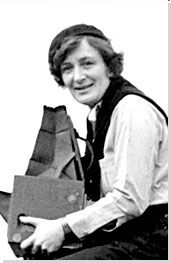


Summary of Dorothea Lange
Dorothea Lange's images of Depression-era America made her one of the most acclaimed documentary photographers of the 20th century. She is remembered above all for revealing the plight of sharecroppers, displaced farmers and migrant workers in the 1930s, and her portrait of Florence Owens Thompson, Migrant Mother, Nipomo, California(1936), has become an icon of the period. Since much of this work was carried out for a government body, the Farm Security Administration, it has been an unusual test case of American art being commissioned explicitly to drive government policy. After the Depression she went on to enjoy an illustrious career in photo-journalism during its hey-day, working for leading magazines such as Fortune and Life, and traveling widely throughout Asia, Latin America, and Egypt. She was instrumental in assembling the "Family of Man" exhibition at the Museum of Modern Art in New York in 1959, a renowned celebration of struggling post-war humanity.
Accomplishments
- Many of Lange's documentary photographs borrow techniques from the lexicon of modernism - dramatic angles and dynamic compositions - to produce startling and often jarring images of her subjects. They never overpower the subjects themselves, but instead subtly direct the viewer to a fresh appreciation of the individual's plight.
- Lange's mature work proved that works of art and documents are not mutually exclusive, and that they can combine to produce beautiful, moving, and campaigning images. Her use of innovative techniques also proved that modernist art need not only convey the private feelings of the artist, but could also be put in the services of popular journalism.
- Lange's work, not only in the Depression but also in the post-war years, is characteristic of a lost age when a broad swath of the mass media was profoundly concerned with social issues. She saw herself firstly as a journalist and secondly as an artist, and she worked with a burning desire to effect social change by informing the public of suffering far away.
Important Art by Dorothea Lange

The White Angel Breadline
One of Lange's better-known photographs, she often cited this particular scene when speaking about her breakthrough into documentary photography. "The discrepancy between what I was working on in the printing frames and what was going on in the streets was more than I could assimilate". Drawn to the lines of people waiting for worker's compensation or food relief, the image of this elderly man waiting for food at the soup kitchen embodies the depressed mood of the times. The camera focuses on the man's hat and face, which show an exploration of texture through comparison of the rough material and wrinkles of the hat, as well as his weathered skin; her unconventional use of the fence in the foreground to lend dynamism to the scene is also characteristic of use of modernist techniques.
San Francisco Museum of Modern Art, the Henry Swift Collection

Ditched, Stalled and Stranded, San Joaquin Valley, California
In this picture, Lange is able to capture a striking look of anxiety on the face of her subject. Stranded in his car, the man's plight suggests the larger problems that society faced during the Great Depression. To add to the feeling of claustrophobia, Lange purposely cropped the photograph into a tighter composition, which originally included a woman sitting in the passenger's seat. Rather than suggesting he pose, Lange has caught him as if unawares, an effect which persuades us all the more of the truth of the image.
The Dorothea Lange Collection, The Oakland Museum of California
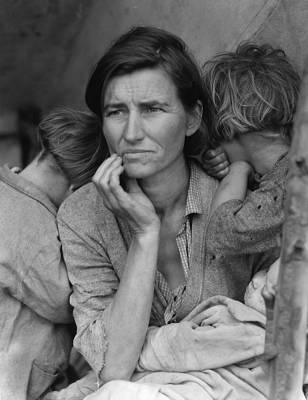
Migrant Mother, Nipomo, California
Probably the most famous of Lange's photographs, the description she wrote of her encounter with Florence Owens Thompson reveals that it left a deep impression on her. "I did not ask her name or her history. She told me her age, that she was 32. She said they had been living on frozen vegetables from the surrounding fields, and birds that the children killed. She had just sold the tyres from her car to buy food. There she sat in that lean-to tent with her children huddled around her, and seemed to know that my pictures might help her, and so she helped me... I knew that I had recorded the essence of my assignment." The indescribably poignant expression on Thompson's face stands out from between the bowed heads of her sons, whose presence reveals the nature of her concerns.
San Francisco History Room, San Francisco Public Library

Plantation overseer and his field hands, near Clarksdale, Mississippi
Lange was an ardent activist and felt strongly about racism. In this composition, the white man with his foot resting on the car seems to be proudly showing off his belongings, including the four black men in the background. The positioning of the men so conveniently fits into Lange's social commentary as to be almost comical, echoing what is ridiculous in the very concept of racial discrimination between whites and blacks. This separation is illustrated in the contrast between dark hats and jackets of the workers, and the light clothing of the overseer.
Collection of the George Eastman House, International Museum of Photography and Film
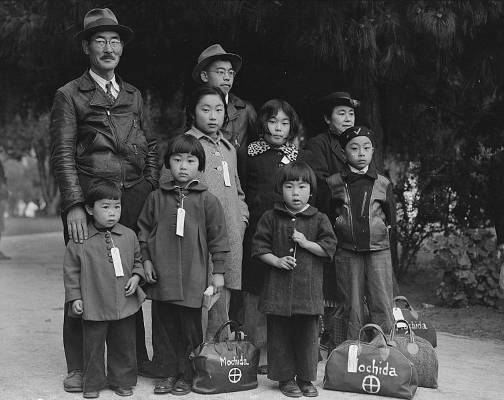
Photograph of Members of the Mochida Family Awaiting Evacuation
This is a photo of the members of the Mochida family awaiting an evacuation bus. Identification tags are used to aid in keeping the family unit intact during all phases of evacuation. Mochida operated a nursery and five greenhouses on a two-acre site in Eden Township. He raised snapdragons and sweet peas. Evacuees of Japanese ancestry would be housed in War Relocation Authority centers for the duration. The solemnity and portrait style of this photograph counteracts the indignity of the Mochida family's pending internment. The tags that hang from their clothing are clearly displayed, echoing those on their luggage and drawing attention to their treatment as less than human. This was among a series of pictures commissioned by the government but which were subsequently impounded when fears arose that they would spark outrage at the treatment of internees.
Oil on canvas - The Bancroft Library, University of California, Berkeley

Argument in a Trailer Camp
In her later work, Lange's more interesting portraits are characterized by their psychological depth and intensity. The strained relationship between this couple represents the tension caused by changing gender roles, as women increasingly joined the workforce during the war years. With the woman in the lighted foreground, Lange casts the female into the role of actor, while the man is relegated to the shadows.
Tempura on canvas - The Museum of Contemporary Photography, Columbia College, Chicago
Biography of Dorothea Lange
Childhood
Dorothea Lange grew up in a middle-class family in New Jersey. Her father, Heinrich Nutzhorn, worked as a lawyer, but also held several respected positions in local businesses, politics and the church, while her mother Johanna managed the household. Both parents were proponents of education and culture, and exposed both Dorothea and her brother Martin to literature and the creative arts.
At the age of seven, Dorothea contracted polio, which left her with a weakened right leg and foot. Always conscious of its effects, she once said that, "[polio] was the most important thing that happened to me, and formed me, guided me, instructed me, helped me, and humiliated me". Her parents divorced five years later; Dorothea never forgave her father, whom she blamed for ending the marriage. She eventually dropped his surname, instead taking her mother's maiden name for her own.
Without Heinrich, the family moved in with Johanna's mother, Sophie, a seamstress with an artistic touch. Although this arrangement was not ideal for Dorothea, who had a mutually antagonistic relationship with her grandmother, Sophie's love of "fine things" and artistic sensibility left its mark on the young girl.
Early Training
Lange showed little interest in academics, and after high school announced to her family that she intended to pursue photography. Looking for work, she approached Arnold Genthe, one of the most successful portrait photographers in the nation. He hired her as a receptionist, but taught her skills of the trade, including how to make proofs, retouch photographs, and mount pictures. Although she worked for several different photographers after Genthe, she always remembered his sense of aesthetics and the importance he placed on high quality, not unlike the lessons her grandmother taught her.
Lange also took a photography course with Clarence White, a contemporary of Alfred Stieglitz. White was influenced by the Pictorialist style of photography, which cultivated many of the effects of fine painting, but he also encouraged his students to individualize their pictures by developing a unique point of view, and his assignments often involved photographing everyday subjects to truly see them. Lange used this concept later in life, where photographs reveal the extraordinary within the average working American.
Lange settled in San Francisco in 1918. Through friends, she made connections with wealthy business owners and gallery patrons, and was soon able to open her own successful portrait studio. Lange considered her work a trade rather than an art, and primarily sought to satisfy her client's desires. She married Maynard Dixon, a well-known muralist, with whom she had two sons, and her marriage drew her deeper into the California art community, but the Great Depression proved a strain on both her marriage and career. Seeing the effects of financial hardship on the people around her, she grew increasingly dissatisfied with portrait work. She took to the streets of San Francisco - documented and sought new techniques, experimenting with close-up shots and simple compositions that emphasized shape and form, rather than focusing only on the subject.
Mature Period
In 1935, Lange was one of the photographers asked to assist with an economic research study led by Paul Taylor, who later became her second husband. Impressed by her work, Taylor recruited her for the Farm Security Administration (FSA), a division of the U. S. government that represented the interests of American farm workers, including tenant farmers and people of color. During this time, Lange recorded the conditions of workers living in poverty-stricken areas of the West coast, the South and the Midwest, including the camps that resulted from the Dust Bowl migration. The photographs from her tenure with the FSA have become iconic within American history and photography.
Out in the field, Lange developed her signature style of photography. Abandoning wide-angle landscape views, she reverted to practices used in her studio and asked the workers to share their stories. These mature photographs often represent intimate portraits, and the captions relate information gleaned from her conversations.
Within this body of work, four main themes emerged. Primarily, the photographs emphasize the relationship between the land and the people, clearly illustrated by the growing hopelessness of the workers unable to revitalize their sterile environments. A feeling of desertion also runs through her depictions of empty streets, abandoned houses, and fields bare of crops. Among her portraits, Lange often represented the depressed man, left idle and dispirited from lack of work. Conversely, images of the strong female heroic figure are also prevalent in her photographs.
Lange became the first female photographer to receive a Guggenheim Fellowship in 1940. First postponed due to family obligations, she later requested another deferment when she was asked to document the internment of the Japanese population after the Pearl Harbor attack. The commission came from the government, yet the resulting photographs threatened to be so controversial that they were impounded for the duration of the war and Lange was not able to see them until twenty years later. They create a subtle yet startling picture of the racism practiced by the American government against its own citizens, and many of the photographs are taken in her signature portrait style, lending a sense of dignity to the people who had been forced from their homes. Lange was able to capture the strength and resilience of the Japanese community, which continued to organize cultural activities and published their own newspapers within the camps.
Late Period
Disillusioned with the failure of her work to enact true social or political change, Lange withdrew from photography for several years. Multiple ailments, including lingering effects from her bout with polio, also took their toll on her health. She briefly taught a photography course at the California School of Fine Arts, using methods that echoed White, her old teacher. By 1950, however, she had resumed working and agreed to participate in the Family of Man exhibition at the Museum of Modern Art in New York.
Lange was contracted by Life to photograph the Mormon society in Utah and the Irish community in County Clare, but these articles also failed to communicate her intentions of social change. When Taylor was appointed a foreign diplomat, she gained the opportunity to record life across the continents, many of which proved more destitute than the conditions she experienced during her work with the FSA. These trips ended as her health continued to deteriorate, although she remained energetic enough to collaborate with New York's Museum of Modern Art on her first solo exhibition. Lange passed away from esophageal cancer in October of 1965, less than three months before her retrospective opened.
The Legacy of Dorothea Lange
Dorothea Lange is an inspiring example of the opportunities that lay open to strong, independent women photographers in the modern era. Her greatest achievements lie in the photographs she took during the Depression. They made an enormous impact on how millions of ordinary Americans understood the plight of the poor in their country, and they have inspired generations of campaigning photographers ever since. But her work after the 1930s also deserves note, not least her involvement with establishing the Aperture Foundation and magazine. Several awards have been set up in her name, including the Lange-Taylor prize for excellence in documentary studies and the Lange Fellowship for documentary photography. Her archives have been preserved near her hometown at the Oakland Museum of California.
Influences and Connections
-
![Paul Strand]() Paul Strand
Paul Strand ![Horace Bristol]() Horace Bristol
Horace Bristol![Maynard Dixon]() Maynard Dixon
Maynard Dixon![Lewis Hine]() Lewis Hine
Lewis Hine![Clarence White]() Clarence White
Clarence White


-
![Imogen Cunningham]() Imogen Cunningham
Imogen Cunningham ![Roy Stryker]() Roy Stryker
Roy Stryker


-
![Ansel Adams]() Ansel Adams
Ansel Adams -
![Catherine Opie]() Catherine Opie
Catherine Opie ![Horace Bristol]() Horace Bristol
Horace Bristol


![Pare Lorentz]() Pare Lorentz
Pare Lorentz![John Steinbeck]() John Steinbeck
John Steinbeck![Roy Stryker]() Roy Stryker
Roy Stryker


Useful Resources on Dorothea Lange
- Dorothea Lange: A Life Beyond LimitsOur PickBy Linda Gordon
- Restless Spirit: The Life and Work of Dorothea LangeBy Elizabeth Partridge
- Dorothea Lange: A Photographer's LifeBy Milton Meltzer, Dorthea Lange