Ask The Art Story AI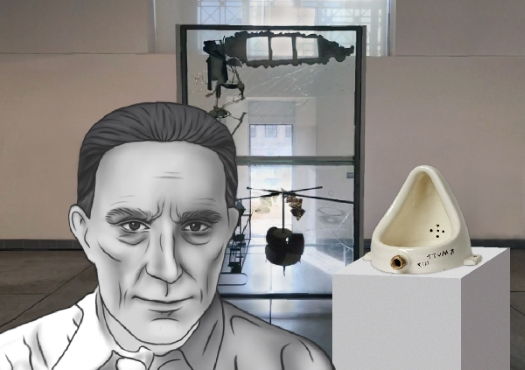


Summary of Marcel Duchamp
Few artists can boast of having changed the course of art history in the way that Marcel Duchamp did. By challenging the very notion of what is art, his first readymades sent shock waves across the art world that can still be felt today. Duchamp's ongoing preoccupation with the mechanisms of desire and human sexuality as well as his fondness for wordplay aligns his work with that of Surrealists, although he steadfastly refused to be affiliated with any specific artistic movement per se. In his insistence that art should be driven by ideas above all, Duchamp is generally considered to be the father of Conceptual art. His refusal to follow a conventional artistic path, matched only by a horror of repetition which accounts for the relatively small number of works Duchamp produced in the span of his short career, ultimately led to his withdrawal from the art world. In later years, Duchamp famously spent his time playing chess, even as he labored away in secret at his last enigmatic masterpiece, which was only unveiled after his death.
Accomplishments
- Coined by Duchamp, the term "readymade" came to designate mass-produced everyday objects taken out of their usual context and promoted to the status of artworks by the mere choice of the artist. A performative act as much as a stylistic category, the readymade had far-reaching implications for what can legitimately be considered an object of art.
- Duchamp rejected purely visual or what he dubbed "retinal pleasure," deeming it to be facile, in favor of more intellectual, concept-driven approaches to art-making and, for that matter, viewing. He remained committed, however, to the study of perspective and optics which underpins his experiments with kinetic devices, reflecting an ongoing concern with the representation of motion and machines common to Futurist and Surrealist artists at the time.
- A taste for jokes, tongue-in-cheek wit and subversive humor, rife with sexual innuendoes, characterizes Duchamp's work and makes for much of its enjoyment. He fashioned puns out of everyday expressions which he conveyed through visual means. The linguistic dimension of his work in particular paved the way for Conceptual art.
The Life of Marcel Duchamp

The artistic inquiries of the highly innovative Cubists were not enough for Duchamp, he continued such early experiments throughout a life that was questioning, redefining, and unorthodox - leading to art beyond what the world thought possible.
Important Art by Marcel Duchamp

Nude Descending A Staircase
Nude Descending A Staircase initially met with an unfavorable response at the Salon des Indépendants, dominated by the Cubist avant-garde who objected to what they deemed as its Futurist leanings, but enjoyed a succes de scandale at the 1913 Armory Show in New York. More than a study of the body's movement through space, the work is an early figurative exercise in painting cinematically, akin to Eadweard Muybridge's sequences of photographs that anticipated motion pictures. This painting together with the contemporaneous Passage from Virgin to Bride marks the end of Duchamp's short-lived career as a painter.
Oil on canvas - The Philadelphia Museum of Art: Collection of Louise and Walter Arenberg

3 Standard Stoppages
Art takes on a scientific guise in this intricate piece whose several component parts are neatly displayed alongside or slotted into a bespoke wooden case. To make this piece, which reads like a visual demonstration of the workings of chance, Duchamp dropped three threads, each exactly one meter long, from a height of one meter. He then carefully recorded the random outline of the fallen thread on canvas, glass and wood. Chance also dictated his choice of title: Duchamp apparently hit upon stoppages, French for the "invisible mending" of a garment, after walking past a shop sign advertising sewing supplies.
Mixed media - The Museum of Modern Art, New York

The Bride Stripped Bare by Her Bachelors, Even, or The Large Glass
The Bride Stripped Bare by Her Bachelors, Even, or The Large Glass was partly inspired by author Raymond Roussel's use of homophones, words that sound alike but have different meanings. Duchamp frequently resorted to puns and double-meanings in his work.With The Large Glass, he sought to make an artwork that could be both visually experienced and "read" as a text. After attending a performance of Roussel's Impressions d'Afrique, Duchamp envisioned a sculptural assemblage as a stage of sorts. Preliminary studies for this stage, which would have been over nine feet tall, included depictions of an abstracted "bride" being attacked by machine-like figures in chaotic motion. The constructed gadgetry featured between the two glass panels was also likely inspired by Duchamp's study of mathematician Henri Poincare's physics theorems.
Mixed media - The Philadelphia Museum of Art

Fountain
The most notorious of the readymades, Fountain was submitted to the 1917 Society of Independent Artists under the pseudonym R. Mutt. The initial R stood for Richard, French slang for "moneybags" whereas Mutt referred to JL Mott Ironworks, the New York-based company, which manufactured the porcelain urinal. After the work had been rejected by the Society on the grounds that it was immoral, critics who championed it disputed this claim, arguing that an object was invested with new significance when selected by an artist for display.
Testing the limits of what constitutes a work of art, Fountain staked new grounds. What started off as an elaborate prank designed to poke fun at American avant-garde art, proved to be one of most influential artworks of the 20th century.
This, now infamous, artwork garnered new attention in the 21st century. In 2014 an article was published that claimed Dada artist and poet Baroness Elsa von Freytag-Loringhoven was the original creator of the work. Though much of the "evidence" backing these claims has been disproven, this remains an issue of contention.
Urinal - The Philadelphia Museum of Art

L.H.O.O.Q
Marcel Duchamp's scandalous L.H.O.O.Q is an altered postcard reproduction of Leonardo Da Vinci's Mona Lisa. For this "assisted" (which implied a degree of manipulation as opposed to the "unassisted") readymade, Duchamp penciled a moustache and a goatee over Mona Lisa's upper lip and chin, and re-titled the artwork. The title riffs on the French pronunciation of the letters, "Elle a chaud au cul," which roughly translates as "She has a hot ass." Rather than transmuting an ordinary, manufactured object into a work of art, as in the bulk of his readymades, in L.H.O.O.Q Duchamp starts with the representation of an iconic masterpiece that he takes down from its pedestal by playfully debunking it. In endowing the Mona Lisa with masculine attributes, he alludes to Leonardo's purported homosexuality and gestures at the androgynous nature of creativity. Duchamp is clearly concerned here with gender role-reversals, which later come to the fore in Man Ray's portraits of the artist dressed as his female alter ego, Rrose Selavy.
Collotype - Museum Boijmans Van Beuningen, Rotterdam

Fresh Widow
This miniature model of a traditional French window was made to Duchamp's specifications by a carpenter in New York. The title, inscribed at the base along with the words "COPYRIGHT ROSE SELAVY 1920," would have been an obvious pun in the aftermath of World War I, which turned many a lusty or "fresh" young spouse into a widow. (Incidentally, the work marks the debut of Duchamp's feminine alter ego, Rose Selavy.) As if to signal mourning, the eight windowpanes are covered in black polished leather, which fully blocks out the view, thus playing havoc with the notion of painting as a window onto the world.
Painted wood, glass, leather - Museum of Modern Art, New York

Rotary Demisphere (Precision Optics)
Duchamp's known aversion for what he termed "retinal art" did not prevent him from conducting optical experiments by means of kinetic sculptures such as this one (though he refused to consider them as artworks). Based on an earlier model Duchamp and Man Ray had experimented with in 1920, Rotary Demisphere (Precision Optics) consists of a white papier-mache globe mounted on a velvet-lined disk that calls to mind the rings of Saturn. The globe is covered with black concentric circles arranged to form a spiral that appears to pulsate when spinning. Engraved on a copper ring around the globe's circumference, the inscription "RROSE SELAVY ET MOI ESQUIVONS LES ECCHYMOSES DES ESQUIMAUX AUX MOTS EXQUIS," ("Rrose Selavy and I dodge the Eskimos' bruises with exquisite words.") When pronounced in French, the phrase wittily conveys the hypnotic visual effect verbally through a complex of echoing sounds.
Mixed media - The Museum of Modern Art, New York

La Boite-en-Valise (Box in a Suitcase)
Like a traveling salesman's kit, this Boite-en-Valise (Box in a Suitcase) is one of twenty-four editions of a leather case that contains sixty-nine miniature reproductions of Duchamp's artworks. Each box offered different, hand-colored art pieces affixed to the lid's inside. Sections in the boxes slide out and unfold to show prints mounted on black board. This work exemplifies the lack of boundary between original and reproduction that Duchamp developed with his readymades. The box also functions as a portable museum: Duchamp made it for his move to New York in 1942, and included selections of his work made up to that date. La Boite-en-Valise calls to mind André Malraux's "museum without walls," not least in its use of photographic reproductions.
Mixed media - Harvard Art Museums/Fogg Museum, Cambridge, MA, Cambridge, MA

Etant donnes
Installed behind a heavy wooden door that was found in Spain and shipped to New York, Etant donnes consists of a diorama viewed through two eyeholes. The scene depicts a nude woman, possibly dead, with her legs splayed, holding an illuminated gas lamp. A mountainous landscape, based on a photo Duchamp shot in Switzerland, creates the background setting. Built in secret over a period of more than twenty years, Etant donnes is considered Duchamp's second major work. He made an entire manual for its installation, which is reproduced in facsimile and available in print. At first glance, Etant donnes is a direct reference to Courbet's painting, Origine du Monde (1866). Yet upon closer consideration, the piece can be viewed as a reflection on the boundaries between artist and spectator, as a means to question self-consciousness, or as a meditation on spiritual purpose through the symbolism of a lit lamp.
Painted wood, latex, and fabric - The Philadelphia Museum of Art

Priere de Toucher (Please Touch)
Priere de Toucher (Please Touch) was designed by Duchamp to accompany the seminal 1947 International Surrealist exhibition he co-curated with André Breton. For the limited edition of the exhibition catalogue, Duchamp and the Surrealist artist Enrico Donati hand-colored 999 foam rubber "falsies," or false breasts, to glue onto black velvet which adhered to the removable book covers. This catalogue, the exhibition it was based on, and a future exhibition on which Duchamp and Breton collaborated yet again, "Exposition Internationale du Surrealisme (1959-60)," mark Duchamp's thematic overlap with the Surrealists, namely an obsession with eroticism.
Book with latex breast - The Philadelphia Museum of Art
Biography of Marcel Duchamp
Childhood

Marcel Duchamp was raised in Normandy, in a family of artists. His father was mayor of Blainville and his mother raised their seven children and painted landscapes depicting the French countryside. Family time was spent playing chess, reading, painting, and playing music. One of Marcel's earliest artworks, Landscape at Blainville (1902), painted at age fifteen, reflected his family's love of Claude Monet. Marcel was close to his two older brothers, and in 1904, after both had left home to become artists, he joined them in Paris to study painting at Académie Julian. His brother, Jacques Villon, supported him during his studies, and Marcel earned some income by working as a cartoonist. Duchamp's early drawings evince his ongoing interest in visual and verbal puns.
Early Training

Paris in the early 1900s was the ideal place for Duchamp to become acquainted with modern trends in painting. Duchamp studied Fauvism, Cubism, and Impressionism, and was captivated by new approaches to color and structure. He related above all to the Cubist notion of reordering reality, rather than simply representing it. His early paintings, such as Nude Descending A Staircase (1912), illustrate Duchamp's interest in machinery and its connection to the body's movement through space, implicit in early Modernism. However, Duchamp was most attracted to avant-garde notions of the artist as an anti-academic, and felt an affinity in this respect with one of his early heroes, the Symbolist painter and graphic artist, Odilon Redon. Early in his career, Duchamp developed a taste for the mysterious allure of Symbolist subject matter, such as the woman as elusive femme fatale. This deep-seated interest in the themes and exploration of sexual identity and desire would lead Duchamp toward Dadaism and Surrealism.
Mature Period

In 1911, the twenty-five-year-old Marcel Duchamp met Francis Picabia, and the following year attended a theater adaptation of Raymond Roussel's Impressions d'Afrique with Picabia and Guillaume Apollinaire. This experience, and Roussel's inventive plots and puns in particular, made a deep impression on Duchamp. He noted that, for the first time, he "felt that as a painter it was much better to be influenced by a writer than by another painter." This interest in cross-genre pollination would influence the artist to develop an eclectic approach to art making.
In 1915, Duchamp immigrated to New York and conceived and manufactured several readymades. By signing them, Duchamp laid claim to found objects, such as a snow shovel, a urinal, or a bicycle wheel. These objects, tied symbolically to themes of desire, eroticism and childhood memory, were designed to show the absurdity of canonizing avant-garde art practice.
He also devoted seven years - 1915 to 1923 - to planning and executing one of his two major works, The Bride Stripped Bare by Her Bachelors, Even, or The Large Glass. This installation of machinery wedged between glass panels was Duchamp's first "aesthetic manifesto," marking his rejection of outmoded painterly obsessions with pleasing the eye (in a theory he called the "Retinal Shudder"). The Bride Stripped Bare by Her Bachelors, Even, or The Large Glass thematically investigated eroticism and desire, which was typical of Duchamp's oeuvre.
Later Years
As Surrealism became popular in France, Duchamp traveled between New York and Paris, participating in printed textual projects, sculptural installations, and collaborations in all mediums with the Surrealists. Yet Duchamp always stayed away from groups - that invariably came with their group politics. He was never truly part of the Surrealist group. Moreover, he was not really part of Dada either. According to research by curator and writer Catherine Craft, Duchamp's readymades actually preceded the founding of the Dada movement in Zurich. As they fit the overall mindset of the movement, much later, when Dada was superceded by Surrealism, Duchamp was able to align himself with Dada, and thereby include his art in art history without fully immersing himself in the movement.

As of 1920, Duchamp adopted an alternate female persona, Rrose Selavy, to fully explore ideas of sexual identity. He continued to make readymades and exhibited his famous Bottle Rack series - an edition of eight bottle racks signed by Duchamp - in 1936. Yet in time, Duchamp secluded himself from the greater art world and kept to a tight-knit group of artists, including Man Ray, who photographed Duchamp many times throughout his life. For over twenty years Duchamp labored in complete secrecy at his second masterwork, Etant donnes, an elaborate, sexualized diorama (the work is currently permanently installed at the Philadelphia Museum of Art). He shunned the public eye, preferring instead to play chess with select guests until his death in 1968.
The Legacy of Marcel Duchamp

After he withdrew from the art world, Duchamp remained a passive, if influential, presence in New York avant-garde circles until he was rediscovered in the 1950s by Robert Rauschenberg and Jasper Johns - the so-called Neo-Dadaists. Interestingly, at around this time Duchamp welcomed an association with Dadaism - willing to be associated with a group many years after the group's demise, without ever having to confirm to the politics and issues that usually rule group dynamics. Duchamp virtually wrote himself into the movement, and thereby, art history.
Duchamp's insistence that art should be an expression of the mind rather than the eye or the hand spoke to Minimalists and Conceptual artists alike. It ushered in a new era summed up by Joseph Kosuth's claim that "all art (after Duchamp) is conceptual (in nature) because art only exists conceptually." The seminal concept of the mass-produced readymade was eagerly seized upon not only by Andy Warhol and other Pop artists who claimed Duchamp as their founding father but also, owing to its performative aspects, by Fluxus, Arte Povera and Performance artists.
Duchamp's radical critique of art institutions made him a cult figure for generations of artists who, like him, refused to go down the path of a conventional, commercial artistic career. Though his work was admired for its wide-ranging use of artistic materials and mediums, it is the theoretical thrust of Duchamp's eclectic but relatively limited output that accounts for his growing impact on successive waves of 20th-century avant-garde movements and individual artists who openly acknowledged his influence.
Influences and Connections

-
![Édouard Manet]() Édouard Manet
Édouard Manet -
![Henri Matisse]() Henri Matisse
Henri Matisse -
![Pablo Picasso]() Pablo Picasso
Pablo Picasso -
![Georges Braque]() Georges Braque
Georges Braque ![Alfred Jarry]() Alfred Jarry
Alfred Jarry