Ask The Art Story AI


Summary of Richard Diebenkorn
Question: what would an artist have to do to become famous and significant without being involved in the New York art world? Answer: paint like Richard Diebenkorn, the American painter who, through his seductive colors and surfaces and exquisite sense of balance between planes - and between figuration and abstraction - came to define the California school of Abstract Expressionism during the early 1950s. Although he moved back and forth between making abstract and figural paintings throughout his career, his version of Abstract Expressionism became an important counterpart to the more well-known brand of the movement popularized by such New York artists as Jackson Pollock and Willem de Kooning. During the 1950s through the 1960s he was noted for developing a unique form of Northern California realism, now referred to as the Bay Area Figurative School.
Accomplishments
- Although Richard Diebenkorn was a great student and teacher of art, he did not, in the end, contribute in any revolutionary way to the narrative of art history. However, it is significant that he was a contemporary artist who could successfully combine such diverse influences as Abstract Expressionism, Color Field Painting, and the whole history of European "belle peinture" ("beautiful painting").
- The truth is that Diebenkorn, in addition to being a more private than public individual and not self-aggrandizing, was fundamentally a West Coast artist - influenced by his New Mexico and California environments. These personal traits also found expression in his ability to create a kind of humanized abstraction, either through the direct use of the human figure within an abstracted setting or through the delicacy and personal expressivity of the touch of his brush.
- One of the most significant and unusual features of his art was the fluidity with which he could change styles between abstraction and figuration, observing the structure and order both in nature and on the canvas. His works exquisitely reconcile his perception of the natural environment with his conception of the created entity on the canvas.
Important Art by Richard Diebenkorn

Palo Alto Circle
Diebenkorn's earliest paintings reflect his interest in Edward Hopper's style, which is very much in evidence here, with its realistic depiction of an American scene expressed in the stark contrasts between shadow and light. We see before us, spread laterally across the picture surface, an uninhabited cityscape. The background consists of the sky, punctuated by the hotel sign, telephone poles, and vents - all indicators of contact with people and the outside world. In the middle ground sits the hotel itself, with shops below at street level, in front of which is a fence separating it from - at the same time it unites with - the foreground chain link fence and railroad tracks. These railroad tracks also connect to the outside world, leading, as they do, out of town. They contrast with the homey, but stately and enduring, presence of the warmly lit hotel. The streetlamp at the far right balances all the horizontals in the painting while helping to fill in the negative space of the sky. Significantly, it is not lit - it is the warm light of day on the rich stucco surface that has captured the artist's attention. The artist's treatment of the formal elements of this work points to his innate sense of the abstract surface, which would become characteristic of his work.
Oil on canvas - Santa Cruz Island Foundation, Ventura, CA

Untitled (Albuquerque)
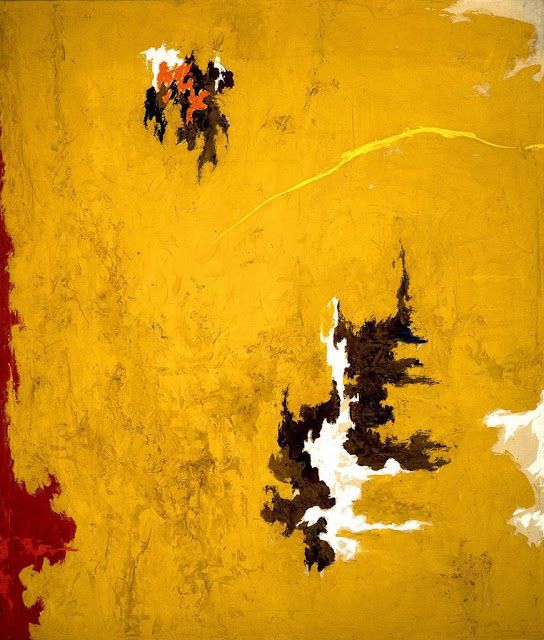
This work typifies Diebenkorn's Abstract Expressionist period in Albuquerque, the influence of New Mexico's desert landscape clearly evident in the sunburnt red and gold colors that the artist summons forth. This painting also exhibits the gestural markings and quasi-symbols that had defined the Abstract Expressionists' interest in a subconscious reality, seen most clearly in the work of Jackson Pollock and Clyfford Still. Although the artist was inspired by the forms and colors he saw in the surrounding desert, the resulting work is an abstraction - a beautifully composed and balanced series of flat shapes executed with subtle and sophisticated layers of color. However, and significantly, this canvas also suggests Diebenkorn's eventual departure from the New York School towards figuration; not only does his palette refer to a specific location (the surrounding desert), but also the large shape areas can be traced back to representational aerial views of the Southwest landscape.
Oil on canvas - The Buck Collection

Berkeley No. 8
Berkeley No. 8 is one of Diebenkorn's last Abstract Expressionist paintings, executed upon his return to California and just before transitioning to more imagistic work as part of the Bay Area Figurative Movement. Perhaps hinting at this return to representational form, Berkeley No. 8 - as opposed to his earlier Abstract Expressionist works - exhibits a more expanded view of the landscape, with an increased number of forms and more varied detail. In the lower right quadrant, the artist introduces additional overlapping and, therefore, more of a spatial component - a suggestion of depth - as well as supplementary diagonal lines and shapes that interrupt the flatness and surface orientation of earlier examples of his work. In this painting, it has been suggested that Diebenkorn was influenced by the landscapes of Chaim Soutine, with their divided surfaces and diagonal intrusions, but more importantly - in view of the fact that the work is both drawn and painted - it relates to and ties together the two kinds of Abstract Expressionism: gestural abstraction and Color Field Painting, as exemplified in the work of Willem de Kooning and Mark Rothko, respectively.
Oil on canvas - North Carolina Museum of Art, Raleigh

Woman on Porch
Diebenkorn's shift from abstract landscape to a more figurative style that had begun in 1954 can be seen in this painting. The artist maintained that works such as this one had been partly influenced by his friends Elmer Bischoff and David Park, who had turned away from landscape toward the figure. Also, Diebenkorn had been looking at the work of such European modernists as Edgar Degas (in the solitary, pensive figure), Pierre Bonnard (in the sumptuous color), Henri Matisse (in fusing the three-dimensional figure with the essentially two-dimensional abstract background), and the German Expressionists (in the mask-like face and the freedom of the brushstroke). From their examples, he learned to paint the sole figure - newly imbued with a level of human psychology - embedded within the abstract surface design.
Oil on canvas - New Orleans Museum of Art

Cityscape I
Diebenkorn painted this suburban California street in 1963, when he moved away from making abstract work and returned to a more representational style, having become a leading figure of the Bay Area Figurative Movement. Cityscape I suggests that Diebenkorn's essentially abstract, signature style, comprised of large planes of bright color executed with expressive brushwork and plotted within a grid-like plane, extends even to his imagistic work. The planes - both the densely-packed planes of the buildings at the left as well as the larger, more open landscape planes at the right - stack up vertically to assert the flat surface of the picture and create its abstract design. Although at one level the painting is clearly a cityscape or landscape, at another level the viewer can cordon off almost any rectangular part of the picture to enjoy an almost totally abstract painting in miniature.
Oil on canvas - San Francisco Museum of Modern Art

Ocean Park No. 54
Ocean Park is the name of the area of Santa Monica where Diebenkorn had his studio; in fact, the views in the paintings may have been based on the view from the studio window. If both his Abstract Expressionist paintings and his Ocean Park represent aerial landscapes, the former are intuitive and impulsive, while the latter are coldly delineated and rational spaces. A comparison of the two shows just how far Diebenkorn's abstract vocabulary had evolved throughout his career. The painting marks a sharp contrast with the organic forms of his Abstract Expressionist work of the 1950s, showing a much more geometric and planned approach. This painting also shows his appreciation for the teachings of modernism and, in this case, the work of Piet Mondrian specifically.
Here, Diebenkorn worked within Mondrian's conceptual grid framework and applied lighter washes of predominantly pastel colors to his squared-off composition. His inspiration still comes from the landscape, but now it is specifically the light-filled southern California landscape. Like the Impressionist painters who also worked in series, Diebenkorn based his 140 Ocean Park paintings on the changing atmospheric effects and conditions that he perceived. There is elegance in the design and palette of this painting that only comes of being a mature painter. Although composed of flat, neat, and rectilinear planes that evoke a sense of space, the emphasis is still on the process of painting itself, with evidence of the artist's thoughts, as he scored and reworked the surface many times.
Oil on canvas - San Francisco Museum of Modern Art
Biography of Richard Diebenkorn
Childhood
Two years after Richard Diebenkorn was born in Portland, Oregon, on April 22, 1922, his family relocated to San Francisco. Although his parents were not particularly supportive of his interest in the arts, Diebenkorn found encouragement from his grandmother, a poet, painter, and civil rights lawyer, who fostered his visual imagination by giving him illustrated books, taking him to local galleries, and impressing upon him a love for European heraldic imagery. Diebenkorn disappointed his father by choosing to study art and art history rather than the more pragmatic pursuits of law or medicine at Stanford University, where he began his undergraduate studies in 1940. Daniel Mendelowitz, one of his art history professors and mentors, introduced the aspiring painter to the work of modernists such as Edward Hopper, whose works would prove formative to Diebenkorn's early artistic development. Mendelowitz also took the artist to visit the home of Sarah Stein, sister-in-law of Gertrude Stein, where he saw works by Paul Cézanne, Pablo Picasso, and Henri Matisse -- modern artists who also inspired Diebenkorn's artistic development.
Early Training
Diebenkorn married fellow Stanford student Phyllis Gilman in June of 1943, and enlisted directly after in the U.S. Marine Corps where he served two years. While stationed at the base in Quantico, Virginia, Diebenkorn took the opportunity to visit the East Coast's most important collections of modern art, including The Museum of Modern Art, The Philadelphia Museum of Art, and The Phillips Collection in Washington, D.C. Upon his return to San Francisco in 1946, Diebenkorn took advantage of the G.I. Bill by enrolling at the California School of Fine Arts. He became a faculty member at the school the following year, after spending a winter painting in the vibrant artistic community of Woodstock, New York. His fellow teachers included Clyfford Still and David Park. He received his B.A. degree from Stanford in 1949.
Mature Period
Always looking for a change of scenery, he moved his family to Albuquerque to pursue his Master of Fine Arts degree at the University of New Mexico in 1950. The contacts he made traveling, teaching, and learning at these different universities had a huge impact on the young artist, who participated in a great exchange of ideas. During this period, when he was flying at low altitude in a plane between Albuquerque and California, he was able to view the landscape from above. This experience had a major impact on the layout of many of his compositions, both in New Mexico and California. Albuquerque in the early 1950s was also where his Abstract Expressionist period truly began, which lasted roughly five years through his move to Urbana, Illinois, (where he had accepted a faculty position at the University of Illinois) and back to California. Berkeley was his place of residence between 1955 and 1966 (his "Berkeley Period"). From the fall of 1964 to the spring of 1965, Diebenkorn traveled throughout Europe; in particular, he was granted a cultural visa to visit important museums in the Soviet Union and view their holdings of Matisse's paintings.
Late Years and Death
Diebenkorn and his wife moved to Santa Monica in 1967, when he became a professor of art at UCLA, where he worked until he retired in 1973. During the late 1960s and early 1970s - along with the friends he had made at various teaching positions, including David Park - Diebenkorn became a central member of the Bay Area Figurative Movement, which rejected Abstract Expressionism in favor of a return to figural representation. Apparently, the freedom of gesture and composition in his Abstract Expressionist period was ultimately not to his liking. Eventually, however, Diebenkorn came to strike a balance between the use of abstract and figural elements in his work. His Ocean Park series (1967-88), for example, consisting of 140 paintings made over 21 years, catapulted the mature artist into the national spotlight. In 1988, Diebenkorn and his wife moved to Healdsburg, California, near the Russian River. Diebenkorn worked on many small-scale, but exquisite, drawings and paintings until falling ill in 1992, when the couple was forced to move into their Berkeley apartment to be nearer to medical treatment. The artist died on March 30, 1993, due to complications from emphysema at the age of 71.
The Legacy of Richard Diebenkorn
Immediately following Diebenkorn's death, The New Yorker Magazine's art critic Adam Gopnik wrote that he "had been, in an unpretentious way, one of the key figures in a great transformation that took place in American art over the past quarter century: the rise of California from a provincial backwater to an artmaking capital equal to New York." Although Diebenkorn did not reach the level of fame of the Abstract Expressionists of the New York School, major retrospectives in 1976 and 1997 helped vault his reputation to that of a major postwar American painter. His work is still studied and emulated by students of painting today. As the critic John Elderfield commented, he is admired "for the persistence and longevity of his achievement... he renews your belief in painting."
Influences and Connections


-
![David Park]() David Park
David Park ![Daniel Mendelowitz]() Daniel Mendelowitz
Daniel Mendelowitz


-
![Abstract Expressionism]() Abstract Expressionism
Abstract Expressionism -
![Cubism]() Cubism
Cubism ![European Modernist Painting]() European Modernist Painting
European Modernist Painting![American Modernist Painting]() American Modernist Painting
American Modernist Painting


Useful Resources on Richard Diebenkorn
- Richard DiebenkornOur PickBy Gerald Nordland
- The Art of Richard DiebenkornOur PickBy Jane Livingston, John Elderfield, and Ruth Fine
- The San Francisco School of Abstract ExpressionismBy Susan Landauer and Dore Ashton
- Richard DiebenkornBy Jane Livingston and Barnaby Conrad III
- Richard Diebenkorn: Paintings and Drawings, 1943-1976By Richard Diebenkorn, Robert T. Buck, and Linda L. Cathcart
- Richard Diebenkorn: Small Paintings from Ocean ParkBy Richard Diebenkorn