Ask The Art Story AI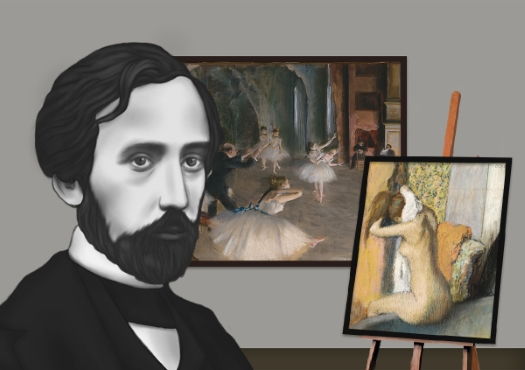


Summary of Edgar Degas
Always remembered as an Impressionist, Edgar Degas was a member of the seminal group of Paris artists who began to exhibit together in the 1870s. He shared many of their novel techniques, was intrigued by the challenge of capturing effects of light and attracted to scenes of urban leisure. But Degas's academic training, and his own personal predilection toward Realism, set him apart from his peers, and he rejected the label 'Impressionist' preferring to describe himself as an 'Independent.' His inherited wealth gave him the comfort to find his own way, and later it also enabled him to withdraw from the Paris art world and sell pictures at his discretion. He was intrigued by the human figure, and in his many images of women - dancers, singers, and laundresses - he strove to capture the body in unusual positions. While critics of the Impressionists focused their attacks on their formal innovations, it was Degas's lower-class subjects that brought him the most disapproval.
Accomplishments
- Degas's enduring interest in the human figure was shaped by his academic training, but he approached it in innovative ways. He captured strange postures from unusual angles under artificial light. He rejected the academic ideal of the mythical or historical subject, and instead sought his figures in modern situations, such as at the ballet.
- Degas's academic training encouraged a strong classical tendency in his art, which conflicted with the approach of the Impressionists. While he valued line as a means to describe contours and to lend solid compositional structure to a picture, they favored color, and more concentration on surface texture. As well, he preferred to work from sketches and memory in the traditional academic manner, while they were more interested in painting outdoors (en plein air).
- Like many of the Impressionists, Degas was significantly influenced by Ukiyo-e Japanese prints, which suggested novel approaches to composition. The prints had bold linear designs and a sense of flatness that was very different from the traditional Western picture with its perspective view of the world.
- There is a very interesting and puzzling dichotomy in the way Degas approached his female subjects. There is much evidence that he was a misogynist, and also, much to prove that he was enamored with the female form that he attempted to represent it in its most absolute state through hundreds of painstaking studies. Whatever the reality may be, his studies and output furthered the exploration of the figure and the portrait in all of the visual arts.
The Life of Edgar Degas

Edgar Degas spent as much time as he could in the cafés, theatres, and dance studios of Paris, and took inspiration from the women (particularly the ballerinas) that he saw there for his Impressionist paintings.
Important Art by Edgar Degas
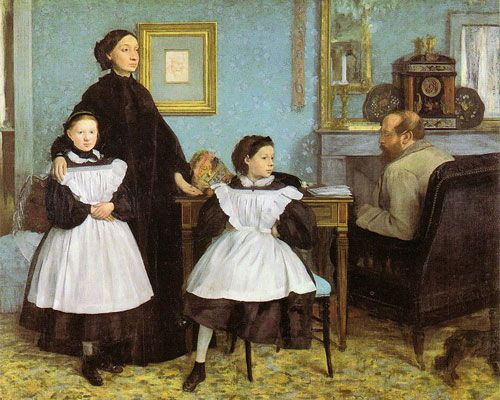
The Bellelli Family
This portrait, with its subdued palette and its unconventional grouping of figures, such as the man having his back to the viewer, demonstrates the impact of Realism on the young Degas. He created it over the course of several trips to Italy, spanning 3-4 years. Each family member — his aunt, her husband and his two young cousins Giovanna and Giuliana — was sketched individually, and then organized into a family portrait, becoming more of a study of individual personalities than a study of them as a group.
Degas had the chance to spend much time with his aunt and her family, but it was not an altogether happy family. The aunt was disappointed in her husband, away from home, and mourning her father's passing. So this early, breakthrough work is also a reflection on Degas' (relatively limitted) experience in a family setting. Here, the father is suggested to be emotionally distant from his wife and daughters, while the mother stands dignified and decisive. Giovanna on the left is clearly the mother's favored daughter, while Giuliana, with one leg poised, is positioned just so to suggest a division in her allegiance.
Oil on canvas - Musée d'Orsay, Paris
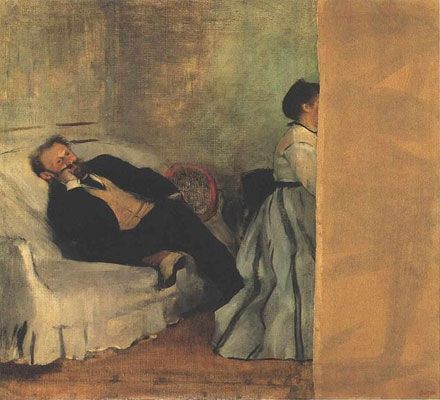
Monsieur and Madame Édouard Manet
This unconventional portrait of Manet and his wife provides a wonderful example of Degas as the “distant spectator,” capturing a moment of solitude that the subjects might prefer go unnoticed. However, a riddle surrounds it. Degas painted it as a tribute to his friends, and it originally showed Mme. Manet playing the piano. However, some time after he had presented the portrait to them, he visited their house only to discover the painting had been mutilated and the right of the picture had been cut away. Degas was furious and removed the picture, though it was never repaired. Some scholars believe it was the depiction of the disharmony in the relationship between the couple that was the reason that Manet slashed the canvas.
Oil on canvas - Kitakyushu Municipal Museum of Art, Japan
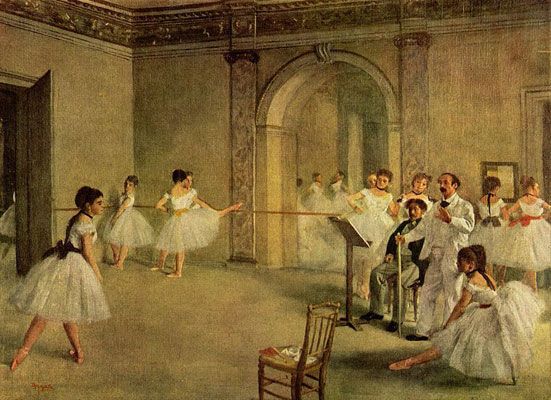
Foyer de la Danse
There is something unique and alluring in all of Degas's studies of ballerinas, of which there are many. In Foyer de la Danse he presents us with one of the unconventional perspectives that are so typical and distinctive in his work. Rather than evoke the light and atmosphere of the scene, as some of his Impressionist peers might have done, Degas has chosen to create a striking arrangement of space, one which echoes the experiences his contemporaries might have had throughout the new modern city. To achieve this, rather than compose the figures in a more orderly and centered fashion, he has dispersed them about the canvas, leaving a chair incongruously placed in the center foreground. Instead of viewing the room as a traditional box-like container for the figures, he paints it at an angle, suggesting multiple vantage points, almost as if this were an early blueprint for Cubism. The approach is characteristic of his modern, realist approach to composition.
The author Sebastian Smee wrote that Degas had the idea "that when people were listening to music, their habitual self-consciousness switched off. Their tendency to present themselves, and to respond defensively to their awareness of being watched, was no longer an impediment to truth-telling. They had lost the power to censor themselves. Something more essential, more truthful would emerge, and play across their faces. Degas wanted to capture that." Indeed, often in his works music is playing, or else, for example, a woman is bathing and similarly dropping her guard. At the same time, this work is one of many that Degas produced of ballerinas, which have come to be viewed by many scholars as problematic, even exploitative. For example, art historian John Richardson notes that Degas "was not interested in capturing their onstage prettiness. He wanted to portray his 'little monkey girls' under stress, 'cracking their joints' at the barre, as he said, their youthful spirits crushed, their muscles in agony, their feet raw and bleeding. […] He sometimes obliged the dancers who modeled for him in the studio to pose for hours on end — legs extended or bent, arms held high overhead—in excruciating discomfort, even for dancers inured to pain." However, Richardson explains that works such as these "hinged on his voyeuristic fascination with the pain ballet inflicted on female bodies [but] make no mistake, there was an undercurrent of cruelty in Degas’s voyeurism."
Oil on canvas - Musée du Louvre, Paris
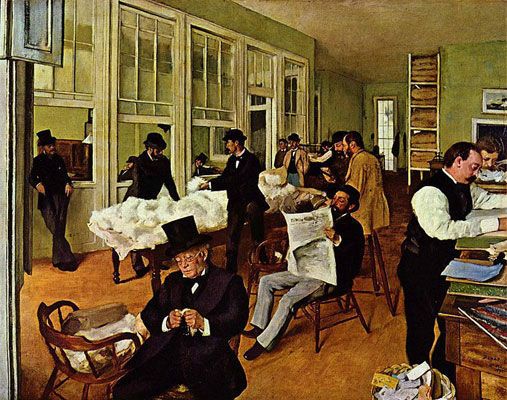
A Cotton Office in New Orleans
Like his earlier study of the Bellelli family, A Cotton Office in New Orleans is the result of several individual sketches and careful attention to detail over a length of time. In the center, reading a newspaper, is Degas's brother, Rene, and in the foreground, somberly handling a ball of cotton, is Rene's father-in-law, Michael Musson, who operated the cotton exchange. Its complex handling of deep space and multiple figures is testimony both to Degas's skill in composition, and his love of striking perspectives, something that makes his work stand out from that of many of his peers among the Realists and Impressionists. He manages to knit together the fractured space by stretching areas of white across the center of the picture, letting our eye move from the cotton on the left, through the newspaper, to the shirt of the figure on the right.
Oil on canvas - Musée des Beaux-Arts, Pau
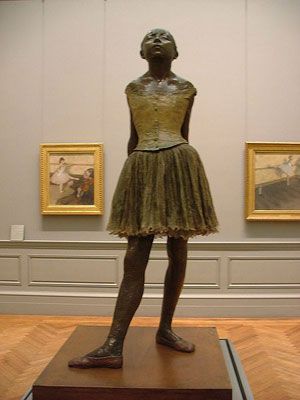
Little Dancer of Fourteen Years
Originally cast in wax, with a skeleton comprised of paint brushes, Degas's study of the young ballet student Marie van Goethem was eventually cast in bronze in 1922, five years after the artist's death. In fact, 27 bronze sculptures were made. It is characteristic of a number of wax sculptures he produced after the 1860s. When he exhibited this figure at the sixth Impressionist exhibition of 1881 (the only such figure to be publicly shown), viewers were shocked by its realism. It is highly unusual in incorporating a miniature gauze skirt, silk bodice and fabric slippers, and in this respect prefigures the introduction of real objects into sculpture in the 20th century.
Bronze with cloth accessories - The Metropolitan Museum of Art, New York
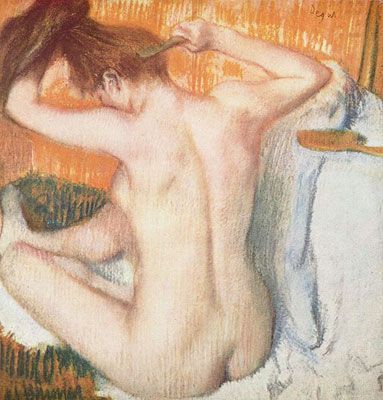
La Toilette (Nude Arranging Her Hair)
La Toilette is typical of Degas's many nudes, and typical of an approach to the nude that made this body of work particularly controversial - both among his contemporaries and among latter-day critics. It demonstrates his tendency to capture the figure from behind, while washing; to show only a fragment of the figure in order to suggest the whole; and to place the figure in shallow space, allowing her contours to produce the strong linear design that balances the picture. Critics attacked his nudes for never having distinct faces, and seemingly to be wiping themselves as if they are not clean, as if Degas depersonalized his subjects.
Degas's interest in the nude might have been encouraged by his academic training, though his posing suggests the modern innovations of the Realists and Impressionists. Indeed when Degas exhibited a suite of pastel nudes such as this at the sixth Impressionist exhibition of 1886, critics attacked their unusual posing. The picture also demonstrates the artist's use of pastel, which he usually painted on tracing paper - the paper allowing him to produce numerous sketches that are easily manipulated across his many studies of form.
Pastel on paper - Pushkin Museum, Moscow
Biography of Edgar Degas
Childhood
Edgar Degas was the eldest of five children of Célestine Musson de Gas, an American by birth, and Auguste de Gas, a banker. Edgar later changed his surname to the less aristocratic sounding 'Degas' in 1870. Born into a wealthy Franco-Italian family, he was encouraged from an early age to pursue the arts, though not as a long-term career. Following his graduation in 1853 with a baccalaureate in literature, the eighteen-year-old Degas registered at the Louvre as a copyist, which he claimed later in life is the foundation for any true artist.
After a brief period at law school, he gave up on the his father's aspirations of Degas becoming a lawyer. In 1855 he was admitted to the École des Beaux-Arts in Paris, where he studied drawing under the academic artist Louis Lamothe, a former pupil of Jean-Auguste-Dominique Ingres. Degas is even later said to follow Ingres's maxim: "Draw lines, young man., draw lines." That same year, the Exposition Universelle took place, and Degas was enthralled by Gustave Courbet's Pavilion of Realism.
Early Period and Training
In 1856, when Degas was aged 22, he traveled to Naples, Italy, to visit his aunt, the Baroness Bellelli and her family. This three-year trip was an important moment in his development, and resulted in the Realist portrait The Bellelli Family (1859). He spent countless hours combing the museums and galleries of Italy, carefully studying Renaissance works by Michelangelo, Raphael and Titian, among others.

In 1864, while copying a picture by Velázquez at the Louvre, he met Édouard Manet, who by chance was copying the same painting. His friendship with Manet was instrumental for Degas, and probably for Manet, and even the development of Impressionism as a whole. The outspoken, well-regarded Manet was a very different personality from the introspective, and often self-doubting Degas. But their friendship and close association lasted until the end of Manet's life and is discussed in detail in Sebastian Smee's book "The Art of Rivalry".
The following year, Degas exhibited at the Paris Salon, the first of six consecutive showings, showing works such as Édouard Manet and Mme. Manet and The Orchestra of the Opera (both 1868-69), paintings that subtly blurred the lines between straight portraiture and genre painting. While Degas was serving with the National Guard in the Franco-Prussian War (1870-71), he realized that his eyesight was defective during rifle training. Evidence of this genetic defect can be seen even in his most celebrated paintings.
Mature Period
Although the 1860s was a productive period in Degas's career, his most renowned body of work was created in the 1870s. By this time he had discovered his true muse - Paris. He (much as Manet and other Impressionists) drew inspiration from its boulevards, cafés, shops, dance studios, drawing rooms, theaters, and operas. And he became well known for his close observation, devoting much time to capturing the detail of surrounding human beings. Perhaps for this reason he rejected the label 'Impressionist', believing it implied something accidental and incomplete.

Evidence of this can be found in seminal works such as Foyer de la Danse (1872), Musicians in the Orchestra (1872) and A Carriage at the Races (1873). Each of these pictures also exemplify how Degas assumed unconventional points-of-view, suggesting the perspective of a distracted spectator. Yet unlike contemporaries like Renoir and Monet, Degas was not a plein air painter, preferring instead the light and reliability of the studio. Incidentally, his few outdoor scenes were produced from memory, or conjured in part from his imagination.
From 1872 to 1873, Degas made an extended trip to New Orleans to visit his brother René and other family members, including his uncle, who operated a failing cotton exchange. During this trip, he produced a number of important paintings, including A Cotton Office in New Orleans (1873), the only one of his works to be purchased by a museum in his lifetime. Following his return home, the French Impressionists held their first group show at the Café Guerbois, in which Degas was included. Despite this association, Degas always held the other members at arm's length. He admired their work and shared many of their ideals, but he never entirely adhered to their philosophy. Nevertheless, he showed work in all but one Impressionist group show, including the final 1886 exhibition. As well, he single-handedly recruited more artists to exhibit at these shows than any other member.
Degas remained a bachelor throughout his life, and had few, if any, romantic entanglements. Manet was convinced that Degas was "not capable of loving a woman," and it was reported by lady-friends of his contemporaries that he was impotent, leading to speculation that he may have been a homosexual, or asexual, or otherwise sexually atypical. Meanwhile, van Gogh (who greatly admired Degas) thought that Degas's "trouble having an erection" may have had more to do with fears that sex might impede his creativity. Said van Gogh, "Degas lives like a little notary and does not love women because he knows that if he […] spent a lot of time kissing them he would become mentally ill and inept. [..] Degas's painting is vigorously masculine. [..] He looks at the human animals who are stronger than he is and [they] are kissing each other [..] and he paints them well, precisely because he himself is not at all pretentious about having erections.” Regardless of the facts of his sexuality, there has been much speculation about the rationale for Degas' unusual and generally unflattering images of women. His intent may have been to suggest the figures caught off-guard, though feminist critics have pointed out that the effect is often degrading. Any male painter, who spends so much time (famously) depicting the female form is bound to receive his share of criticism - and the same hold true for a female that abstracts the nude male.

In fact, there is much to consider regarding his treatment of the female subject in his work, much of this (and the below) is wonderfully discussed in an essay on Degas by the writer and art critic Julian Barnes. For example, the detractors include the poet Tom Paulin who in 1996 said "in this exhibition are women in contorted poses ... They're like performing animals, they're like animals in the zoo." Further, the curator and historian Tobia Bezzola wrote: "It is not known whether Degas had sexual relationships with women; at any rate there is no evidence that he did .. [His] series of monotypes depicting brothel scenes is the most extreme example of the mixture of voyeurism and abhorrence with which he reacted to female sexuality." But it is also worth remembering the usual practices of painters of his generation who tended to work from a female model, drew her in a semi-voluptuous (or even pornographic) manner, and concluded (or maybe started with) a tryst of one type of another.
Late Period

As the 19th century came to a close, Degas's pace of work waned, and he began spending more time collecting the works of other artists he admired. He purchased work by contemporaries such as Manet, Pissarro, van Gogh, Gauguin and Cézanne, as well as older artists who had informed Degas as a young man, like Delacroix and Ingres. Late works, like the bronze Woman Rubbing Her Back with a Sponge (1900), is a testament to Degas's continued devotion to capturing the female form.
Although Degas abandoned oil painting later in life, he continued to work in a variety of media, including pastels and photography, yet sculpture became his preferred medium as his eyesight deteriorated. He increasingly became a recluse, and most of his friendships with artists like Monet and Renoir, eventually dissolved. These ruptures were hastened by Degas's outspoken anti-Semitism, which was amplified by his stance during the infamous Dreyfus Affair. He died in 1917.
The Legacy of Edgar Degas
Although Degas suffered criticism during his lifetime, by the time of his death his reputation was secure as one of the leaders of late-19th-century French art. His distinct difference from the Impressionists, his greater tendency toward Realism, had also come to be appreciated. His standing has only increased since his death, though since the 1970s he was been the focus of a lot of scholarly attention and criticism, primarily focused around his images of women, which have been seen by many contemporary scholars as chauvinistic, ringing true with his overt antisemitism and overall lack of moral compass. Yet the true nature of Degas’ relationship with, and treatment of, the women and young girls in his life is in fact rather more complex. Moreover, the case of Degas reminds us that it is faulty to judge people who lived centuries ago (and their actions) based on contemporary moral standards. Art historian John Richardson perhaps put it best when he called Degas a "misogynist in a misogynistic society".
Many of Degas’ models clearly felt uncomfortable in his presence, with one complaining that this "odd monsieur […] spent the four hours of my posing session combing my hair," and another saying that modeling for Degas meant "climbing into tubs and washing their asses." And Degas was not oblivious to his treatment of women. He once told painter Georges Jeanniot "I have perhaps too often considered woman as an animal. Women can never forgive me; they hate me, they can feel that I am disarming them. I show them without their coquetry, in the state of animals cleaning themselves." Yet, it is possible that what appeared to be abusive treatment of the "fairer sex" was merely a commitment to his work. Indeed, Degas' contemporary and acquaintance, French actor Georges Rivière, once noted that "He, who often depicted them with real cruelty, derived great pleasure from being with them, enjoyed their conversation, and produced pleasing phrases for them." Richardson himself recognizes that "though his tongue may have been cruel, Degas was fanatically loyal to his family and friends."
Influences and Connections


-
![Édouard Manet]() Édouard Manet
Édouard Manet -
![Henri Fantin-Latour]() Henri Fantin-Latour
Henri Fantin-Latour ![Louis Lamothe]() Louis Lamothe
Louis Lamothe![Eugéne Boudin]() Eugéne Boudin
Eugéne Boudin


-
![Mary Cassatt]() Mary Cassatt
Mary Cassatt -
![Henri de Toulouse-Lautrec]() Henri de Toulouse-Lautrec
Henri de Toulouse-Lautrec -
![Claude Monet]() Claude Monet
Claude Monet -
![Pierre-Auguste Renoir]() Pierre-Auguste Renoir
Pierre-Auguste Renoir ![Walter Sickert]() Walter Sickert
Walter Sickert


Useful Resources on Edgar Degas
- Degas and the DanceOur PickBy Susan Goldman Rubin
- Degas (Basic Art)By Bernd Growe
- Degas, Sickert and Toulouse-Lautrec: London and Paris 1870-1910Our PickBy Anna Gruetzner Robins, Richard Thomson
- The Art of Rivalry: Four Friendships, Betrayals, and Breakthroughs in Modern ArtOur PickBy Sebastian Smee
- The Private Collection of Edgar DegasBy Ann Dumas
- Degas: The Man and His Art (Abrams Discoveries)By Henry Loyrette
- The Private Lives of the ImpressionistsOur PickBy Sue Roe
- The Letters of Edgar DegasOur PickBy Theodore Reff
- Degas's Drawings of DancersBy Edgar Degas
- Degas: Beyond Impressionism (National Gallery London Publications)Our PickBy Mr. Richard Kendall
- DegasBy Werner Hofmann
- DegasBy Robert Gordon, Andrew Forge
- Degas: A Passion for PerfectionOur PickBy Jane Munro
- Degas, Painter of BallerinasBy Susan Goldman Rubin
- Degas and the NudeOur PickBy Xavier Rey, Anne Roquebert, George Shackelford, Lucian Freud, and Martin Gayford
- Degas and New Orleans: A French Impressionist in AmericaBy Gail Feigenbaum