Ask The Art Story AI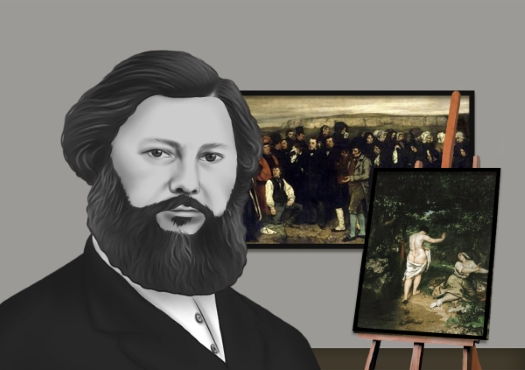


Summary of Gustave Courbet
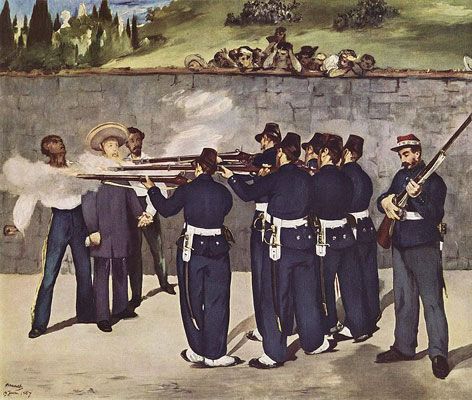
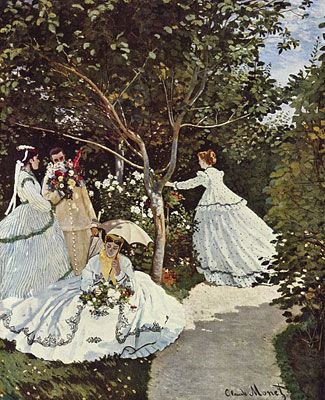
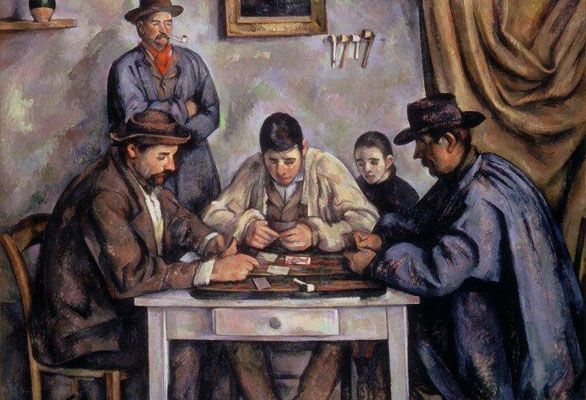
Gustave Courbet was central to the emergence of Realism in the mid-19th century. Rejecting the classical and theatrical styles of the French Academy, his art insisted on the physical reality of the objects he observed - even if that reality was plain and blemished. A committed Republican, he also saw his Realism as a means to champion the peasants and country folk from his home town. He has long been famous for his response to the political upheavals which gripped France in his lifetime, and he would die in exile in Switzerland when he was found responsible for the cost of rebuilding of Paris' Vendome Column. More recently, however, historians have also seen his work as an important prelude to other artists of early modernism such as Édouard Manet and Claude Monet.
Accomplishments
- Courbet's Realism can be understood as part of the wider inquiry into the physical world that occupied science in the 19th century. But in his own realm of art, he was most inspired by his distaste for strictures of the French Academy. He rejected Classical or Romantic treatments and instead took humble scenes of country life - subjects usually considered the stuff of minor genre painting - and made them material for great history painting. For this he gained huge notoriety.
- During the Paris Commune of 1871, Courbet briefly abandoned painting for a role in government. This was characteristic of his left-wing commitments. His art was not overtly political, but in the context of the time, he was not ignored as he expressed ideas of equality by heroicizing ordinary individuals, painting them at great scale and refusing to hide their imperfections.
- In the process of clearing away the rhetoric of Academy painting, Courbet often settled on compositions that seemed collaged and crude to prevailing sensibilities. At times he also abandoned careful modeling in favor of applying paint thickly in broken flecks and slabs. Such stylistic innovations made him greatly admired by later modernists that promoted liberated compositions and amplified surface texture.
- Instead of being completely reliant on the state-run Salon system, Courbet pioneered the solo retrospective as a private commercial venture, an approach that many later renegade artists followed.
Important Art by Gustave Courbet
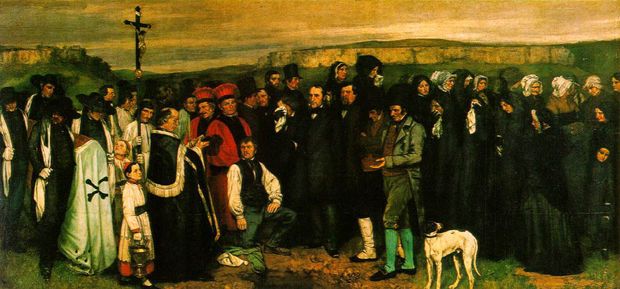
Burial at Ornans
This 22 foot long canvas situated in a main room at the Musee d'Orsay buries the viewer as if he or she were in a cave. In a decidedly non-classical composition, figures mill about in the darkness, unfocused on ceremony. As a prime example of Realism, the painting sticks to the facts of a real burial and avoids amplified spiritual connotations. Emphasizing the temporal nature of life, Courbet intentionally did not let the light in the painting express the eternal. While sunset could have expressed the great transition of the soul from the temporal to the eternal, Courbet covered the evening sky with clouds so the passage of day into night is just a simple echo of the coffin passing from light into the dark of the ground. Some critics saw the adherence to the strict facts of death as slighting religion and criticized it as a shabbily composed structure with worn-faced working folk raised up to life-size in a gigantic work as if they had some kind of noble importance. Other critics such as Proudhon loved the inference of equality and virtue of all people and recognized how such a painting could help turn the course of Western art and politics.
Oil on canvas - Musée d'Orsay, Paris
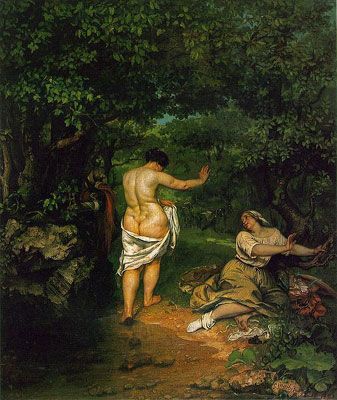
The Bathers
This is one of the best examples of Courbet's non-classical treatment of nudes. In this eight foot tall painting two women are partially naked without any mythological justification or rhetoric, rendered naturally and not idealized. The painting was poorly received, with Delacroix seeing no excuse for these "naked and fat bourgeoisie.. buttocks, and meaningless gestures." But rather than being negative, the attention was good publicity, and Courbet sold the work in spite of the criticisms.
Oil on canvas - Musée Fabre, Montpellier
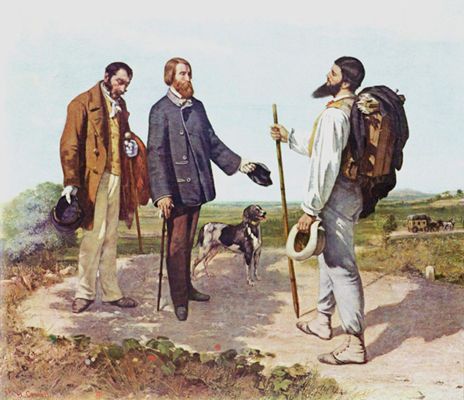
The Meeting or Bonjour Monsieur Courbet
In this large work Courbet painted himself meeting Alfred Bruyas, a key patron and supporter. The painting expresses the collector's appreciation of the genius of Courbet. As an extension of Bruyas, the servant is caught in the greatest gesture of respect, but the key point is this moment of mutual appreciation between artist and patron. As expressions of great intellect and importance, Courbet's head is tilted back slightly and he is the one standing directly in unfiltered light.
At the same time, Courbet's self-importance shines through on this canvas. His beard points at the patron as if in judgement. The artist also carries a stick that is double the size of the one that his patron supports himself on - another allusion to the strength of the artist.
Oil on canvas - Montpellier, Musée Fabre

The Painter's Studio: A Real Allegory Summing Up a Seven-Year Phase of My Artistic Life
This 19 foot long painting is an expression of Courbet's self-love and pride in his iron will, hard work and revolutionary genius. Just as he heroicized others in the Burial at Ornans, he does the same for himself in this work. With a good measure of egotism, Courbet expresses that things get done and attitudes change when people think for themselves and challenge the status quo. Courbet places himself full-size, brush in hand, working on a landscape picture. His friends on the right are emblematic of kindred spirits and innovation, while the admiring boy is an expression of Courbet's confidence that his legacy will transcend generations. The nude model standing behind the artist affirms his greatness and her role as muse. To the left stand the working poor, Courbet's recognition of their right to be included. His nemesis, Napoleon III, is presented as a poacher holding a firearm, accompanied by his dogs. Courbet's chin-up gaze trumps Napoleon's downward tipped head in an expression of the innovator dominating over the authoritarian.
Oil on canvas - Musée d'Orsay, Paris

Sleep
This work shows Courbet's interest in an erotic Realism that became prevalent in his later work. Raw eroticism is delivered without aid of cupids or mythological justification of any kind, making this work vulgar to those with the prevailing taste of the day. Such unsanctified nudes provoked much discussion about flaws in Courbet's character and art, but the artist reveled in the added attention and increased reputation as a confrontational artist.
Oil on canvas - Musée des Beaux-Arts de la Ville de Paris
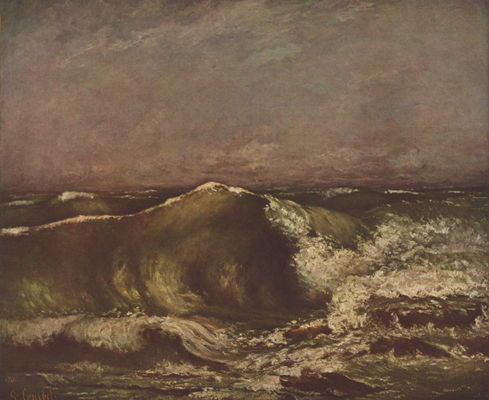
The Wave
Many early Modernists were influenced by Japanese prints and it is argued that Courbet is one of the first to be affected by this Eastern aesthetic. Likely, taking a cue from the prints, he shows us a slice of water closed off from the view of vast space. The painting epitomizes Courbet's landscapes and seascapes that were always composed of broken patches of paint loaded in both the dark and light areas. Such painterly treatment was inspiration to the budding Impressionists.
Oil on canvas - The Oskar Reinhart Collection, Winterthur, Germany
Biography of Gustave Courbet
Childhood
Born in the summer of 1819 in the small rural town of Ornans, near the French Alps, Courbet grew up in a picturesque environment with a supportive family. He enjoyed vigorous physical activities, like swimming with his sisters in the Loue River and playing in the family's pastures and vineyards. At school Courbet relished being the center of attention and entertaining his classmates with his wit and charm.
Though Courbet's general education was solid, his formal art training was mediocre. At fourteen he took lessons from a minor Neoclassical painter, which likely gave him a foundation to react against. Through the prodding of his father he studied pre-law at a local college, but he was miserable until a drawing professor at the college invited him to take painting lessons in a home studio. This gave him further confidence in his artistic potential and convinced him to pursue his passion.
Early Years

At 21, Courbet moved to Paris. He avoided study in the studios of any of the period's many academic celebrities, nor did he enroll in the top tier academic system for the arts in Paris, the École des Beaux-Arts. Instead he took a few lessons from lesser-known teachers, but mostly taught himself by copying paintings by Caravaggio, Rubens and others in the Louvre. On a visit to Holland he was also able to copy the paintings of Rembrandt and Velazquez. While Academy students waited up to a year to pick up a brush (as drawing classes came first), Courbet made his own rigorous schedule and jumped headlong into painting. He often replicated a classical painting again and again to uncover its secrets. He rounded out his independent study by painting from nature and paid models. When visiting home at Ornans, he painted friends and family.
Courbet also threw himself into his personal vision of Realism which rejected any classical treatment or rhetoric. Although this was quite radical at the time, he still focused on being selected for the official French Salons. But, during his first seven years in Paris only three of his 25 submissions were accepted.
Mature Period
Courbet painted consistently in a Realist mode during his time in Paris. For example, he was quick to decline a request to paint angels for a church - remarking, "Show me an angel and I will paint one." Instead he painted regular folk in all their glorious ordinariness, and it was not a surprise when, in 1848, Courbet's growing group of influential friends appointed him leader of the Realist movement in Paris. The poet Charles Baudelaire, and the outspoken anarchist Pierre Proudhon, were both part of this group of intellectuals that pushed each other to challenge the norms of the day.
Also in 1848, under a newly formed Republic, the Paris Salon became jury-free for one year. This allowed Courbet's submission of ten paintings to win automatic acceptance, where they made a great impression, and helped the painter win a gold medal the following year. Under Academy rules, the gold medal gave Courbet immunity against future selection committees, a bypass that he enjoyed until 1857, when this rule was changed. Without this protection, Burial at Ornans (1849), amongst other important paintings, probably would have been rejected. This huge confrontational painting was Courbet's most audacious display of rural Realism. The grand scale at which he depicted the ordinary people attracted a firestorm of rebuke, with many conservative critics uncomfortable with the picture's implicit support for democratic politics.

Ironically, shortly after the debut of Burial at Ornans, the French government reverted to an authoritarian Empire under Napoleon III. Courbet remained staunchly opposed to his rule, and in time the Emperor would also have cause to express distaste at Courbet's nudes. In 1853, Napoleon III and his wife Eugenie made the most memorable gestures of disapproval: the story goes that while perusing the Paris Salon, Eugenie made a remark of appreciation of Rosa Bonheur's painting, The Horse Fair, which exhibited enormous workhorses from a rear view. Shortly thereafter, standing in front of Courbet's painting of The Bathers (1853), that features two robust farm women bathing in a stream, she remarked that Courbet's models bore a resemblance to the bulky Bonheur horses - then, supposedly, the Emperor struck the canvas with the nude with his riding crop.
Two years later, when three of the most important of the fourteen canvases Courbet submitted to the Paris 1855 World Exposition jury were rejected, the artist invented a way of doing business that became just as shocking and innovative as his paintings. He defiantly made his own pavilion outside the grounds under the banner "Realism", and displayed forty paintings from his 15-year working period.
Late Period
During the 1860s Courbet focused on erotic nudes, hunting scenes, landscapes, and seascapes. In this work he further subverted Academic Classicism in ways that promoted his new vision and inspired other modernists. For instance, his late series of seascapes pointed the way for the Impressionists. Courbet's water is raw and tangible where thick paint on a surface speaks almost as forcefully as the illusion of water itself.
Courbet's nudes from this decade challenged the norms of his day and in some cases remain confrontational even to the present day. The most notorious, Origin of the World (1866), displays a woman's lower torso and open thighs. The classical artifice is stripped away and the viewer is forced to focus on the most intimate view of female anatomy; Courbet directs the viewer exactly where to look and implies that looking at such pictorial reality should be acceptable. This frank treatment of the nude foreshadowed the raw eroticism of some early-20th-century painters such as Egon Schiele.
For most of his career, Courbet was not regarded well by the French Academy and other state institutions. But in the year 1870 has was awarded the Legion d'Honneur, the greatest French order of merit, which Courbet proceeded to turn down. In typically rebellious, Courbet fashion, he crafted an open letter where he stated that "Honor is neither in a title nor in a ribbon, it is in actions and the motivations for those actions. Respect for oneself and for one's ideas constitutes the greater part of it. I do myself honour by staying true to my lifelong principles.."
Courbet never married often claiming his art didn't allow him the time to settle down. In 1872 he did propose to a very young woman, declaring in a letter to her that, were she to accept, she would be envied across France, and even "be reborn three times without ever coming across a position like this one". Yet, the woman refused - Courbet remained a life-long bachelor.
Final Years and Death
When the French Empire was finally crushed in the Franco-Prussian war, Courbet was elected chairman of the Republican Arts Commission under the short-lived Paris Commune. Under his watch the Place Vendôme Column, which Napoleon I had created from the bronze of enemy cannons, was destroyed. Courbet's precise role in the column's destruction is uncertain, and it is possible that he intended only to move it. Nevertheless, the column's undoing led to his own. When the new Commune quickly failed, Courbet was sent to prison in 1871 for six months, spending the later part of the sentence in a clinic when he became sick. This tragedy segued into another when in 1873 he was ordered to personally pay 300,000 francs for the erection of a new Vendôme Column. Facing this impossible bill, he went into a self-imposed exile in Switzerland. He did continue to paint, but never returned to France. He died of heavy drinking and liver disease in La Tour-de-Pails, Switzerland in 1877, at age 58. His remains are now in the Cemetery of Ornans.
The Legacy of Gustave Courbet
Gustave Courbet's democratic eye revolutionized Western Art. His new form of Realism paved the way for other Modern movements, such as Impressionism and Post-Impressionism. Manet, Monet, Renoir, and others had direct contact with Courbet and were profoundly affected by the man and his paintings. Courbet's visceral paint application also opened a path for figure and landscape painters of the 20th century such as Willem de Kooning, Fairfield Porter, Lucian Freud, the Bay Area Figurative Painters, and others.
Influences and Connections


-
![Charles Baudelaire]() Charles Baudelaire
Charles Baudelaire ![Pierre Proudhon]() Pierre Proudhon
Pierre Proudhon


![French Romanticism]() French Romanticism
French Romanticism


![Champfleury]() Champfleury
Champfleury![Max Buchon]() Max Buchon
Max Buchon