Ask The Art Story AI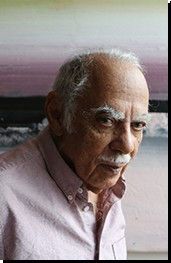

Summary of Edward Clark
Ed Clark is an American Color Field painter whose style was shaped by the years he spent in Paris in the early 1950s. As an African-American who had been raised in the segregated South, he found Paris tolerant, and the atmosphere encouraging. While there, he developed a sophisticated abstract style that was markedly influenced by the Tachisme painter Nicolas de Stael. His early work is remembered for his "push-broom technique," which encouraged his full physical involvement in painting. He is also noted for the monumental scale of his work, and the fact that he is one of the first painters to have used shaped canvases.
Important Art by Edward Clark

Untitled
In this photograph, Clark stands in front of his painting Concord, which was the largest work Clark completed in Paris.
Photograph - Artist's collection

The City
The City stands as one of Clark's first major experiments in abstraction. The painting evolved while he was working on a realistic representation of the city; dissatisfied with his results, he proceeded to "destroy" the image with his brush but found he liked the result of his destruction. Executed in an all-over manner, the colors almost appear to be in dialogue with one another.
Oil on canvas - Collection of John and Helen Slimak

Untitled
Although not the first, this work is amongst Clark's early experimentations with shaped paintings. Like many of Clark's works, this piece is large in scale, measuring 46 by 55 inches
Oil on canvas with paper collage on wood - The Art Institute of Chicago

Big Egg
This painting is among Clark's early experiments with oval forms. Present is a strong horizontality that is emphasized by Clark's placement of warm and cool colors in individual fields.
Acrylic on canvas - Artist's collection

Untitled: Paris Series 1988
In this work Clark's departure from the Color Fields of the 1950s in favor of more dynamic tubular forms is evident. Unlike the Color Fields that were more discrete, with minimal intermingling of colors and forms, Clark juxtaposed his shapes and mixed his colors in a way that suggests a dialogue with one another.
Acrylic on canvas - Artist's collection

Pink Wave
A more recent work, Pink Wave reveals Clark's continued interest in the significance of action and gesture and the presence of the artist's hand.
Acrylic on canvas - G.R. N'Namdi Gallery
Biography of Edward Clark
Childhood
Edward Clark was born in the Storyville section of New Orleans on May 6, 1926. When he was six, his parents Merion and Edward Sr., moved their family to Baton Rouge where they lived in a shotgun house with his father's great aunt. At this time, Clark began his elementary schooling, where he was first exposed to drawing. On one occasion, a nun at his Catholic school issued a challenge to Clark and his classmates: whoever could produce the best tree drawing would receive a gold star. Taking up the challenge, Clark won acknowledgement from his teachers for his artistic abilities as well as the gold star, and this experience awakened in Clark the desire to become an artist.
Two years later, Clark's family relocated north to Chicago. In 1943, at the age of 17, he left high school and enlisted in the air force during the height of World War II; he was stationed for two years in the South Pacific and returned to Chicago upon his release.
Early Training
With the aid of the GI Bill, Clark enrolled in the Art Institute of Chicago in 1947, where he studied with painter Louis Ritman. In 1952, he left Chicago and moved to Paris. As an African-American, this period abroad was pivotal for his development, because it allowed for opportunities and experiences that segregation made unavailable to him in the United States. Once in Paris, he attended the prestigious Académie de la Grande Chaumiere, and studied with Edouard Goerg and Ossip Zadkine. Clark appreciated the relaxed, workshop environment of the Chaumiere - in comparison to what he viewed as the formal and often stifling approach of the Art Institute of Chicago. And, in addition to his training at the Chaumiere, he was also exposed to a multitude of artists and movements, including the CoBrA group (Copenhagen, Brussels, Amsterdam) and the gestural abstraction of Art Informel. He was especially influenced by the abstractions and thickly impastoed canvases of Russian-born artist Nicolas de Stael - particularly his painting, The Footballers. From de Stael, Clark adopted the application of bright colors in densely packed, block-like forms. The resulting works were characterized by forms that seem to be arranged so as to echo one another.
Mature Period
In 1953, Clark's financial support from the GI Bill ended but he decided to remain in Paris rather than return to the United States, despite the likelihood of financial hardship. Paris, for Clark, represented a space of social and artistic freedom that was unattainable in the United States, where racism abounded and black art and artists were primarily confined to exhibiting their works in libraries and community centers - spaces that were inferior to the mainstream art galleries. On this, Clark has stated, "[Paris was the]...freest of cities and a true magnet for artists. We would meet among artists of all countries, with no distinction of class, race or political ideology. We were artists, nothing else." While in Paris, Clark shared studio space and also lived intermittently with several other American expatriate artists, including Herbert Gentry and Joan Mitchell.
While he would return to Paris many times throughout his life, during this period Clark not only embraced abstraction but also began painting on a monumental scale. After experiencing difficulties in finding paintbrushes that could accommodate his work, he created the so-called "push-broom technique," in which he repurposed a janitor's push broom as a paintbrush, which allowed him to paint large surfaces easily. Like Jackson Pollock, Clark would lay his canvas on the floor and spontaneously pour paint onto it. He would then perform what he termed "the big sweep," which involved him pushing the broom in an accelerated manner that would create bold, broad strokes while adding a sense of speedy and dynamic action to his gestures. These works are characterized by large spaces dominated by a few colors (usually three distinct hues) that are rendered in an all-over manner. As such, they bear a great similarity to the works of Mark Rothko and Franz Kline. Clark received critical acclaim in France and was lauded by Michel Concil-Lecoste, a critic at the journal Le Monde. In 1953, critic and curator Michel Tapie included Clark in an exhibition of American artists living in France, making Clark the only African American to be included in the exhibition, which was held at the Galerie Craven. His paintings were also exhibited at several major Parisian galleries including Galerie Creuze, Galerie Maeght and Galerie Huit. And he was included in Michel Seuphor's 1957 publication Dictionnaire de la Peinture Abstraite.
In 1957, Clark returned to the United States and settled in New York City, where he became a charter member of the Brata Gallery, a small art cooperative that was located on 10th Street. Several other second-generation Abstract Expressionists were also affiliated with the gallery, including George Sugarmen, Al Held, Nicholas Krushenick, and Sal Romano. At this time Clark began experimenting with "shaped" paintings. At first this process was forced upon him due to financial problems; he began to paint on paper with the intention to return to the canvas when he was more financially secure. But after returning to canvas, he added paper to the surface in a way that caused it to stretch over the side of the canvas and hang limp. As a corrective, Clark built an armature under the paper as a support. Consequently, these "shapes" became painting and collage as well as sculpture.
Clark returned to Paris in 1966 and remained there until 1969. In 1966 he had a one-man show at Galerie Creuze, where Art International reviewer R.C. Kenedy described his brushstrokes paintings as aggressive and violent. During this time, Clark began producing oval-shaped paintings, which he saw as a continuation of his experiments with shape. By moving toward a more circular form, he sought to incorporate perception by mimicking the shape of the eye. In the 1970s Clark further evolved this concept with the creation of elliptical-shaped works.
Late Years
In the 1970s Clark began to travel extensively - to Greece, Nigeria, Mexico, Brazil and China - incorporating the colors and experiences of journeys into his painting.
In addition to shifts in his color palette during the course of his career, Clark has also experimented with line and form. Much of his work during his early period maintained a strong horizontality that was congruent with the push of his broom. But in the 1980s he abandoned his three-unit Color Fields for tubular forms that are curved and multi-directional - a contrast to the static Color Fields of the 1950s. In the 1990s and the 2000s he began relying on vertical strokes combined with floating masses of color that intermingled with one another across the picture plane, resulting in monumental abstract compositions that reflect his entire career of experimentation with color, form, and line.
The Legacy of Edward Clark
Clark currently lives and works in New York City and returns to Paris often. In addition to his many other accomplishments, he also appears in the Melvin van Peebles film Story of a Three-Day Pass (1967), and painted a mural inside the plane of the late Reginald Lewis, a multi-millionaire and owner of Beatrice Foods, a snack food and grocery store conglomerate. Throughout the course of his career Clark has fought to remain relevant and is constantly evolving his style in order to do so.
Influences and Connections


-
![Joan Mitchell]() Joan Mitchell
Joan Mitchell ![Helen Gardner]() Helen Gardner
Helen Gardner![Herbert Gentry]() Herbert Gentry
Herbert Gentry![Al Held]() Al Held
Al Held


-
![Frank Stella]() Frank Stella
Frank Stella ![Al Held]() Al Held
Al Held![Sam Francis]() Sam Francis
Sam Francis![George Sugarman]() George Sugarman
George Sugarman


-
![Joan Mitchell]() Joan Mitchell
Joan Mitchell -
![Jacob Lawrence]() Jacob Lawrence
Jacob Lawrence ![Herbert Gentry]() Herbert Gentry
Herbert Gentry![Jean Miotte]() Jean Miotte
Jean Miotte