Ask The Art Story AI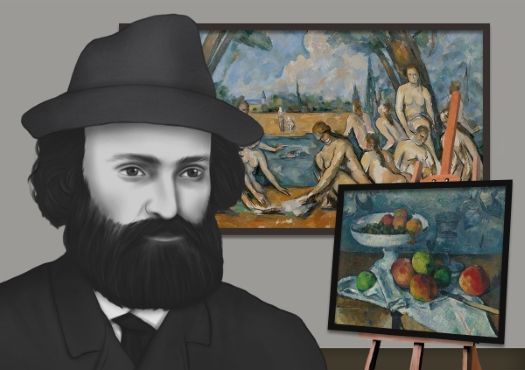


Whoever in dismay before the strangeness of certain contemporary works denies to the original painting of our time a sufficient significance and longs for an art with noble and easily-read figures and gestures, should return to Cézanne and ask what in the appeal of his 'weighty art' depends on a represented human drama."
Summary of Paul Cézanne
Paul Cézanne was the preeminent French artist of the Post-Impressionist era, widely appreciated toward the end of his life for insisting that painting stay in touch with its material, virtually sculptural origins. Also known as the "Master of Aix" after his ancestral home in the South of France, Cézanne is credited with paving the way for the emergence of twentieth-century modernism, both visually and conceptually. In retrospect, his work constitutes the most powerful and essential link between the ephemeral aspects of Impressionism and the more materialist, artistic movements of Fauvism, Cubism, Expressionism, and even complete abstraction.
Accomplishments
- Unsatisfied with the Impressionist dictum that painting is primarily a reflection of visual perception, Cézanne sought to make of his artistic practice a new kind of analytical discipline. In his hands, the canvas itself takes on the role of a screen where an artist's visual sensations are registered as he gazes intensely, and often repeatedly, at a given subject.
- Cézanne applied his pigments to the canvas in a series of discrete, methodical brushstrokes as though he were "constructing" a picture rather than "painting" it. Thus, his work remains true to an underlying architectural ideal: every portion of the canvas should contribute to its overall structural integrity.
- In Cézanne's mature pictures, even a simple apple might display a distinctly sculptural dimension. It is as if each item of still life, landscape, or portrait had been examined not from one but several angles, its material properties then recombined by the artist as no mere copy, but as what Cézanne called "a harmony parallel to nature." It was this aspect of Cézanne's analytical, time-based practice that led the future Cubists to regard him as their true mentor.
The Life of Paul Cézanne

Though Paul Cézanne famously said, "I will astonish Paris with an apple," he turned away from Paris (but not from fruits) for a quiet life in Provence where he painted, as he said, "nature by means of the cylinder, the sphere and the cone." His artistic approach launched one of the four major trends in movement now defined as Post-Impressionism. And his move to the countryside became a model for other Post-Impressionist leaders including Signac, Gauguin, and van Gogh, who also worked and lived in the South of France.
Important Art by Paul Cézanne
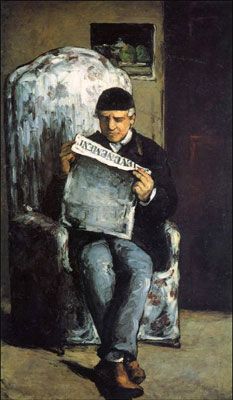
Louis-Auguste Cézanne, the Artist's father, Reading “L'Evenement”
This portrait is one of the most renowned early works by Cézanne. The rigid composition is dominated by somber hues applied in a thick impasto. The expressive premise for this piece is suggested by the artist's inclusion of his own still life in the background, as though to solicit recognition of his talent by his famously disapproving parent. As if to force the issue, Louis-August is portrayed reading a liberal newspaper, a highly unlikely event, as he was widely known for his conservative outlook.
Oil on canvas - The National Gallery of Art, Washington DC
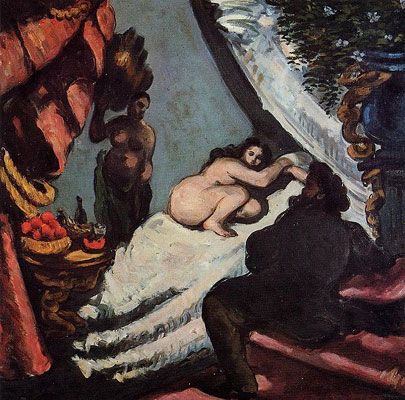
A Modern Olympia
This composition is Cézanne's adaptation of the theme of the demi-mondaine, or high-class prostitute suggested in Édouard Manet's scandalous Olympia of 1863. Unlike Manet's treatment, however, Cézanne portrays the prostitute as an awkwardly naked and recoiling figure, setting off the figures of her suitor (completely invisible in Manet's rendering of the subject) and an African chambermaid as transgressing "outsiders." The figures are depicted in both an expressive and abbreviated, indeed almost ungainly manner, with facial features only vaguely outlined, like masks, while their fleshy, corpulent bodies are visually articulated by dynamic, curving contours. The interior of the room is defined by a series of sweeping diagonals and bold colors depicting draperies, fruit, and an implied floral arrangement (Manet's version of the subject sported a resplendent bouquet in the center of the canvas). The suitor may be equated with Cézanne himself, possibly referring to his well-known anxiety with the opposite sex, which he struggled with throughout his life.
Oil on canvas - Private Collection
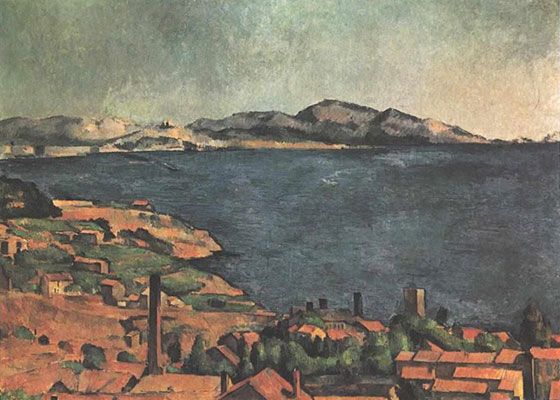
The Bay of Marseille, Seen from L'Estaque
In this view of L'Estaque, the artist's palette bursts with a vibrant bouquet of colors previously unseen in his work. The rigid architectonic forms of the houses define the foreground, while the rest of the picture is realized just as "solidly" through the bold blues of the sea and the sky. The complementary colors are skillfully employed by the artist to create an illusion of pictorial depth. The entire composition reminds us the artist's stated desire to "make of Impressionism something solid and enduring, like the art in museums." Cézanne painted numerous views of L'Estaque, which was one of his favorite destinations in the south of France.
Oil on canvas - The Art Institute of Chicago

Madame Cézanne in a Red Dress
This is an example of the many portraits Cézanne painted of his mistress and eventual wife, Hortense Fiquet. Cézanne does not romanticize her form: the sitter's figure is rigidly imposing, almost soldier-like, her face bluntly plain and asymmetrical with only one ear visible. It seems that the sitter exists purely for compositional purposes, her dress in itself serving as an excuse for the artist to experiment with various tones of red, like a convenient palette. The stark geometrical accents dissect the canvas in both horizontal and vertical directions, thus creating the impression of a carefully arranged, monumental still life, as opposed to a portrait of a lifelong companion or "loved one."
Oil on canvas - The Metropolitan Museum of Art, New York
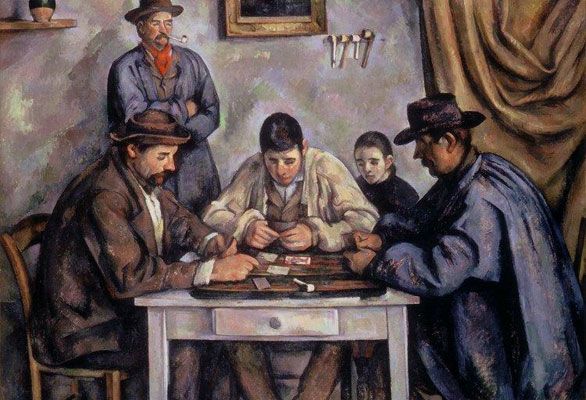
The Card Players
Cézanne produced his series of Card Player paintings, drawings, and related studies in his ancestral home in the South of France, where he found in the image of men playing cards something timeless, like the mountains cradling an ancient people. As though they came together around a simple peasant table for a seance or cosmic conference, the card players seem at once transient and unmoving, very much masters of their environment and yet weathered testaments of time's passing.
Oil on canvas - The Metropolitan Museum of Art, New York
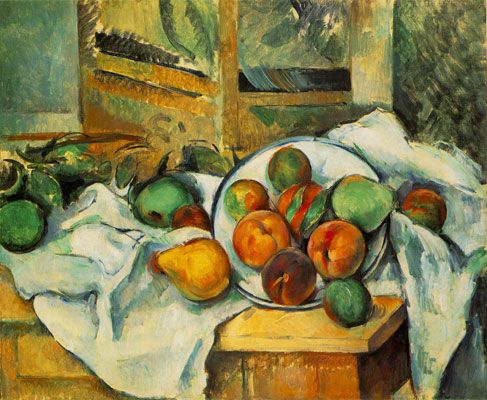
Table, Napkin, and Fruit (A Corner of the Table)
After studying Dutch and French Old Master still life painting at the Louvre and other Parisian galleries, Cézanne formulated his own semi-sculptural approach to still lifes. Typically strewn across an upturned tabletop, Cézanne's pears, peaches, and other pictorial elements seem at once to rest on a solid, wooden plank and yet float across the surface of the canvas like a new kind of calligraphy. As if to press home that point, Cézanne typically includes chairs, wooden screens, water pitchers, and wine bottles to suggest that the gaze of the viewer rise vertically up the canvas, rather than plunge deep within any implied corner of a real kitchen.
Oil on canvas, 47 x 56 cm (18 1/4 x 22 in) - The Barnes Foundation, Pennsylvania
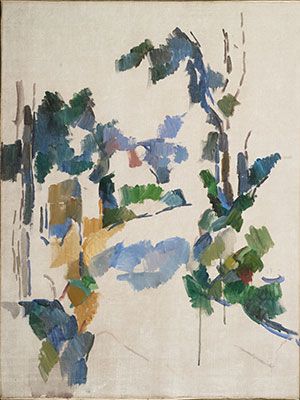
Study of Trees
In nearly abstract watercolor landscapes dating from the latter part of his life, Cézanne achieved a perfect balance, or equilibrium, between color, form, and relatively untouched areas of the paper. The brushstrokes themselves seemed to speak a visual poetry entirely apart from the painting's subject. In this study of trees, which invariably comes from the long tradition of Japanese woodcuts, Cézanne is moving further toward abstraction by constructing the landscape view through various constellations of color. What seems an "unfinished" composition nonetheless successfully suggests the feeling of nature without fully representing it, the overall canvas structured by intersecting diagonals that tip and turn out of the picture plane, like leaves shifting in the sunlight. This lively arrangement, along with the artist's obvious acknowledgment of the raw canvas as a positive component, directly anticipates the "incomplete" landscapes of the Fauves and provides future generations with a method to experiment with pictorial possibilities beyond the rigid tradition of naturalistic representation.
Oil on canvas - The Fogg Art Museum, Harvard University, Cambridge, Mass
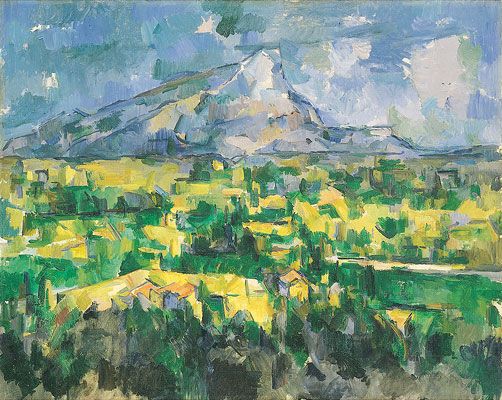
Mont Sainte-Victoire
This is one of the last landscapes of Mont Sainte-Victoire, favored by Cézanne at the end of his life. The view is rendered in what is essentially an abstract vocabulary. Rocks and trees are suggested by mere daubs of paint as opposed to being extensively depicted. The overall composition itself, however, is clearly representational and also follows in the ethos of Japanese prints. The looming mountain is reminiscent of a puzzle of various hues, assembled into a recognizable object. This and other such late works of Cézanne proved to be of a paramount importance to the emerging modernists, who sought to liberate themselves from the rigid tradition of pictorial depiction.
In Cézanne's mature work, the colors and forms possessed equal pictorial weight. The primary means of constructing the new perspective included the juxtaposition of cool and warm colors as well as the bold overlapping of forms. The light was no longer an "outsider" in relation to depicted objects; rather light emanated from within. Instead of the illusion, he searched for the essence. Instead of the three-dimensional artifice, he longed for the two-dimensional truth.
Oil on canvas - The Pushkin Museum of Fine Art, Moscow
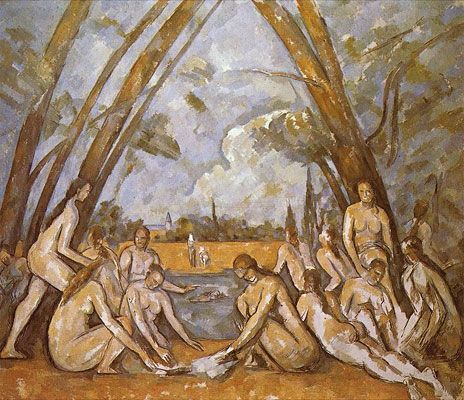
The Large Bathers
The Large Bathers is one of the finest examples of Cézanne's attempt at incorporating the modern, heroic nude in a natural setting. The series of very human nudes, no Greco-Roman nymphs or satyrs, are arranged into a variety of positions, like objects of still life, under the pointed arch formed by the intersection of trees and the heavens. The figures are devoid of any particular personality - the artist assembles them for purely structural purposes. Here Cézanne is reinterpreting an iconic Western motif of the female nude, but in an exceptionally radical way. The sheer size of the painting is monumental, confronting the viewer directly with abbreviated shapes that resolve themselves into the naked limbs of his sitters. This is not yet abstraction, but in such instances Cézanne has already moved beyond the figurative tradition.
Oil on canvas - The Philadelphia Museum of Art
Biography of Paul Cézanne
Childhood
Paul Cézanne was born in 1839 in the town of Aix-en-Provence in the South of France. His father was a wealthy lawyer and banker who strongly encouraged Paul to follow in his footsteps. Cézanne's eventual rejection of his authoritative father's aspirations led to a long, problematic relationship between the two, although, notably, the artist remained financially dependent on his family until his father's death in 1886.
He was extremely close friends with Émile Zola, a writer born in Aix as well, and who would later become one of the greatest literary figures of his generation. The adventurous Cézanne and Zola were part of a small circle that called themselves "The Inseperables". They moved to Paris together in 1861.
Early Training
Cézanne was largely a self-taught artist. In 1859, he attended evening drawing classes in his native town of Aix. After moving to Paris, Cézanne twice attempted to enter the École des Beaux-Arts, but was turned down by the jury. Instead of acquiring professional training, Cézanne made frequent visits to the Musée de Louvre, where he copied works by Titian, Rubens, and Michelangelo. He also regularly visited the Académie Suisse, a studio where young art students could draw from the live model for a very modest monthly membership fee. While at the Académie, Cézanne met fellow painters Camille Pissarro, Claude Monet, and Auguste Renoir, who were at that time also struggling artists, but who would soon comprise the founding members of the nascent Impressionist movement.

The early oils of Cézanne were executed in a rather somber palette. The paint was often applied in thick layers of impasto, adding a sense of heaviness to already solemn compositions. His early painting indicated a focus on color in favor of well-delineated silhouettes and perspectives preferred by the French Academy and the jury of the annual Salon where he continuously submitted his works. All of his submissions, however, were refused. The artist also travelled regularly back to Aix to secure funding from his disapproving father.
The year 1870 marked a crucial shift in Cézanne's painting which was occasioned by two factors: the artist's move to L'Estaque in the South of France to avoid the military draft, and his closer association with one of the most distinguished young Impressionists - Camille Pissarro. Cézanne was fascinated with the Mediterranean landscape of L'Estaque, with its abundance of sunlight, and the vibrancy of colors. Meanwhile, Pissarro proved instrumental in persuading Cézanne to adopt a brighter palette, as well as to abandon the heavy and ponderous impasto technique in favor of smaller and livelier brushstrokes. In L'Estaque, Cézanne executed a series of landscapes dominated by the architectonic forms of the rural houses, the dazzling blues of the sea, and the vivacious greens of the foliage.
In 1872, Cézanne returned to Paris, where his son Paul was born. His mistress, Hortense Fiquet, would finally become Madame Cézanne in 1886, notably just following the artist's father's death. Cézanne painted over forty portraits of his companion, as well as several enigmatic portraits of their son.
In 1873, Cézanne exhibited in the Salon des Réfuses, the notorious show of artists who had been refused by the official Salon (he counted himself among a circle that included Édouard Manet, Claude Monet, and Camille Pissarro, among others). The critics slammed the avant-garde artists, which apparently hurt Cézanne deeply. In the next decade he mostly painted away from Paris, in either Aix or L'Estaque, and he no longer participated in unofficial group exhibitions.
Mature Period
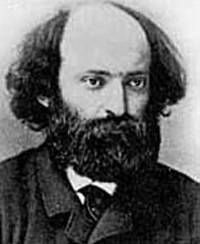
Cézanne's experience with painting from nature and rigourous experimentation led him to develop his own approaches to art. He strove to depart from the portrayal of the transient moment, long favored by the Impressionists; instead, Cézanne sought true and permanent pictorial qualities of objects around him. According to Cézanne, the subject of the painting was first to be "read" by the artist through the understanding of its essence. Then, in the second stage, this essence must be "realized" on a canvas through forms, colors, and their spatial relations. The colors and forms thus became the dominant elements of his compositions, completely freed from the rigid rules of perspective and paint application as promoted by the Academy.

Depicting reality as such was never Cézanne's primary objective. In his own words, it was "something other than reality" that he endeavored to reveal. In the 1880's, Cézanne executed a large number of still lifes, completely reinventing the genre in the two-dimensional mode. The central feature of these still lifes was the crucial shift of attention from the objects themselves, to the forms and colors that were potentially communicated by their surfaces and contours.
Cézanne's portraits, including an extensive body of self-portraits, exhibit the same set of traits. The compositions are vividly impersonal, for it was not the sitter's character that Cézanne struggled to depict but the formal and coloristic possibilities of the human body and its interior nature.
Late Period and Death

In the last decade of his life, Cézanne limited his artistic pursuits almost exclusively to two pictorial motifs. One was the depiction of the Mont Sainte-Victoire, a dramatic mountain that dominated the parched and stony landscape at Aix. The other was the final synthesis of nature and the human body in a series of so-called Bathers (nudes depicted frolicking in a landscape). The later versions of the Bathers were becoming increasingly abstract in regard to how form and color seemed to fuse together on the canvas.
After contracting pneumonia, Paul Cézanne died in his familial house in Aix on October 22, 1906. The last decade of his life had been marred by the development of diabetes and severe depression, which contributed toward alienating the artist from most of his friends and family.
The Legacy of Paul Cézanne

When looking at Cézanne's late work, it is impossible to miss the emergence of a unique artistic approach. Cézanne offered a new way of comprehending the world through art. With his reputation evolving steadily in the late years of his life, an increasing number of young artists fell under the influence of his innovative vision. Among them was the young Pablo Picasso, who would soon steer the Western tradition of painting into yet another new and utterly unprecedented direction. It was Cézanne who taught the new generation of artists to liberate form from color in their art, thus creating a new and subjective pictorial reality, not merely a slavish imitation. The influence of Cézanne continued well into the 1930s and 1940s, when a new artistic manner was coming to fruition - that of Abstract Expressionism.
Influences and Connections


-
![Camille Pissarro]() Camille Pissarro
Camille Pissarro -
![Ambroise Vollard]() Ambroise Vollard
Ambroise Vollard ![Victor Chocquet]() Victor Chocquet
Victor Chocquet![Julien 'Pere' Tanguy]() Julien 'Pere' Tanguy
Julien 'Pere' Tanguy![Émile Zola]() Émile Zola
Émile Zola