Ask The Art Story AI

Summary of Leland Bell
Leland Bell, a post-war American painter, musician and instructor, defied categorization, creating works that were simultaneously classical, abstract, and representational. He set himself apart from his peers with a unique, rhythmic style that employed strong outlines, bold sections of color, and an engaging dynamism. Bell embraced the human figure as a primary subject when other artists were moving away from figurative representation. His artwork's exuberant take on everyday life did not conform to any one movement, making Bell distinctive within the art world.
Accomplishments
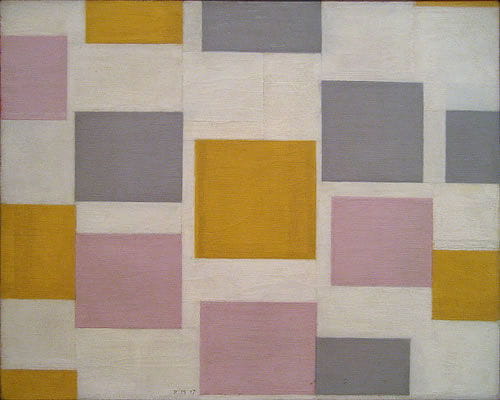
- A former jazz drummer, Bell was drawn to the rhythmic movement in the artwork of Balthus, Alberto Giacometti, and Piet Mondrian, all of whom greatly influenced Bell's own aesthetic style.
- Bell's most frequent subject was his own personal, domestic life. Unlike his contemporaries who sought to transcend or re-imagine the everyday world, Bell rejoiced in it.
- Bell reworked his artworks numerous times, even after they were displayed or published, remaining passionate about painting as a continual process rather than a means to create a final product.
Important Art by Leland Bell

Croquet Party
Based on photographs of a weekend spent with family and friends, Croquet Game is one of the few paintings Bell has not modified since its original creation. It is representative of the recurring, career-long motif of family and domestic scenes. At the far left is Bell with his arm around his wife Ulla, who appeared in many of Bell's works, showing a tender connection between the two. The profound influence of Helion and Léger on Bell's work is apparent even in these early works, particularly in Bell's dark outlines that would become starker and crisper in his later paintings.
Oil on canvas - Center for Figurative Painting, New York

Still Life with Portrait of Temma
Given his focus on domestic life, still life arrangements were unsurprisingly a frequent subject for Bell. In these paintings, he often included disparate objects such as roses, skulls and cymbals, the latter a reference to his musical interests. Even in this seemingly static scene, Bell found ways to integrate movement through shadow and in the folds of the fabric. While remaining abstract, the carefully placed objects in these still life paintings each have a strong, distinct presence; the black outlines give clarity to the individual parts while bringing harmonious balance to the composition. In addition to the outlines, Bell's use of flat color and manipulations of perspective are reminiscent of works by Léger.
Oil on canvas - Center for Figurative Painting, New York

Temma in Orange Dress
In many of Bell's works, the arms and legs are a primary focus to convey a feeling of movement. Here, the curves of Temma's limbs are echoed in various parts of the chair, the curved shadow under the chair and the shapes delineated on her dress. These curves contrast with the sharp, geometric shapes of the furniture and surrounding architectural frame. Temma in Orange Dress is one of many canvases Bell painted of his daughter throughout his career.
Oil on canvas - Estate of the artist

Dusk
Numerous Bell paintings recreate a scene similar to that of Dusk, where a domestic group responds to a butterfly or bird, taking inspiration from Balthus' La Phalene (The Moth), in both the intrusion of nature and the figures' lively gestures. Bell's playful, almost choreographed images make expressive use of the arms, both to denote a celebratory mood and to visually connect sections of the painting, almost like a Greek frieze. Bell depicts each figure as an individual entity, while also drawing them together through nearly sculptural use of light and shadow.
Acrylic on canvas - Center for Figurative Painting, New York

Morning II
Part of a series of paintings of similar titles and subjects, Morning II is one of Bell's largest two-figure works. Bell placed these statuesque bodies within an intimate scene of intersecting planes, diverse angles and rhythmic movement to evoke the energy and flow of life. He connected the figures through outstretched, moving limbs and planes of flat color. In contrast to the distinct, black lines outlining the forms within his paintings, Bell often blurred fingers and toes into the surrounding colors, further suggesting continued movement. Balthus, one of Bell's main sources of influence, uses a similar tactic in his La Phalene, in which a nude woman's outstretched hands and feet recede into the background.
Acrylic on canvas - Estate of the artist

Standing self-portrait
Bell's self-portraits, of which he painted many, are striking and powerful images. Many focus only on the face, while others, such as Standing self-portrait, feature the entire body. In all of them, Bell presents the head in a very sculptural manner, giving it weight and intensity as well as a psychological depth in the carefully rendered features. This painting also includes everal personal references: one of his Morning paintings hangs on the back wall, and to the right are drums that denote Bell's proficiency as a jazz musician.
Oil on canvas - Private Collection
Biography of Leland Bell
Childhood
Leland Bell was born in Cambridge, Maryland, in 1922, and grew up in Flatbush, Brooklyn. As a young boy, he was interested in drawing, often copying Norman Rockwell's illustrations and pictures in cowboy books. He also earned extra money by drawing caricatures for people on the street. Bell's other passion, jazz, led him to frequent New York's jazz clubs. In high school, Bell's Russian-Jewish parents moved the family to Washington, D.C. where he occasionally cut class to copy the works he saw at Phillips Memorial Gallery (now the Philips Collection) and the Library of Congress, and was particularly drawn to works by Paul Klee and Thomas Eakins.
Early Training
Toward the end of high school, Bell met painter Karl Knaths, who suggested Bell move to Provincetown, Massachusetts. Following a brief stay there, Bell moved to New York in 1941. For a period he lived next door to painter Robert De Niro, Sr., who suggested Bell join him as a guard at the Museum of Non-Objective Painting (later the Guggenheim). Bell worked there briefly, but was fired for telling a visitor that he could see a better painting at another exhibition. Largely a self-taught artist, Bell did spend a short period in 1942 studying at Hans Hofmann's school where he met Icelandic figurative painter Louisa Matthiasdottir. (In fact, Bell has said that he first attended Hofmann's school because he had heard about the pretty Icelandic women enrolled there.) Bell then spent a brief time in the Pacific with the Merchant Marines, but was back in New York by 1943. In 1944, he married Matthiasdottir, whom he called Ulla, and their daughter Temma was born in 1945. Temma would also later become a painter.
Mature Period
Most of Bell's work from the 1940s no longer exists. Those paintings that remain, particularly from early in that decade, are more abstract than his later artworks, while showing the same energetic sensibility. Bell did not view his work in distinct abstract and figurative phases; rather, he saw fluidity in his style throughout his career. Bell began moving toward a stronger representational and figurative focus just as abstract work became popular among his fellow New York artists. From 1950 to 1951, Bell and his family traveled to Paris, where he absorbed the work of colleagues Jean Helion, Balthus, and Alberto Giacometti. Upon returning to New York, Bell continued painting while also taking on numerous side jobs, such as a deckhand on a tugboat, a waiter, a janitor, and a library stockboy. Following a 1955 exhibition at New York's Hansa Gallery, Bell received numerous solo exhibitions at various galleries in the city. He also began a long relationship with gallery owner Robert Schoelkopf, who gave Bell frequent shows, starting in 1964 and continuing for several decades. Much of Bell's work from this time focused on portraiture, particularly in paintings of himself and of Ulla. Despite Schoelkopf's consistent support, Bell sold few paintings and remained somewhat ignored by the critics, likely due in part to the fact that his work did not fit neatly into any one category. Instead, his style remained independent and distinct from that of his Abstract Expressionist and Minimalist colleagues.
Late Years and Death
In addition to painting, Bell was a well-respected and renowned teacher and lecturer. He was particularly resolute about defending the artists he revered, and was vociferous when disagreeing with others. Bell was a founding faculty member at the New York Studio School, beginning in 1964, and taught painting Parsons School of Design, Yale University, Indiana University, and the Kansas City Art Institute. Over the next decades, he continued refining both his artistic style and his previously created paintings. (For instance, Bell expanded on his Family Group series of the late 1960s to create the Butterfly Group works of the 1970s and 1980s.) Although he created a number of still life paintings, the human figure remained his most consistent subject matter, especially his wife and daughter. His later paintings, such as the Butterfly Group (1968) and Morning series (c. 1970s-80s), demonstrate his most well formed style of movement, sharp delineations of space and plays on light and shadow. Bell died in New York in 1991.
The Legacy of Leland Bell
Shaping his own distinctive style outside the influence of the more popular Abstract Expressionist movement may have prevented Bell from receiving the critical and financial support his contemporaries garnered. Yet, it was precisely this commitment to a less fashionable, figurative focus that made Bell a significant artistic figure and passionate lecturer. Today, Bell's paintings are held in the collections of the Metropolitan Museum of Art in New York, the Hirshhorn Museum and Sculpture Garden in Washington, D.C., the Rose Museum of Brandeis University, Massachusetts, and the Mint Museum in Charlotte, North Carolina, among others.
Influences and Connections


-
![Balthus]() Balthus
Balthus -
![Alberto Giacometti]() Alberto Giacometti
Alberto Giacometti ![Jean Helion]() Jean Helion
Jean Helion


-
![Nell Blaine]() Nell Blaine
Nell Blaine ![Louisa Matthiasdottir]() Louisa Matthiasdottir
Louisa Matthiasdottir![Albert Kresch]() Albert Kresch
Albert Kresch![Gabriel Laderman]() Gabriel Laderman
Gabriel Laderman


-
![Thomas B. Hess]() Thomas B. Hess
Thomas B. Hess ![Hilton Kramer]() Hilton Kramer
Hilton Kramer