Ask The Art Story AI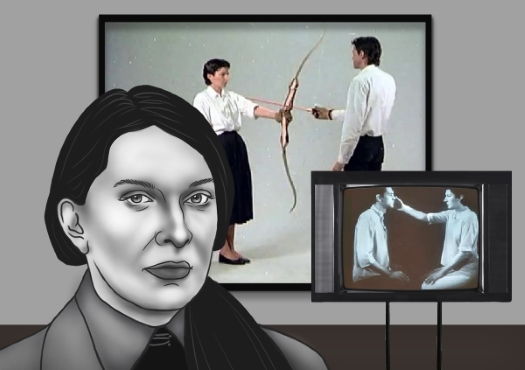


Summary of Marina Abramović
Towards the late 1950s, as abstract art began to lose impetus, many artists across the world began to embrace performance art. Performance had been a feature of avant-garde art since around 1910, but Marina Abramović's work is typical of the aims of the new generation in her eagerness to avoid traditional, object-based art materials (such as paint and canvas), and to cut down the distance between the artist and the audience by making her own body the medium. Brought up during Yugoslavia's repressive Communist dictatorship, and raised by parents closely tied to the regime, Abramović's dramatic and dangerous performances often seem like cathartic responses to these early experiences. She has produced a quantity of sculpture, but she is best known for performance, and she remains one of only a handful of performance artists of her generation who have continued to perform late in their career.
Accomplishments
- Marina Abramović's work is typical of the ritualistic strain in 1960s performance art. It often involves putting herself in grave danger and performing lengthy, harmful routines that result in her being cut or burnt, or enduring some privation. She views her art almost as a sacrificial and religious rite, performed by herself for a congregation of viewers. And the physical ordeals she endures form the basis for exploring such themes as trust, endurance, cleansing, exhaustion, and departure.
- We might interpret her work as having displaced art from traditional media such as painting and sculpture, and moved it directly on to her body. Yet far from conceiving it as simply a surface, she has said that she thinks of the body as the "point of departure for any spiritual development."
- Between 1976 and 1988 she collaborated with the German-born artist known as Ulay. The performances the pair created during this time often exploited their duality to investigate ideas such as the division between mind and body, nature and culture, active and passive attitudes, and, of course, between male and female.
The Life of Marina Abramović
Enduring pain and thriving through it are skills and necessities that root from Abramović’s early years under communist oppression.
Important Art by Marina Abramović

Rhythm 10
Abramović's first forays into performance focused primarily on sound installations, but she increasingly incorporated her body - often harming it in the process. In Rhythm 10, she used a series of 20 knives to quickly stab at the spaces between her outstretched fingers. Every time she pierced her skin, she selected another knife from those carefully laid out in front of her. Halfway through, she began playing a recording of the first half of the hour-long performance, using the rhythmic beat of the knives striking the floor, and her hand, to repeat the same movements, cutting herself at the same time. She has said that this work marked the first time she understood that drawing on the audience's energy drove her performance; this became an important concept informing much of her later work.
20 knives, tape recorder

Rhythm 5
Viewing both life and performance art as reaching beyond the realm of awareness, Abramović has created performances in which she sleeps or becomes drugged into unconsciousness to examine this crucial aspect of life. In Rhythm 5, she created a star shape with wood shavings covered in gasoline and lit the wood on fire. After cutting her nails and hair and dropping them into the fire, she lay down within the burning star, a symbol both of the occult and of Communism in Yugoslavia. When audience members realized her clothes were on fire and she had lost consciousness due to the lack of oxygen amidst the flames, they pulled her out, ending the performance. After performing Rhythm 5, she said she "realized the subject of my work should be the limits of the body. I would use performance to push my mental and physical limits beyond consciousness."
Wood shavings, gasoline, fire

Rhythm 0
With a description reading "I am the object," and, "During this period I take full responsibility," Abramović invited spectators to use any of 72 objects on her body in any way they desired, completely giving up control. Rhythm 0 was exemplary of Abramović's belief that confronting physical pain and exhaustion was important in making a person completely present and aware of his or her self. This work also reflected her interest in performance art as a way to transform both the performer and the audience. She wanted spectators to become collaborators, rather than passive observers. Here, they physically directed the actions, while in other performances, Abramović involved the audience through a dynamic exchange of energy. In Rhythm 0, the audience divided itself into those who sought to harm Abramović (holding the loaded gun to her head) and those who tried to protect her (wiping away her tears). Ultimately, after she stood motionless for six hours, the protective audience members insisted the performance be stopped, seeing that others were becoming increasingly violent.
72 objects including a feather, pen, book, saw, honey, band-aid, salt, rose, gun, bullet, paint, whip, coat and scissors

Rest Energy
Rest Energy was only four minutes and ten seconds long, but it was a highly intense piece that revealed the fragility of the line between life and death. Abramović and Ulay faced each other, aiming an arrow on a tense bow, just inches from her heart. They placed small microphones on their chests to make audible their increasingly rapid heartbeats in response to the growing danger. This work was one of their many performances that depended on a close relationship and trust. Many of their works also often involved elements of extreme duration, a characteristic that Abramović continued after she and Ulay stopped working together.
Bow and arrow

Balkan Baroque
Reminiscent of Cleaning the Mirror #1 (1995), in which she sat on a stool for three hours washing a skeleton, Abramović created Balkan Baroque in response to the innumerable deaths that had taken place in the former Yugoslavia. Sitting on top of 1,500 cow bones in a white dress, she spent four days, six hours a day, washing each of these bloody bones, surrounded by projected images of her parents and herself. The accompanying sound included her recorded description of methods used in the Balkans for killing rats and her singing of her native folksongs. The performance progression was made visceral due to the unbearable heat of the basement room and fetid smell. For Abramović, it was not enough to simply recount the number of people lost in modern-day war. Instead, she aimed to remember the lives, efforts, and hopes of individuals killed by carefully touching and cleaning "their" physical bones and blood. Transforming her individual performative experiences into universal ideas was also an important concept for Abramović throughout all her work. The comparison between the inability to scrub away all the blood and the inability to erase the shame of war is a concept she viewed as having universal reach.
Projections, cow bones, copper sinks and tub filled with black water, bucket, soap, metal brush, white dress

The House with the Ocean View
In The House with the Ocean View, Abramović spent twelve days in the Sean Kelly Gallery without eating, writing, or speaking. Contained within three 'rooms' built six feet off the ground, Abramović slept, drank water, urinated, showered, and gazed at the viewers wearing a differently colored outfit each day. She could walk between the three rooms, but the ladders leading to the floor had rungs made of butcher knives. Set to the sound of a metronome, Abramović ritualized the activities of daily life, focusing on the self and simplicity while eliminating all aspects of narrative and dialogue. She saw this piece as an act of purification - not just for herself, but also for any viewer who entered the space. This piece was a shift from the masochism of her earlier works to performances that focus more on ideas of presence and shared energy, although there is still the element of danger present in the butcher knife ladder. In addition, it was an extension of the challenging durational works that have long been a significant aspect of Abramović's career.
Sink, bed, chair with mineral pillow, table, toilet, shower, pants and shirts in different colors, white towels, metal bucket, metronome, bar of natural soap, bottle of rose water, bottle of pure almond oil, ladder of wood and butcher knives
Biography of Marina Abramović
Childhood
Marina Abramović was born in 1946 in Belgrade, Yugoslavia to parents who held prominent positions in the Communist government. Her father, Vojin, was in the Marshal's elite guard and her mother, Danica, was an art historian who oversaw historic monuments. After her father left the family, her mother took strict control of eighteen-year-old Abramović and her younger brother, Velimir. Her mother was difficult and sometimes violent, yet she supported her daughter's interest in art. While growing up, Abramović saw numerous Biennales in Venice, exposing her to artists outside of Communist Yugoslavia such as Robert Rauschenberg, Jasper Johns, and Louise Nevelson.
Early Training
Abramović studied painting at the Academy of Fine Arts in Belgrade (1965-1970), and at Radionica Krsta Hegedusic, Academy of Fine Arts in Zagreb (1970-1972). It was in the early 1970s that she began creating performative art, initially creating sound installations, but quickly moving towards works that more directly involved the body. During this period she taught at the Academy of Arts, University of Novi Sad (1973-1975).
Mature Period
In her early work, Abramović often placed her body in danger: she took drugs intended to treat catatonia and schizophrenia (Rhythm 2, 1974); she invited viewers to threaten her body with a variety of objects including a loaded gun (Rhythm 0, 1974); and she cut her stomach with a razor blade, whipped herself, and lay on a block of ice (Thomas Lips, 1975). She has suggested that the inspiration for such work came from both her experience of growing up under Tito's Communist dictatorship, and of her relationship with her mother: "All my work in Yugoslavia was very much about rebellion, not against just the family structure but the social structure and the structure of the art system there... My whole energy came from trying to overcome these kinds of limits." Accordingly, these rebellious performances, which took place in small studios, student centers, and alternative spaces in Yugoslavia, ended by 10pm, the strict curfew set by her mother.
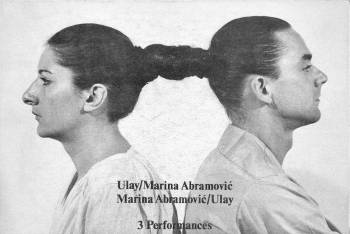
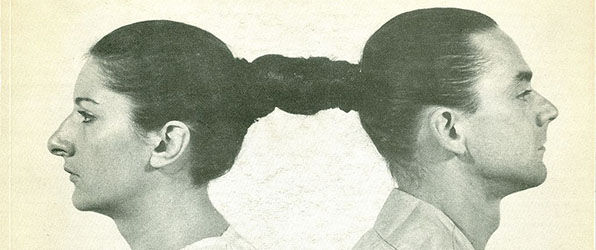
Abramović created these pioneering works when performance art was still a new, emerging art form in Europe, and until the mid-1970s she had little knowledge of performances being done outside Yugoslavia - even then, she learned of such work only through word of mouth. But in 1975, while in Amsterdam, Abramović met the German-born artist Frank Uwe Laysiepen - known as Ulay - and the next year she moved out of her parents' home for the first time to live with him. For the next 12 years, Abramović and Ulay were artistic collaborators and lovers. They traveled across Europe in a van, lived with Australian Aboriginal people, spent time in India's Tibetan Buddhist monasteries, and traveled the Sahara, Thar, and Gobi deserts. Their works, which they performed in gallery spaces primarily in Europe, included Imponderabilia (1977), in which they stood naked in a narrow doorway, forcing spectators to pass between them; Breathing In/Breathing Out (1977), in which they inhaled and exhaled from each other's mouths until they almost suffocated; Relation in Time (1977), involving them sitting back to back with their hair tied together; Light/Dark (1977), in which they alternately slapped each other's faces; and Nightsea Crossing (1981-1987), a performance in which the pair sat silently opposite each other at a wooden table for as long as possible. When Abramović and Ulay decided to end their artistic collaboration and personal relationship in 1988, they embarked on a piece called The Lovers; each started at a different end of the Great Wall of China and walked for three months until they met in the middle and said goodbye. They have had very little contact with each other since that point, both proceeding independently with their artistic work.
Late Period
After this separation from Ulay, Abramović returned to making solo works; she also worked with new collaborators such as Charles Atlas (on Biography, 1992); and she worked increasingly with video (such as in Cleaning the Mirror #1, 1995). In 1989, she began making a number of sculptural works, Transitory Objects for Human and Non-Human Use, which comprise objects meant to incite audience participation and interaction. In addition to her performances during the 1990s, Abramović taught at the Hochschule der Kunste in Berlin and the Académie des Beaux-Arts in Paris (1990-1991), as well as the Hochschule fur Bildende Kunste in Hamburg (1992). Beginning in 1994 she taught for seven years as a performance art professor at the Hochschule fur Bildende Kunste in Braunschweig, Germany.
She was awarded the Golden Lion for Best Artist at the Venice Biennale for Balkan Baroque (1997), and in 2003 she won a New York Dance and Performance Award ("Bessie") for The House with the Ocean View (2002), performed at Sean Kelly Gallery in New York. In 2005, she restaged performances by artists such as Vito Acconci and Bruce Nauman, as well as her own Thomas Lips (1975) in an exhibition at the Guggenheim Museum called "Seven Easy Pieces", for which she earned a U.S. Art Critics Association Award.
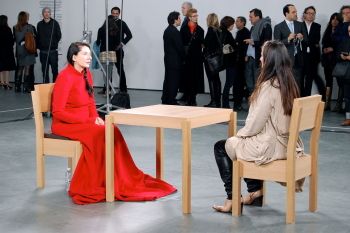
While many artists, including Abramović, made very little effort in the early 1970s to capture their performances on film or video, feeling that the true performance could never be repeated, she has since argued for the importance of continuing the life of these works through re-performance. She has said, "the only real way to document a performance art piece is to re-perform the piece itself." To that end, the Museum of Modern Art recently held a retrospective exhibition - its first ever for any performance artist - that included performances of her work and a new piece, The Artist is Present, performed by Abramović herself. For the full duration of the 2010 exhibit, she would sit across from an empty chair in which museum visitors were invited to sit opposite her for as long as they liked.
The Legacy of Marina Abramović
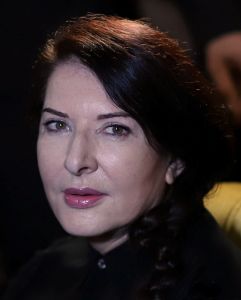
Abramović, who has referred to herself as "the grandmother of Performance Art," was part of the earliest experiments in performance art, and she is one of the few pioneers of that generation still creating new work. She has been, and continues to be, an essential influence for performance artists making work over the last several decades, especially for works that challenge the limits of the body. Although she does not view her own artwork through the frame of Feminist Art, her confrontations with the physical self and the primary role given to the female body have helped shape the direction of that discipline. Her commitment to giving new life to older performance works - both hers and the works of others -- led her to create the Marina Abramović Institute for Preservation of Performance Art, set for a 2012 opening, in Hudson, New York. This non-profit organization will support teaching, preserving, and funding performance art, ensuring an enduring legacy for her performances and, more broadly, for the ephemeral art form itself. About this Institute, Abramović has said, "Performance is fleeting. But this, this place, this is for time. This is what I will leave behind."
Influences and Connections


-
![VALIE EXPORT]() VALIE EXPORT
VALIE EXPORT -
![Ulay]() Ulay
Ulay ![Susan Sontag]() Susan Sontag
Susan Sontag


-
![Ana Mendieta]() Ana Mendieta
Ana Mendieta -
![Matthew Barney]() Matthew Barney
Matthew Barney -
![Coco Fusco]() Coco Fusco
Coco Fusco ![Karen Finley]() Karen Finley
Karen Finley


-
![Ulay]() Ulay
Ulay -
![Laurie Anderson]() Laurie Anderson
Laurie Anderson ![Charles Atlas]() Charles Atlas
Charles Atlas